Top Podcasts
Yat Siu Of Animoca Brands - Culture And Royalties Are Key For Web3 | Outer Edge 2023 Main Stage
Jeff Kelley shares the Outer Edge 2023 Main Stage with Yat Sui, Co-Founder and Executive Chairman of Animoca Brands. Together, they discuss culture and royalties as major building blocks in the Web3 space. Yat discusses why culture is the backbone of all economies and how Web3 can transform it to create a new form of shareholder capitalism. He explains the right way to protect the rights and value of content creators in a very open digital world, giving them the payouts they are due without cuts or reservations. Yat also talks about how Web3 can help people become more financially literate, allow teachers to create educational apps, and eliminate the monopolistic model of Web2.
Listen to the podcast here
Yat Siu Of Animoca Brands - Culture And Royalties Are Key For Web3 | Outer Edge 2023 Main Stage
We’ve got our first speaker coming to the main stage. I’ve been so excited about this ever since I saw he was coming. We’ve got a fireside chat with Yat, Culture and Royalties are the Key to Web3. Our first speaker is Yat Siu. I know he’s not from LA because he walked here. He is a champion. This man is the Cofounder and Executive Chairman of Animoca Brands.
Animoca is a leader in digital entertainment, gamification, and blockchain. They are paving the way in digital property rights, helping to advance the open metaverse. We have interviewing him, Jeff Kelley, one of our own. He is one of the Cofounders of the Edge Of Company, the company that has brought you this entire event. Let’s make it loud for Yat and Jeff, please.
It’s great to see everybody here. Yat, welcome. It’s great to see you as well.
Thank you for having me. It’s a real honor to be here.
Let’s jump right in. Let’s talk royalties and culture. As you look over 2022, as we know, in crypto, a week is a month, a month is a year, and a year is a decade. What shifts have you seen that have influenced your thinking about now and the future?
One of the things that has become much more apparent, especially what happened in 2022, is that culture is becoming much more the vanguard of bringing people into Web3. It is much more important that people come for the culture and understand it. In 2022, the narrative particularly in the US of what Web3 and crypto were taken over by what we describe as Wall Street Crypto, the financial systems out there, the scandals around FTX, Terra, Three Arrows, and all that stuff.
People started to forget that what this is all about is building new economies. Web3 is about building new ecosystems that have financial inclusivity which is nation-building. The core for nation-building in any place around the world, whether this is virtual or physical, is culture. If you think about the strength of what it means of your American culture, if America didn’t have a culture in your beliefs, for instance, and you use traditions, then you wouldn’t have the strength of the nation that you have right now, and you wouldn’t be doing what you’re doing. That’s why we focus so much around culture, broadly speaking.
Everything you’re doing here with NFTs, with this digital property, is a form of culture. We describe non-fungible tokens as stores of digital culture in the same way that some people might describe Bitcoin as a store of value. They’re both important. If you think about how you interact in your own life, 99% of what you probably interact with mostly is all in a cultural context. Even traditions, even things you purchased, the clothes you buy, and the place you choose to live in speak to a personal culture.
When we talk about what happened in 2022 because of the marketplaces eroding, for their own market share, and the value they give to creators, we thought that was dangerous. We still think it’s dangerous because the whole thing that can bring value into the metaverse is now no longer having this income stream that is important.
We described it a little bit if you delete essentially royalties to creators, it’s a little bit like this. Imagine Ethereum with no gas. Eventually, you would have an effect of a tragedy of the commons, and that would disappear. You would no longer have an ecosystem that could support and maintain itself. The positive news is that there’s been enough uproar. If you do, a smart contractor has allow lists.
If you put legal frameworks around it, they started to enforce royalties. When we launched our Mocaverse NFTs, they were fully enforced both in Blur and OpenSea. What was a big topic months ago, everyone was declaring royalties are dead, that’s not true at all anymore. We’re back on a positive track, although there’s still work to do.
There you go. That’s a distinctive lens, the driving, the ideas, and the concepts through the lens of culture. In your quote, you said, “Creators are the backbone of all culture and culture is the backbone of our economies.”
Look at America as a single example. The second largest service economy in America is what they call arts and culture, but that’s direct employment. That’s people working in movies. That’s probably most of Los Angeles. The consequence of that is not just people who are musicians, creators, and artists. That is almost $900 billion in 2022 as the second-largest service economy. The largest service economy is retail and trade, which measured around $2.2 trillion or $2.3 trillion. That’s obviously much larger.
When you think back and say, “What is retail and trade?” This is retail and trade. The purchase of your cars is retail and trade. The houses you purchase are retail and trade. Is that just utility? It’s culture. Everything you’re wearing is culture. Every Nike outfit you’re buying, every Gucci outfit you’re buying, or whatever fashion brand is all culture.
In other words, even though the direct economy is coming from creators and artists, which is $900 billion, the number one economic output, which is retail and trade, the trade and goods of all kinds of culture. Now, if you didn’t have culture or if you didn’t have Hollywood, then you won’t have Netflix. You won’t have the app store. What’s the purpose of Google? What do you search for most of the time? Do you search for how to make food or do you search for areas of culture, the things that you’re looking for, or the way we spend time?
Even when we think about things in our own life, things like passion or love, these are all areas of culture. Culture is underlying everything. Imagine for a moment that you lived in a country that had no culture. That would be a pretty terrible place to live. We know some places in the world that are that perhaps, or have limited culture, and as a result, they don’t have that diversity. They don’t have that freedom. It also doesn’t have economic development. To us, culture also allows for economic development because of diversity and intellectual property rights. It’s important.
Let’s talk about protecting rights a little bit. If culture is the conduit for value and creators are the foundation of that, how should creators be thinking about protecting rights and value for themselves?
One of the things that you can see with the Web3 community versus other communities that are not in this space is the financial knowledge people have. In Web3, in terms of financial literate, it’s almost one-to-one. If you’re in Web3, you are at least level 2 or level 3 in financial knowledge. When you interact with many people who are in Web2 or not in the Web3 world, the probability of meeting someone who understands how to think of financial systems or financial education is low. The reason that it’s so low is that we don’t teach financial literacy at school.
My mom was an artist. She was a musician. She was performing in Europe. She was always taken advantage of as an artist because they always told her, “You’re an artist. You don’t have to worry about money. You don’t need to know any about this stuff. I’ll take care of that for you.” Sounds familiar? This happens. I’m not saying that agents in themselves are bad people. They do an important service, but it’s because they hold the power of money and because they understand the financial system.
One of the other things that people often say is, “Artists and creators should focus on creating, let the guys who know about money focus on money.” The problem is that because money is also power, once they control that, they abuse it. They’re like, “First, we’ll give you 50%, then I give you 30%, then I give you 10%,” because you control that, which is changed from the individual relationship between agents into the platforms.
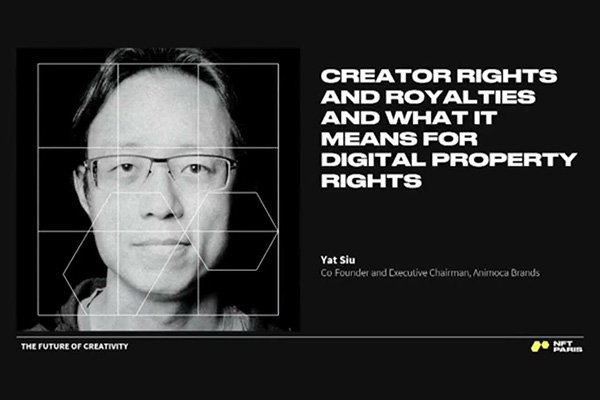
Culture And Royalties: Agent themselves are not bad people. But because they hold the power of money, they often abuse them when handling creators.
The platform is being Apple, Facebook, Google, or Amazon. It doesn’t matter. They’re the ones who now become the agents of your culture and your content, and they’re taking it away for you. That’s why Web3 is so important. If we adopt Web3 more broadly, first of all, there’s more equitable distribution of the value chain because you can audit and see that.
The other much bigger effect that we think will happen is that every person, as many people who may have not been in Web3 but then joined Web3 and got into it became financially literate. They started to understand not just their own value, but the value of other things. They understood, “I should buy this too. I should own my property. I should own my intellectual property.”
It sets them up for the long term because they become equity holders, which is the problem. Capital accumulation is much more valuable than pure labor. This is the thing where most of the world has been excluded from because they still think of labor as the main form of value creation when it’s basically capital accumulation and the whole world of capital that’s created problems in capitalism as we see it nowadays.
When you think about ownership and you mentioned the value and the payouts to creators, it starts at 50, goes down to 40, 30, 10, and sometimes close to zero. It reminds me of, and I’ve heard you speak of, music streaming and the evolution of that element of our economy. It’s changed tremendously in the last decade or plus. What are your thoughts on that side of the house?
One of the tragic things about the music industry is that we have become accustomed to the idea that we shouldn’t pay for music. This was not true in the 80s. Back in the day, I was trained as a classical musician. I didn’t go in that direction, but that’s what my parents were doing. They could make a good living as a musician because people would be willing to pay for music. It was quite normal.
What happened first wasn’t even streaming. Streaming was a reaction to piracy. Things like Napster, Pirate Bay, and so on came in. By growing their own marketplaces and communities, they pirated music simply. It happened for such a long period of time, which is also the reason that we’re trying to fight this zero-royalty thing as we did aggressively as possible because we didn’t want it to become a social norm.
Paying for music is not a social norm anymore. Paying for music is almost considered stupid. Why would you pay for music? You could get an all-you-can-eat subscription. Suddenly, every company is competing on that basis. What happened with decades of piracy is that now, musicians have been commoditized. They can no longer make music as a musician. It’s performance.
When the streaming platforms came and said, “I can solve this for you,” they gave all their rights essentially to the streaming platforms. Spotify in 2022 paid out $7 billion for creator royalties, most of them to the publishers and the distributors. Even that amount of money isn’t enough for musicians to survive on. They make micro cents per stream. There’s no money involved in that. That has to do with the fact that there’s no ability for capital formation in a streaming model because it is like a rental. The amount of money you make if you rent a property is different than if you can sell it because you can give it capital forward value. That’s what property rights do. That’s capital formation.
I’ll give you one data point, which is interesting. $7 billion was paid to creators from Spotify in 2022. NFTs in the bear market in 2022 generated $24 billion in revenue of sales, of which 90% went to creators and owners. Think about that. An industry that is millions of customers is generating three times the value that Spotify, which has 200 million, 300 million, or 400 million customers generates. That is a paradigm difference between owning something and renting something.
Culture And Royalties: NFTs in the bear market generated $24 billion in revenue of sales in 2022, with 90% going to creators and owners. Even with just millions of customers, it is generating three times the value of Spotify.
This is true in the physical world as well. The reason you can buy a house in Beverly Hills or wherever in America for the premium that it is, is because it’s your property. You can invest in it for long-term value, but if you could only ever rent the house forever, the value you generate is what you pay each month, which is what we do in the digital world in the form of a subscription.
You can now compound the value of a subscription long-term because of ownership, which is how capitalism works. That’s the part where everything therefore will get appended with creator economies. If you’re an artist and you can make money from a few thousand customers much more sustainably than through a few million customers, why would you do that?
You can also create much more freedom in the art you want to make because you no longer have to appeal to the mass market. You can appeal to a core audience that will appreciate you, which we do now. For instance, you go to a restaurant. The restaurant doesn’t serve 1 million customers. Most restaurants serve a few thousand people with their particular cuisine and a particular culture that they put in. You appreciate that. You’re willing to pay a premium for that food because it means something special and that’s good.
Now, I see the digital world is very much like fast food. In the music industry, everything has to become McDonald’s. If it’s not, you don’t make money. With Web3, with ownership, we can go back to our creative roots and everyone can start creating more diverse content, which we’re seeing in NFTs. You see the NFT content that is out there, whether it’s Bored Apes, Cool Cats, or Mocaverse. Both the customers that make these ecosystems are not millions of customers. They’re tens of thousands, maybe hundreds of thousands. That is already a big enough economy.
That demonstrates the power of what’s happening in Web3. Let’s talk a little bit more specifically and zoom in a little bit. If I’m a creator or a builder, I am thinking about a drop, and I’m coming out of crypto winter into the future here, what consideration should I have in mind about the value creation at mint versus sustainable royalties and other factors?
We take two philosophical approaches in terms of when we think of mints and successful approaches on this one. The first one is that Web3 is the perfect way to align interests. In other words, how do you leverage that? The reason why you want to give mints at low prices, or maybe even free isn’t because you don’t want to make money. Obviously, you want to make money to be sustainable. It’s because what you’re doing is giving the NFT your project to your community to help co-create it with you.
Think of it almost as a recruitment drive of bringing in community members to grow that. They become essentially your sales force, your agents, and the ones who are building that business. Effectively, it’s almost like giving shares, but it’s not quite because it’s not the same to a group of people who will help build your business. That’s one way to think of that.
Whereas if you extract too much value in the beginning, you could do that, but then the role of creating that value rests entirely with you. If you ended up doing a $10 million NFT drop, that’s okay. However, everyone who bought the NFT has the absolute expectation that you’re going to do everything in your power to make it valuable. It’s a different experience. It’s like when you’re giving something to someone else and you say, “Come build this with me.”
You can see this effect in things like Bored Apes, for instance. For those who remember, it was a very low-cost mint. The benefit of that was that every member had the motivation to help build it up, to build the ecosystem that it is. The royalties are what drove the engine to create the things that we have with mutant apes, derivatives that came out, and all the games and other deeds. That was only possible because of royalties. It wouldn’t have been possible otherwise.
The second thing is that we consider the way when you generate sales from the community effectively as a form of liability. This is something that many projects don’t think of this way, especially big brands who come in and think of it as, “Let me take as much money as I can.” In fact, we have a joke internally about Web 2.5. Web 2.5 is a real meaning in terms of, “Let’s make it easy for Web2 guys to go to Web3.” The problem with the Web 2.5 argument is, “Which side of Web 2.5 are you on? Are you Web 2.4 or you Web 2.6?”
Many people want control of Web 2 but want to make money like Web3. That doesn’t work. The mental model we think of is when we generate sales, we think of it as a liability. When we take money from customers which are owners effectively because of NFTs, we owe them something. We have a duty back to the customers. It doesn’t mean that you can all succeed, but if you have a mindset that you’re serving customers because you took their money, it’s different than saying, “I did a drop and made some money. Great. Here’s another drop in. Let me keep selling,” which is a little bit what happened in 2021 and, to some extent 2022, where it was still thinking Web2 in terms of maximum extraction as opposed to co-creation.
I always encourage builders in the space to think about you’re co-creating with your community. Use the mint mechanism as a way to build that. From that, you basically have a force that money can’t buy. If you have 1,000 fans that will promote your product and keep building you up, you can’t hire 1,000 people.
When we think about what’s next, you’re in this unique position. You’re seeing so many different companies supporting and investing in so many different companies. How is Animoca brands supporting this vision that you’ve already articulated in this conversation? What does that future look like?
For us, we have multiple ways in which we invest in building the stage. A lot of people will think of Animoca brands as a VC. We’re not a traditional VC. We invest out of our balance sheet. We are a builder in the space with things like Sandbox. We also invest in ecosystem companies that help us build the space broadly.
We’re investors in probably 30 to 40 different marketplaces. We’re invested in over 130 games. In total, we now have over 400 portfolio companies that we’ve invested in to help build up that space all over the world. The lens that we think that is interesting on this one is we’re still early in terms of Web3 adoption, broadly speaking. Every one of you here is building. We think of it as a little bit like building the internet in 2000 or 2001.
You still have a while to go except capital formation is powerful. You can make more value in the early stage when there’s still what appears to be a low number of users relative to the broader market. That’s fascinating. The other one is looking at markets beyond your particular area. In 2022, unfortunately, because of everything that’s happened, the US has taken a much more negative view of crypto, broadly speaking. NFTs have been caught up in that a little bit. Whereas in Asia, the whole space has been looked at positively. You don’t have the same resistance.
Thank you.