Top Podcasts
Yat Siu Of Animoca Brands And Yogev Shelly Of TinyTap On How To Use NFTs To Leverage Learning, And More…
What impact will NFTs and Web3 have on education? The educational process is fascinating but the system is rife with things that we thought we could only wish to be better. Animoca Brands and TinyTap are here to prove us wrong. Represented in this interview by Yat Siu and Yogev Shelly, respectively, these brands are hard at work in making the world of NFTs relevant to teachers and education. Yat and Yogev join Josh and Eathan to discuss how they are using NFTs to create interactive learning experiences for students but in a way that also rewards the teachers. They discuss whether ChatGPT and similar AI tools are a friend or foe to education. They also share how TinyTap is opening new doors for educators, students and families to amplify learning opportunities and at the same time, onboard them into Web3. Tune in for all of these and more!
Listen to the podcast here
Yat Siu Of Animoca Brands And Yogev Shelly Of TinyTap On How To Use NFTs To Leverage Learning, And More…
This is Yat Siu of Animoca Brands.
This is Yogev of Shelly of TinyTap.
We are here to talk about advancement in education through NFTs.
We’re on the Edge of NFT, the most educational show in the land.
NFT-curious readers, stay tuned for this episode to learn how TinyTap is opening new doors for educators, students, and families to amplify learning opportunities and, at the same time, onboard them into Web3, whether ChatGPT is a threat or an asset to education and also whether ChatGPT comes up with good questions, and why our guests would love for everyone in the world to know they can be as creative as anyone else.
Don’t forget that we put together a gathering called NFT LA that brought out thousands of the world’s most innovative doers in the NFT space. Head over to NFTLA.live to get tickets to our bigger, bolder, and better but also as intimate and impactful event happening in Los Angeles from March 20th to the 23rd, 2023. See you there.
This episode features Yat Siu, Cofounder and Executive Chairman of Animoca Brands, and Yogev Shelly, CEO of TinyTap. Both partnered to disrupt education through NFTs. A veteran of technology entrepreneurship and an investor based in Hong Kong, Yat Siu is a global leader in blockchain and gaming with the mission to deliver digital property rights to the world’s gamers and internet users, thereby creating a new asset class, play-and-earn economies, and a more equitable digital framework contributing to the building of the open metaverse.
Since 2018, Yat has been an early advocate for the use of blockchain and NFTs in the gaming industry, which will allow gamers to enjoy true ownership of their game assets, data, and consequently, equity. With a clear vision of the potential of decentralized apps and assets, Yat quickly steered Animoca Brands to a leadership position in blockchain, gaming, NFTs, and the open metaverse.
A lifelong creative, Yogev Shelly, Founder and CEO of TinyTap, received his Bachelor’s of Art and Design from Bezalel in Jerusalem. Yogev opened an interactive design studio as a means to pursue a content creation career, something he has carried with him ever since. He began to learn coding as a hobby, which would eventually lead to the development of the first iteration of TinyTap, a tool he first used as a way to engage with his ailing father who suffered from dementia.
TinyTap back then was primarily used by Yogev himself, creating activities that centered around his family. Yogev used pictures and voice recordings to ease the symptoms of dementia. Teachers worldwide found TinyTap on the app store and began using it for similar means. They would build interactive lessons for their students to create fun and engaging material to use in class.
This organic adoption of user-generated content inspired Yogev with a vision for the future. TinyTap provides a code-free platform that empowers educators to create and share interactive educational content and receive a revenue share when that content is used by learners. Welcome back to the show, Yat. Welcome for the first time, Yogev.
Eathan, it’s so interesting that here we have Yat in Davos. You were on Digital.Davos. The conversation in Davos that Yat was catching us up on is all about the bigger impact on society of technology. Certainly, education is one of those industries that’s so right for disruption. People talk more about the challenges than the solutions. Here, we have an interesting solution to a big problem.
Before we get started, I want to jump in and share that our co-host, Jeff Kelley, shares his regret that he can’t join us. He’s at a memorial service for our colleague who passed away unexpectedly, but he wishes he was here to be with us.
Here’s a shout-out to Jeff and best wishes to him, his family, and his colleagues’ family as well. In regard to the conversation around education, Yat, give us a view and what’s going on in Davos in 2023 besides some snow.
First, my condolences to Jeff, his friends, and his family. In Davos, broadly speaking, first of all, the mood is much more optimistic than I expected, which is good. Maybe people came in with some skepticism about how the market is. Roughly toward the end of Davos, everyone was feeling quite good about themselves and the market overall. I’m not sure where that comes from, but the conversations were positive. There are a few macro things to consider that are adding to that sentiment, not just rising token prices, which has been somewhat of an interesting development.
There were two main topics that we’re driving over here at Davos. One of them is Ukraine. If you think about what’s happening in Ukraine, that has been going in favor of the general market and Western sentiment. That’s adding to the mood. The second one is the metaverse. The metaverse is front and center in almost all conversations at Davos events. The World Economic Forum announced some of the metaverse findings with the working governing council, which we’re part of.
We were part of the release, which the council members on that one aren’t just Web3 companies. We’re a bit of a minority. It includes companies like Meta, Google, Microsoft, and all our favorite names. This is an interesting conversation strike to grow the bridge. In any sense, it was a positive step there. The other thing is that, in Davos, many of the side events were a lot of Web3, crypto, and blockchain-type companies as well. Certain sections of it may as well have felt like Web3 Davos. It was quite fun.
We were there. If you have a chance, there’s a vending machine in Davos where you can get yogurt, cheese, and sausage right out of the machine at any time of the day. That’s a little FYI for you. Let’s talk a little bit more broadly about the macro topics that this show comes together to cover. We have here a new form of sustainable, ethical, and equitable capitalism that Animoca Brands cares deeply about. That’s one reason you’re in Davos. It leads to the rest of the focus of the show, which is education, in particular, disrupting education. Paint a picture for us of this new framework of capitalism and how you’re going about approaching this.
Particularly, this is why we’re so excited about Web3. We believe in this concept of the shared network effect. We have spoken often about how the metaverse, Web3, and blockchain should be viewed as building economies as opposed to thinking of them as companies or businesses. Like a country, the size of its GDP and its economic growth has a net benefit generally to the whole population and everyone involved rather than benefiting a few. The problem that we have in the world, generally speaking, is that capitalism is generally a form of shareholder capitalism, which is most embodied when you look at where the value accrues.
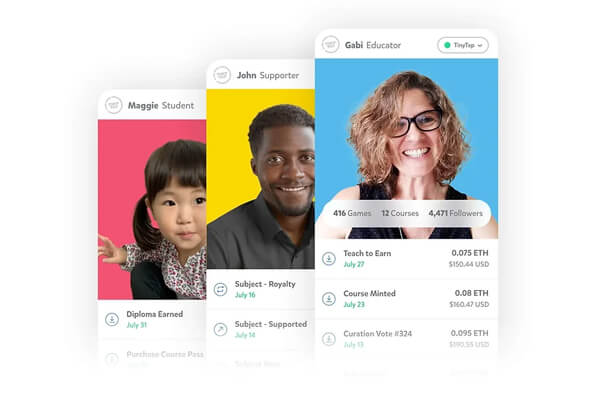
TinyTap: The Metaverse, Web3 and blockchain should be really viewed as building economies as opposed to thinking of them of companies or businesses.
If your company is successful, then the management, the founders, and the shareholders do well, but not the customers who have contributed to the success of these companies. This isn’t necessarily digital companies, but digital companies are the ones who are probably best exemplified. They don’t get outside of being a consumer of the service. They don’t get a benefit for having helped build the business after all. You look at something like Facebook. If people stop using Facebook, the value of Facebook is zero, yet the people who use that platform are mindful of the data, and they don’t get any value for it.
It seems that the consumer, and that’s the term, is there to be extracted from. That’s the kind of capitalism that we generally have. Web3 is a form of true stakeholder capitalism. It’s not indirect. It’s very direct. If you take, for instance, one of our other properties, which is The Sandbox, as an example, and if you buy land in Sandbox, you become a stakeholder in the truest sense of the word, which means that if Sandbox does well, you do well too. If Sandbox does poorly, you suffer equally.
What happens is the entire community has now a common sense of purpose because they’re all part of that same stake, which also means you have a natural defense mechanism as we have in our neighborhood. If our neighborhood is going badly, the community will come together and say, “What can we do here?” Stakeholder capitalism isn’t how we share value across the community. Stakeholder capitalism has the word stake. It means that everyone has something at risk.
We know what happens in societies. When you have something at risk or when you are staking something, you’re not just staking money. You’re staking reputation and things that are important to you. When you have something at stake, then it’s worth defending and protecting. That’s what we’re hoping to build here with a new data paradigm, blockchain, and Web3. What was traditionally a customer-consumer now becomes a customer-owner. As a result, that customer-owner has a shared purpose with the community that he or she is joining. That is, broadly speaking, what we’re so excited about. This is only possible in something like Web3. You can’t do that in the traditional Web2 paradigm.
Here’s a shout-out to a book called Skin in the Game by Nassim Nicholas Taleb, a relatively famous economist of sorts. That’s what the whole book is about. How do we get skin in the game for various players in various systems to make it most functional for all? I also thought it was interesting to mention the word consumer. I thought of it in terms of something like Facebook or a lot of these social apps. We have turned consumers into producers. They’re producing the content, but it’s extractive. They’re not just consuming, to be honest.
Traditionally, the concept of a consumer is someone who takes and consumes whatever is being produced. In that case, what you would think would traditionally be consumers are producers in the truest sense of the term. I would love to check in with you, Yogev, about what’s going on here with TinyTap. I want to know how NFTs and Web3 technologies are improving earning opportunities, for example, for educators through the system.
I’m going to build on what we have said until now. Yat, I also haven’t heard that focus and highlight on the word consumer. That’s very interesting to think about. Web1 is the right place to put consumers in because we just consume the content there. Maybe Web2 should be about producers, and Web3 is about owners. That’s a nice way to connect everything.
I’m going to talk at length about what we have created on TinyTap and how we’re advancing the visions we already had before with Web2, but now we can amplify with Web3. The starting point of what we’re building is the ownership part, to give the creators the ownership of what they create, and through that, opening all sets of new business opportunities and models for them.
As we were working on that, it made it much clearer that owning the content is a much fairer and truer way to link your success to a company’s success than the traditional way we’re investing in companies or taking part in companies. If I’m an avid Meta user, and I want to participate in the success, I can go to the public market and buy their shares, but we all know that has nothing to do with the actual success in terms of traction and revenue of the company. It’s more of a hype in the market. The market can vanish it. The actual underlying assets are where the value is at.
If I own a part of the Evolution of Dance back then on YouTube, I don’t know if audiences here know what I’m talking about, any successful videos that didn’t get a lot of views when the platform was young but suddenly, this platform becomes huge, and I was a part owner of that video, then I enjoyed that success. It’s linked directly to the success of the company. In a way, owning pieces of content and platforms that we use and engage with is a much better way to link ourselves to the success of a company that we believe in than going to the public market. I hope that’s where we’re going. That’s what we’re trying to advance also in education.
Can you get a little bit into how this works? There’s another business. I don’t know if it’s necessarily a competitor, but there’s something interesting about it. I know about this company for years because my wife and her sister got involved in it. It’s called Teachers Pay Teachers. It’s a platform where if you’re a teacher and you made a PDF thing, you can upload it there.
Other teachers will spend $2 or $5 on this educational pack. It’s so much easier for that other teacher to use that content and so forth. They eventually started calling it Teachers Make Millions because teachers are making millions by creating this content. I’m sure the model is similar and different from that thing on your platform. What are the similarities and differences there?
We love Teachers Pay Teachers. We have been in connection with them for years and have been inspired by them. That is also a testament to the fact that the current education system doesn’t provide everything that teachers need and that it relies on the creativity of educators. What they’re doing on Teachers Pay Teachers is allowing teachers to sell lesson plans and PDFs to other teachers so they can use them in the classroom, which means a lot of the time when you send your kid to school, you imagine that everything is there and ready for them to go, but there’s a teacher that needs to come up with something creative and have it ready for tomorrow. She can use some other teachers’ resources.
It is teachers within teachers. We want to expand it to teachers to parents and teachers to students and learners on TinyTap because we’re leveraging the interactive aspect, which allows the consumption of individuals at home. You said teachers make millions. One of the biggest problems that we’re trying to solve is that there are a lot of people who want to be entrepreneurs. They have great ideas on how to do education differently. It’s anyone who didn’t enjoy the education system or has other ideas on how to do that, but as Yat can testify, it’s super difficult to start an EdTech venture, raise the funds for that, reach the market, and the distribution. Not all countries have an ecosystem for startups.
It’s difficult to be an entrepreneur. That’s why it is essential to go to Web3 and help them find business models that can help them get funding and partners to distribute that because if you look into Teachers Pay Teachers and a lot of other platforms, normally, it’s the Pareto rule. It’s 20/80 or much less than that who are making the most millions. You have the top 10 or 100 names making millions. The rest are creating great content but have no idea how to market that. We see that on TinyTap as well. People create content, but then they also need to market and push that. You need partners to join you.
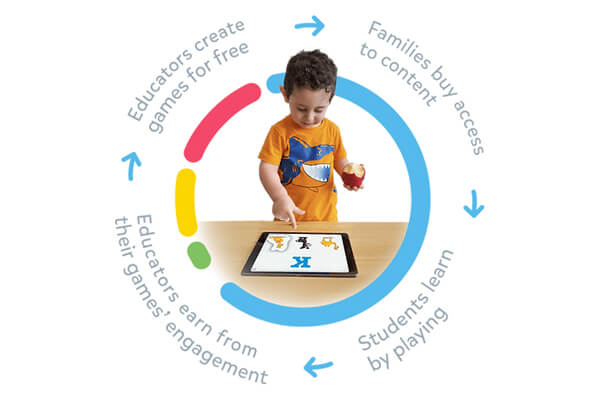
TinyTap: Anyone who didn’t enjoy the education system or have other ideas on how to do that can testify that it’s super difficult to start an edtech venture. That’s why it is essential to go to Web3 and really help them find business models that can help them get funding.
To do an international partnership with someone you don’t know, normally, you need agreements, laws, and a court that can enforce that. A lot of that is being solved with the trust that Web3 introduces here because if there is a smart contract behind it that says that both of us own a piece of content, you don’t even need to know me, but you know and trust the system that you will receive the funds from that content’s revenue. In a way, it removes so much of the friction. That’s what we’re trying to build. I’ll talk about it more as we continue.
I have a follow-up question. You all have children. We’re talking about a situation where education does need to evolve. Some of my friends with children were hiking and talking about the challenge of AI in ChatGPT. The chatbot has the ability to change the game in terms of doing research and writing papers. All these assignments that I got as a kid, people can do it now in five minutes with some AI help. As you think about TinyTap and other types of ways to gamify learning, are you also thinking about how to defend against AI and make sure people are enlarging their brains through education? My concern is that all these AI tools can go against the curve of actual pure learning.
ChatGPT is a marvel. Yat, I’m not even sure that you’re up to date on that, but we already had a chance to integrate ChatGPT into TinyTap. There’s a very simple way where you can ask ChatGPT to create a game about the solar system, and you will get a TinyTap game ready tomorrow. We’re trying to be friends with it, not push it away. One of the uniqueness that we’re bringing in the way TinyTap teaches people that is different from the online educational platforms that we’re familiar with, like Udemy or Coursera, is that we’re not about videos and consumption information.
It’s an active learning experience. You ask the question. You need to participate and use your brain. Sometimes it hurts, but you’re a part of the lesson. You’re not just participating. If you’re asking questions or seeing videos, it’s not enough. We want you to work your brain, participate, and be a part of the lesson. ChatGPT can be a great help in that.
I typed into ChatGPT, “Give me a good question to ask Yat Siu of Animoca Brands.” Let’s read it. We don’t have to answer it, but it’s pretty good, “Can you discuss the strategy and vision behind Animoca Brands’ acquisition and development of popular gaming franchises such as Formula 1, Garfield, and CryptoKitties, and how you see these franchises fitting into the overall growth and success of the company?” That is not bad.
ChatGPT opened up people’s thoughts and opinions as to what AI can do. Unfortunately, we have heard some stories about some schools banning ChatGPT, which is the wrong answer because, if you think about it, ChatGPT can be a strong ally in education. When you think about generally what AI can do, one of the struggles, and this is why TinyTap stood out here, was creating personalized content for individual learners that happen to be different because we are all different people.
One of the reasons many of us are trying to solve education is that we recognize that people aren’t one-size-fits-all. We don’t all think the same. Therefore, we don’t all learn the same. If you think about it, there are thousands of ways to learn English. Why do you need thousands of ways to learn English? It’s because we are different. Some people are visual. Some people prefer text or whatever that may be.
Hear, hear for regulation.
I look forward to seeing you, Yat.
It’s good ’80s toys.
That’s impressive.
What is the most recent thing you purchased?
Twelve Publisher NFTs on TinyTap.
That is a qualified response.
That sounds about right.
Not so much unless you want to get creamed.
They were there for a while.
I remember that. Google used to do that.
It’s Google Cardboard.
There’s a new DeLorean coming out.
I’ll take the electric DeLorean.
I’ve got a reMarkable pad.
Important Links
-
@TinyTapAB - Twitter
-
Spotify - Edge of NFT
-
iTunes - Edge of NFT