Top Podcasts
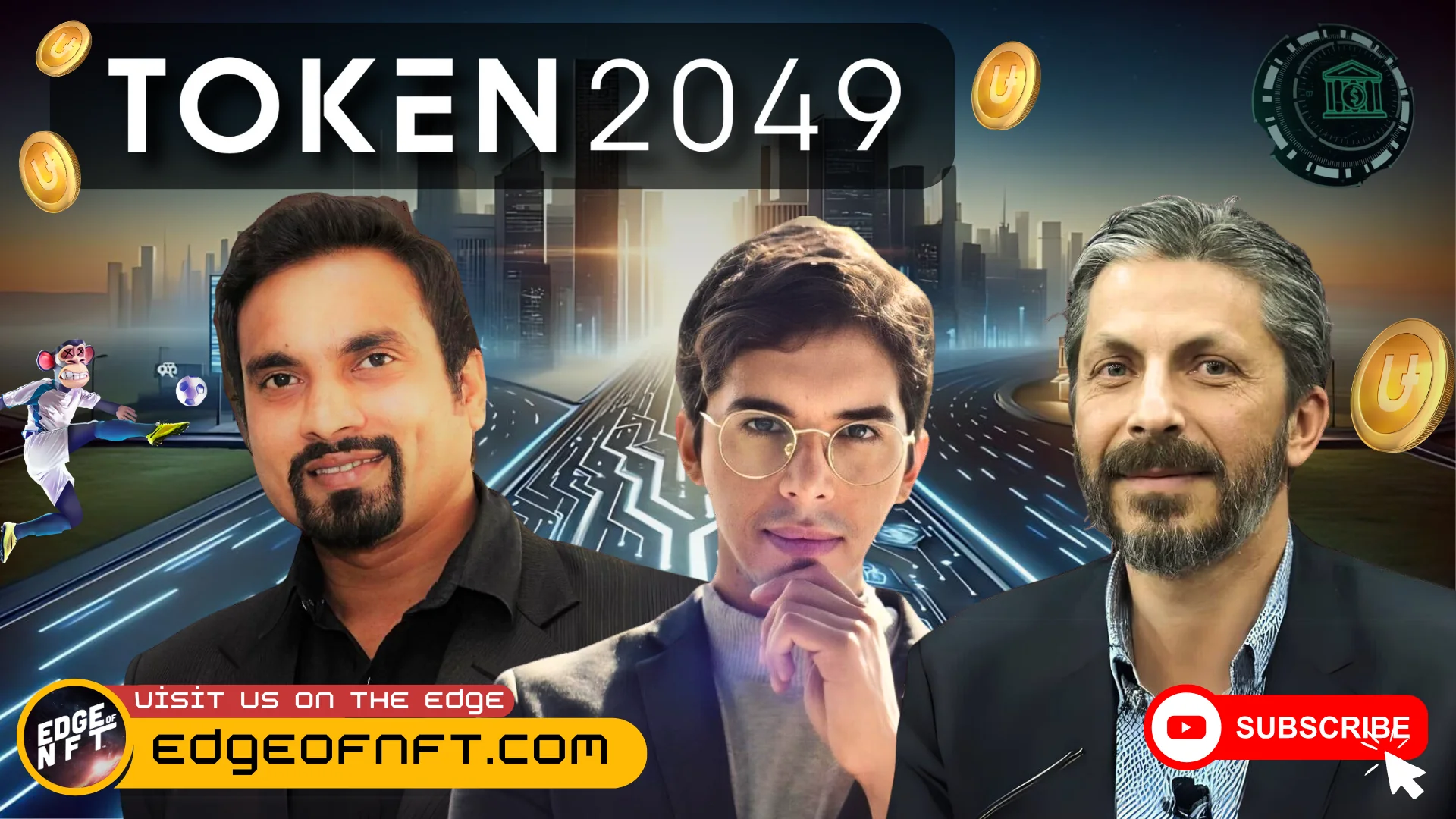
The Future of Cryptocurrency: Excitement and Innovation at Token2049
Discover how Emmanuel Quezada, CEO and cofounder of Utopia, is revolutionizing online safety and user control through blockchain and AI technologies. Delve into the impact of GameFi, AI Music, and NFTs in media and entertainment as Emmanuel shares his vision for a secure and decentralized internet. Learn about Utopia’s partnerships with top brands, upcoming NFT drops, and their innovative work in online safety for children. Emmanuel also opens up about his family’s political legacy in Mexico, and how Web3 can shape the future of internet regulation.
Please enjoy!
Listen or watch this episode on Apple Podcasts, Spotify, Myco, Overcast, Podcast Addict, Pocket Casts, Castbox, Iheart Radio, YouTube, YouTube, Amazon, Audible, or on your favorite platform. Remember with Myco.IO you earn for your attention.
Sponsorship and Advertising: If you are interested in sponsoring the podcast, please fill out the Sponsor Interest Form, which we review 1-2 times per month.
Key Topics Covered:
-
Utopia’s Mission for Web3 Online Safety: Emmanuel Quezada discusses Utopia’s focus on creating a safe and secure internet for children and users through blockchain and AI.
-
Regulating the Internet for Web3: Emmanuel explains his vision of how regulating Web3, instead of retrofitting Web2 regulations, can create safer environments for users.
-
Partnerships with Major Brands: Utopia’s partnerships with renowned companies like HSBC, Coca Cola, and their upcoming NFT collaborations with major sports brands and Bored Ape Yacht Club.
-
Emmanuel Quezada’s Family Legacy in Mexico: Insights into Emmanuel’s family background in politics and their aspiration to run for the presidency of Mexico by 2030.
-
NFT and Web3 Innovation: How Utopia integrates NFTs with brands to build trust and drive innovation in the evolving Web3 space.
What was your favorite quote or lesson from this episode? Please let us know in the comments on YouTube. https://www.youtube.com/@edgeofnft/
Episode Highlights:
-
Emmanuel Quezada on Web3’s Future: “Web3 isn’t just about technology; it’s about creating a secure and fair internet for the next generation.” [Timestamp: 14:30]
-
Creating Safe Spaces for Children: “The internet should protect its youngest users, and Web3 gives us the tools to ensure safety.” [Timestamp: 21:05]
-
Utopia’s Vision for NFTs: “Our NFT collaborations with major brands are not just about collectibles; they’re about creating immersive, secure digital experiences.” [Timestamp: 35:40]
For the full transcript, see further below.
**People and Resources Mentioned: **
Connect With Us:
-
Website: https://www.edgeofnft.com/
-
Twitter: https://x.com/EdgeofNFT
-
LinkedIn: https://www.linkedin.com/company/edge-of-nft-podcast/
-
Instagram: https://www.instagram.com/edgeofnft/
-
Discord: https://discord.gg/CQhZUdsV
-
Telegram: https://t.me/edgeofnft
-
Facebook: https://www.facebook.com/edgeofnft
About Our Guest:
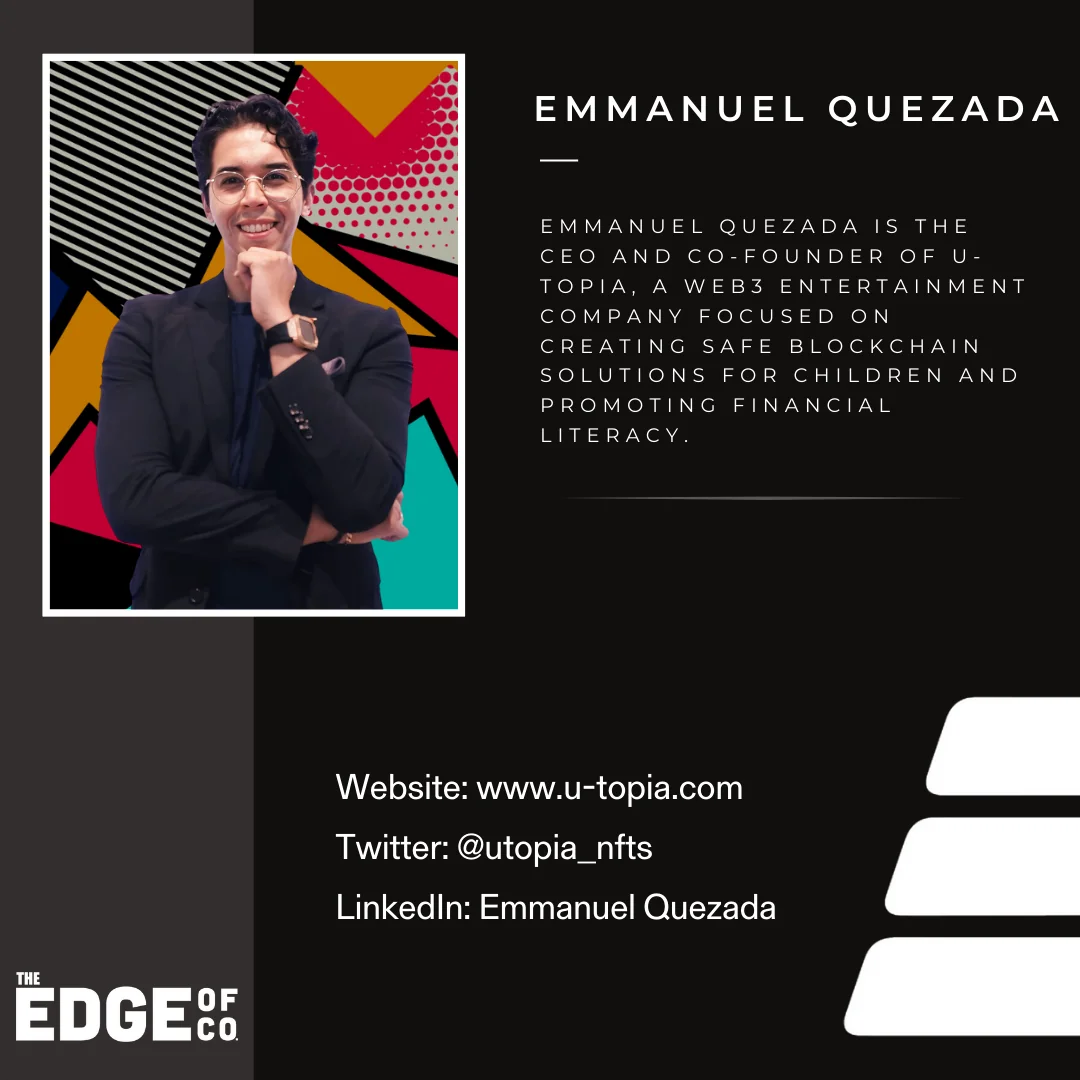
EMMANUEL QUEZADA
- **Bio: **Emmanuel Quezada is the CEO and cofounder of Utopia Ecosystem, a Web3 platform focused on enhancing online safety and user control through blockchain and AI. Emmanuel’s work spans multiple industries, including GameFi, AI Music, and video entertainment. He’s passionate about building a safer internet and has worked with top brands like Coca Cola, HSBC, and NETGEAR.
-
Website: Utopia
-
Twitter: @utopia_nfts
-
LinkedIn: Emmanuel Quezada
Subscribe to the Podcast:
Disclaimer:
This is not financial or tax advice. Edge of NFT content is strictly educational and is not investment advice or a solicitation to buy or sell any assets or to make any financial decisions. Whenever making financial decisions, we recommend doing your own research and talking to your accountant for financial advice. Disclosure: From time-to-time we may feature sponsored content for which we receive value and we may share links for which we receive a commission if you make a purchase through one of these links. See our full Disclaimer (https://www.edgeofnft.com/disclaimer), Terms & Conditions (https://www.edgeofnft.com/terms-of-use), Privacy Policy (https://www.edgeofnft.com/privacy-policy), and Copyright Notice (https://www.edgeofnft.com/copyright-notice) for details.
Full Episode Transcript:
Josh Kriger:
Hi, everyone. What’s going on? This is Josh Kriger, cohost of Edge AI at token 2049 here in Dubai, and this is part of a special Dubai roadshow sponsored by Bitlayer. And I’m speaking today with Emmanuel Khazada of Utopia, also known to his friends and homies as EQ. What’s going on, man?
Emmanuel Quezada:
Hello, brother. No. It’s, it’s been crazy, but, everything seems fine now.
Josh Kriger:
Just to set the context, we thought the bear market was difficult, but then we experienced the worst flood in 25 years in Dubai. Yeah. So, you know, yesterday, I don’t know if you can Kelley,
Emmanuel Quezada:
we
Josh Kriger:
were, trapped in a metro for 11 hours.
Emmanuel Quezada:
I I slept on a couch because there there were no taxis. You know, the hotel Armani, like, they just put a blanket on me, almost AI a kiss on my forehead and it was AI, just chill. It was impossible in the last NFT 24 hours. I was walking in the water. I was like, yeah.
Josh Kriger:
Yeah. But now we’re we’re here.
Emmanuel Quezada:
Dry All Dry now. All all
Josh Kriger:
is well. And, I think there’s a lot of excitement to talk about, in the space and what you’re doing with Utopia. But just to give everyone a little bit of comp context, Emmanuel is CEO and cofounder of Utopia Ecosystem, and these guys are driving blockchain projects in GameFi, AI Music, video entertainment such as Polyglot. He’s also worked with top brands such as HSBC, Coca Cola, Janney, Catchbox, Sony, NETGEAR, and recently had investment from GDA Capital. And for those that don’t know about Utopia, it’s a web 3 platform that enhances online safety and user control through advanced blockchain AI focused on creating a secure Internet environment, which is really cool. We we have this show, Edge of NFT. We have another show, Edge of Of.
Emmanuel Quezada:
So you’re, like, crossing all these different, intersections. It’s necessary. Like, if you really want to bring utility, you need to touch different bases. And even if those are, like, fancy buzzwords, if you want to simplify, we’re just a media web3 entertainment company, just that, and we try to touch as many verticals as we can.
Josh Kriger:
Very cool. And, so I’m from, Boston originally, live in LA, and you’re from Mexico?
Emmanuel Quezada:
I’m from Mexico. So I’m from, originally from Chihuahua, like the dog. Oh, sir. AI biggest states of Mexico. And, yeah, I start I start learning about crypto there. And then I’ve been cross like, I’ve been traveling around the world more than 20 countries now. So yeah.
Josh Kriger:
Cool. And people may be familiar with your last name because of your brother. Right?
Emmanuel Quezada:
Yeah. So AI, it’s, if if you if you know a little bit of Mexico, Quezada family has been in the politics for a while. We’re part of the other Quesada family. So yeah, my dad recently created a political party with my brother and, right now, they’re running for mayor of the biggest state of of, Mexico this year. And then, by 2030, we’re running for the presidency of Mexico. Alright.
Josh Kriger:
Let’s go. Yeah. Nice. Nice. And and I guess, like, it sounds like all of you are sort of, aspiring towards making a big impact in the world, clearly. That that’s sort of the theme of your family.
Emmanuel Quezada:
It is. So, there’s something called the hero complex. So I’ve heard of it. Yeah, you hear of it. So, yeah, that’s that’s quite, regular on the CEOs and, my family has been quite effective at creating a few heroes in the in the history of of the whole blood lineage and, yeah, every single member of my family right now is trying to do something to save the world, and I choose web trade. AI, I love that. And I
Josh Kriger:
think there’s a lot of impact possible here. It seems like you’re really leaning into utopia and how it enhances online safety, which is an important consideration as we move forward. You know, we’re beyond the point of return where, everyone’s clicking on everything. So Yes. So, how are you sort of doing that with, Blockchain AI, and what’s your vision of Utopia?
Emmanuel Quezada:
So, I think that a a little bit higher Eathan this, I my purpose in life, I found it when I was 21. It was pretty specific. I was pretty lucky to have that purpose in an early stage. It was, safe innocence, so I just wanted to save innocence, right, and, where the most innocence come from, from the children, so AI say, okay, I want to, I want to protect the children, my skill set allows me to work a lot with people 1 on 1, but as well allows me to, like, think a little bit forward and because I work with governments around the world, I say, okay, I think that I can regulate and the the internet for children is a very ambitious one, I was thinking you regulate web to internet, so when when you’re looking for my name and, like, I’ve been speaking to the governments around, algorithms, how bad it is, social media, how impact the brain development of the children, but then I decide, no. Web3 is the way because it’s easier to regulate something that is not here yet than just clean all the parts, right? So, yeah, that’s that’s my main focus right now.
Josh Kriger:
Beautiful. And and sort of what how is YouTube sorry.
Emmanuel Quezada:
Utopia. Yeah.
Josh Kriger:
Let’s repeat that. Beautiful. So how is Utopia sort of integrating NFTs with brands, at at this point in sort of the the the company’s evolution?
Emmanuel Quezada:
1st, the boring part. So AI I have a lot of knowledge around compliance and risk management. So I I’m a paper guy. I like to rate contracts, AI? So, we know how to create contracts for brands to feel comfortable jumping into the web tree. That’s the number one. And the second one is that companies are actually incentivated to explore the new technologies. They want to be in the in the technology edge line because they know what that can make for their business. So, because we’re a really compliant company that works with governments and top brands, companies come at us and NFT on their needs or depending on the market, we develop a collaboration agreement to to expand the product.
Emmanuel Quezada:
So AI now, I cannot say much, but I have a sports, I have a sports partnership coming, the biggest one in the world and, basically, we’re doing an NFT collection with them. We’re going to be broadcasting live matches. We’re going to be doing, 3 d, 3 d, movements. We are going to be doing AI. We’re going to So, there is a lot of things that we do depending on the customer. So, yeah, that’s that’s where
Josh Kriger:
Really exciting. Yeah. I mean, this is something we talk about on the show a lot. We’ve had everyone on from Adidas and Mercedes to Hennessy and, just interviewed, Eric Paulier, the CEO of Adam, who did the campaign with Pepsi. Right? So so we appreciate sort of the nuances of sort of getting brands involved in checking the the boxes, dotting your i’s, crossing your t’s. Are they are they ready to get back into it? I know there was, like, a deep pause at least in the United States, and we’ve seen sort of Paris fashion brands get excited about web 3. What what sort of the brand sort of disposition at this point in terms of the companies that you’re talking to? How eager are they to jump back into the space?
Emmanuel Quezada:
Not that excited, I will say. There is a lot of pushback especially from the companies that already experiment with the NFTs, I think that the web because the Web3 is not fully regulated NFT, we we know this, the companies are still afraid to get involved with the Webtree agents, right? I don’t blame them. There has been a lot of, bad behavior around the Web3 because of the lack of regulation. I don’t blame the Web3. I don’t blame the government. It’s just 2 different speed, but the brands are still uncertain so I’m guessing that as soon as the brands find someone that they can trust on, someone that has more skin on the game, that’s where they’re like, okay. Let’s do it. Let’s, okay, I want to do a minute.
Emmanuel Quezada:
Let’s do a minute. I want to do a game fight. Let’s do a game fight. I want to do a n of 5. Let’s do NFT f 5. But they need to find the perfect match and they need to do a lot of due diligence. So it’s just low and not everyone is capable to do that.
Josh Kriger:
Cool. But, certainly, you mentioned one of the largest brands in the world you’re about to, work with. So it does sound like, there’s some, you know, big, leaders that are sort of paving the way for for everyone else. So that’s that’s just that’s exciting. Let’s touch on, you
Emmanuel Quezada:
know, your efforts Carthon Internet security using Web 3 for children. How does Web 3 help solve that problem? So there is there is a lot of problems. So the main problem is that kids are using Internet. Right? And, and the way that they’re using the Internet right AI, it’s
Josh Kriger:
Often without controls. So a lot of parents are using apps now to control the time in the spot.
Emmanuel Quezada:
Do do you have kids?
Josh Kriger:
I don’t.
Emmanuel Quezada:
You don’t? Okay. But you have nephews or, like, relatives.
Josh Kriger:
Yeah. It comes up a lot with with, you know, new parents that I know.
Emmanuel Quezada:
Yeah. And, like, you can see kids, like, 2 years old, like, touching and AI. You’re just going straight, full attention into that. You remove the iPad and then you have a demo, right? Like, a demo, like, that that that kids get super stressed because the technology, the interaction of kids and technology hasn’t been studied enough or at least has not been publicly studied enough so something that we need to start doing is that we need to start getting conscious that the kids should be always exposed to technology but on a safe AI. So, what I discovered that is, this is the main project that we’re doing. We’re doing a wallet for children because the wallet is a login of the web 3. If you control the login, you control the access. So if we can control exactly.
Emmanuel Quezada:
Right? And if you if you want to work with the government, you better control the access of the or brands, you better control the access of the users. For example, right now we have Sandbox, right? Sandbox, I think that it should go more directed to the market, should be like younger NFT. But in, in places like Dubai Kriger now, we have Snoop World, Snoop Dogg World that that has drugs and dancers and I’m okay I’m okay with that as an adult but I don’t know if the kids want to see that, right, or, they have the playboy world. I don’t know if that is compliant AI for the children. But, like, if you control the access and you have all the metadata, it can be distributed. It can be, like, full NFT, blah blah blah. But if you have the access, you will be able to at least say the kids, no. No.
Emmanuel Quezada:
No. Don’t go there. You’re getting it.
Josh Kriger:
Very cool. Very cool. And AI guess in addition to that, you have a exclusive NFT drop that’s gonna work with, the Bored Ape Yacht Club. Is that correct?
Emmanuel Quezada:
It is correct. So, right now we’re matching web3 communities with web2 brands so my my partners they’ve been doing this for years and, yeah, the web3 communities, I think that they have a big value, big, big value, but they need to have, like, some organization, AI? So but the biggest one that we kind of think of, it was the apes because the apes are always been there they are super, like, well structured and actually, we’re doing an event right now, a yacht event with them so, yeah, pretty cool so, we grab, existing apes and now we’re matching it with brands so right now we’re dropping a radio station, ai radio station Kelley byc. Fm the website is live and as well we’re dropping a NFT collection with the food, ball, pins that AI wouldn’t say which ones and, the black club, AI? So, I will AI those NFT, in the combination and later on we’re going to bring the pudges, we’re going to bring the turtles, the sukis, and we’re just going to start mixing it and create fun games.
Josh Kriger:
That sounds really exciting. And tell me a little bit more about your UCOIN sort of token. What’s the utility? How does that work within your ecosystem?
Emmanuel Quezada:
100%. Great, great question. So, just imagine that you are BlackRock, AI, and someone comes at you and says, ‘Hey, can can I do this NFT collection?’ Right now, I don’t want to say this way because I might get enemies, but, like, I don’t trust everyone. And even if I trust them, I don’t know about the market. I don’t know how unpredictable the market is or how the CEOs are going to behave or what is going to happen. So we have to create our own token, to create our own network, to create our own NFT so we can guarantee that our partners are in a safe ecosystem and doesn’t matter what happens in the outside. It doesn’t matter if if, the next big l one crashes. Our partners are safe, they’re secure, and, they they have a a good ecosystem.
Emmanuel Quezada:
Very cool. Very cool. That’s the utility.
Josh Kriger:
So we’re in AI, and, you know, Richard and I and our team are off to Riyadh for Outer Edge Riyadh, which will have happened, before this pod podcast airs.
Emmanuel Quezada:
Yeah.
Josh Kriger:
This is a really exciting region, in my mind. How would you sort of characterize the UAE, and why is it important to utopia?
Emmanuel Quezada:
I cannot see utopia growing in any other area in the world. I’m I’m I’m not saying city, I’m not saying country, I’m saying area, right? I’m non Muslim but these are Muslim countries and they have great values for the families, they have amazing values for the family so, I I I believe that these people appreciate the kids, appreciate what is the future of the kids and they’re pushing the technology NFT they’re pushing and pushing and pushing the technology, and they’re always welcoming foreigners. So when you touch Dubai, you fall in love with Dubai, you don’t move AI. That’s that’s, that’s what happened.
Josh Kriger:
Very cool. This has been a fun chat. We’ll have to chat more. It’s great meeting you, and I think there’s a lot of synergy with what we’re up to and our values as well. Before we cut, we do have a fun segment I wanna roll through a couple questions with you. It’s called Edge quick hitters, and this is where we grill our favorite web 3 heroes, like you mentioned Yeah. With some rapid fire questions. So Emmanuel, up for the challenge?
Emmanuel Quezada:
I’m not. I didn’t study. I I wasn’t aware of it, but okay. Let’s do it.
Josh Kriger:
Perfect. That’s what we like. Okay. Alright. What’s the first thing you remember ever purchasing in your life?
Emmanuel Quezada:
A perfume for my dad.
Josh Kriger:
Okay. Cool. And what’s the first thing you remember ever selling in your life?
Emmanuel Quezada:
Chocolate to my uncles. Sold sold within the family.
Josh Kriger:
Was this for, like, a school thing? Or
Emmanuel Quezada:
No. No. No. I You make it? Yeah. Yeah. Yeah. You make your own chocolate? Yeah. The perfume.
Emmanuel Quezada:
So I I purchased the perfume with the chocolate.
Emmanuel Quezada:
Yeah. So I was 4 years old. I wanted to give a gift to my dad. I have I I say, mom, hey. Can you purchase me chocolates? I go with my Kelley. I start selling chocolate, but chocolates with the form of dogs. And, yeah, I save enough money to give the perfume to me, there. There there you go.
Emmanuel Quezada:
yeah.
Emmanuel Quezada:
Josh Kriger:
Emmanuel Quezada:
Josh Kriger:
Emmanuel Quezada:
Josh Kriger:
Emmanuel Quezada:
Josh Kriger:
Emmanuel Quezada:
Josh Kriger:
Emmanuel Quezada:
Josh Kriger:
Absolutely.
Emmanuel Quezada:
Josh Kriger:
Josh Kriger:
Emmanuel Quezada:
Jason Dehni:
Jason Dehni:
Jason Dehni:
Jason Dehni:
Jason Dehni:
Jason Dehni:
Yeah.
Jason Dehni:
Jason Dehni:
Jason Dehni:
Jason Dehni:
Jason Dehni:
Jason Dehni:
Jason Dehni:
Thank you, Saksim. You. Thank you.
Emmanuel Quezada:
AI bye.
Hey, everyone. I’m here at the Bitlayer event here at AI Golf in Dubai. There’s actually a a virtual golf course right behind you, which is pretty awesome. I’m here with the Jason Janney with Credbull. I’m here to learn a little bit more about, what’s going on here. So, pleasure to
meet you. Pleasure. Thank you for having me.
Of course. So, first, I’ll learn a a little bit about you. Tell me about how you even got into Web3 in the first place.
Sure. Well I spent 17 years in TradFi. I was primarily in asset management, private banking, SME NFT. And, you know, I was working in Hong Kong at the time. I was, CEO of an insurance and asset management company. And, you know, the more senior you got in TradFi, the more disillusioned you become at how rigged the system is. And I discovered crypto and AI back in NFT, and I never looked back since because I just saw the opportunity of how to fix some of the issues that we encountered in AI, around access, around, you know, just kind of AI the average person, the privileges, and the opportunities that the ultra rich in institutions get on a daily basis. So for me, I’ve never looked back since since 2015.
That’s awesome. I, I also started in traditional finance, and I I I was in, Kelley Management, and it broke my heart to see that there are so many ways that the risk can stay rich and nothing was being taught to a legitimate person or could have access. And I saw also I saw crypto as that opportunity to to bridge that, and it sounds like you also saw that. So as you then, see about all these different tools, how does your journey go from learning about this in 2015 to then now being part of Credible here in 2024? Yeah, so Credit Bull is is I think of it as a kind of a web 2.5. It takes a what is traditionally a an exclusive asset class, like such a private credit,
and democratizes it. We recently launched the very first licensed on chain private credit fund. So we offer, various, high fixed yield products, and also the opportunity to participate in the performance of the fund. Now this fund is not tokenized RWA. It is decentralized RWA. Meaning that, where you look at, you know, most all actually tokenized funds, there still is AI, opaque funds. You still don’t see you have no transparency into how the funds are managed. And when you look at kind of active fund management, it’s a $100,000,000,000,000 asset class.
AI% of active managers underperform their own index every single year. So we wanted to not tokenize the fund because that only really addresses kind of operational efficiency. We wanted to decentralize the funds, meaning that there’s full governance by the investors, by the lenders into the fund, on strategy, on risk controls, on capital deployment, both on chain and off chain in real time and real time performance. And everything is visible. So there is no opaqueness. There’s NFT, limitation as to who can participate in the fund. We provide broad access to the entire market, the same terms and conditions that an institutional investor would get. A retail investor would have Kelley the same.
That is amazing for many reasons. A quick little antidote. I knew someone who tried to do something similar NFT not quite where they’re being trend like, the biggest word for me on that was transparency and being able to follow everything. Because there were funds NFT were set up that I’m gonna guarantee you what 8% or whatever it was. And then, they happened unfortunately, to go pretty heavy into Terra Luna. When Terra Luna happened, the fund basically wouldn’t Kelley up and people didn’t get their money back. Obviously, if you could have had more transparency, easy way to negate that. So not just doing that but also having everything else involved AI sure gives a lot of your investors a lot
of peace of mind. You know it’s interesting you say that because I lost a lot of money in a, active management who which is supposed to be deploying a certain strategy and end up going into Luna. And actually it might be the same fund that that you’re in. And, so I had no visibility into how the fund was being managed. So for us, you know, especially with private credit, it’s being it’s criticized as being an opaque asset class. So we wanna take the veil off of it and just, you know, make sure that, 1, there is engagement, and approval by the community on how we actually deploy the capital, and there’s full transparency on the execution of it. So, you know, we this is for us is is it’s again, it pushes the boundaries of, RWA not being tokenized. It’s it has to be decentralized.
It’s time for us to think about decentralization around access, around transparency, around, liquidity, and around broader access. Right NFT, a lot of token SRWA’s don’t address more, those issues. They only address operational efficiency. And that’s not DeFi.
It’s not. And, I like that you’re addressing all of of, cause they’re all important, but by going forward more decentralization and and and having that be at the forefront as the anchor, I think it’s also gonna be, as you said, a 2.5. Right? So it’s for for someone coming from traditional finance over, it’s not as Kelley. But for your hardcore web 3 person too, they’re like, I resonate with that.
Yeah. Yeah. And look, there’s, we have, various features to our product offering. You know, our proposition is that it’s high fixed yield, so 10% fixed as well as 30% participation in the performance. The the target, yield gross yield of the fund is 18 to 20%. So you have 10% fixed as your base, and then potentially another 3% on top of of. It’s entirely non correlated to crypto. Mhmm.
So we are an asset allocator to SME lending platforms, the fintechs, who specialize in SME lending. So we allocate to very established, highly audited platforms we that we have relationships with. And they invest to in creditworthy SMEs. That allows us, broad diversification. AI, in the full deployment of the fund, it could be over 1 and a half 1000000 SME transactions and over the course of the year. Wow. And that can be all visible depending on your, you know, your appetite to go through them. Every single transaction is visible back on chain through, off chain oracles.
But also for retail, we actually also AI it a little bit because we want to engage the community to learn about different investment strategies, about different, you know, like basic financial literacy in a way. Right. So we gamify it. We reward points for engaging and so forth, and they get rewarded with our utility token. And they can with yield and token reward, it could it could exceed 30%. So for us is, yes, you’ve got your traditional investment, solutions for your institutional and accredited. But Kelley Eathan we’re focusing on, this is why it’s so attractive for us to be, involved with Bitlayer, is that we fundamentally believe in the principles of DeFi, which is around transparency, governance, access, liquidity. And right NFT, we’ve sort of forgotten that narrative.
Yes. And, certainly, that’s why I got into crypto, and this is why I didn’t like being in traditional finance. So I’m holding on to those principles. I’m bringing, you know, bringing DeFi back to RWA.
Yeah. I I love it. You know, people who aren’t necessarily coming from the traditional finance got their first taste of of of DeFi summer. And it’s it’s kinda gone to the wayside because good principles weren’t put in place. And sounds like Credible is trying to address a lot of of, but also looking at one of the best asset classes out there, Bitcoin, and being able to to do a lot on top of that, which is what Bitlayer is doing. So what does that cross collaboration look like right now for Credible? Bitlayer.
To be honest with you, we’re super excited about it because, you know, Bitcoin, you know, you know, Bitlayer is an l two bit, built on on, on Bitcoin. And it’s about liquidity, and it’s about decentralization. So for us, we have, we’re we’re actually AI some really cool products that I can’t talk about right now, but Okay. That, will come out in, early next year. Okay. That, let’s just say Kelley I would fundamentally kind of, alter the makeup of how you, draw liquidity on RWA. Yeah. And I think that’s really cool.
And that’s right NFT what’s needed is that the big piece that’s missing in RWA is how do you actually make it more liquid? And we’re we’re working really hard to solve that right now.
Yeah. It’s a it’s a tough one to crack once it’s cracked, and it’s excites me. So I I can’t wait to see that ultimately ends up. But looking across, the rest of NFT at the time of this recording, how big is happening tomorrow. So what are you looking forward to as you look at the rest
of the year? You know, there’s a lot of really cool things happening, a lot of innovation. To be honest with you, I’m, I I focus more on, like, you know, being here in in Dubai at token NFT. There’s just I’ve met so many really, great projects, so many great innovators, thinkers of, collaborators. You know, I’m super excited about the RWA narrative and where it’s going. It is not a, kind of it’s a, you know, it’s not a cyclical narrative. This is a narrative that’s gonna be building, over time, and it’s gonna be a dominant sector within DeFi. And what I mean by DeFi is more decentralizing RWA. And that’s what I’m really excited about.
We are launching various products to align with that. You know, we’re focused on our own TGE in Janney, and, lots of Kelley cool activations with retail that’s coming. And, you know, there’s some great collaboration happening across the ecosystem right now. And, you know, walking away from this conference, AI from the challenging weather we’ve had, it’s actually, I’ve learned a lot of, you know, what’s what’s what’s gonna be driving the market and what’s gonna be driving the market. It’s not gonna be AI of Wall Street using blockchain technology, which has been the case, you know, with, you know, BTC ETFs and, you know, Larry Fink kind of tokenizing his funds. It’s been driven by Wall Street. We need to take that narrative back and have the narrative be driven by web 3 of focusing on decentralization, focusing on access, focusing on liquidity. And there’s a lot of really cool stuff that’s happening right now that will start to come to market second half of this year.
I’ve, I I love that you bring that up. It’s this conversation I’ve had with a lot of friends where, like, when does that moment happen? And I think this is the Kelley. We finally see that happen. So I I also agree with what you said on that. But, you know, Jason, this has been great getting to learn a lot about this. For people listening, how can
they learn more about Credible? Visit our website, credbull. AI. Follow us on Twitter, Credible AI. And, we’ll be sharing a lot more about, our product offering in the coming weeks as well.
Excellent. Definitely appreciate your time today, and, everybody keep listening and watching. Incredible.
Thank you. Appreciate it, man. Thank you.