Top Podcasts
Swoops Episode With Hot Topics: Howl
The revolutionary basketball simulation game, Swoops is starting to redefines ownership and engagement in virtual sports. Tune in to today’s episode as the Edge of NFT team engages in a conversation with David Goldberg to learn how Swoops has taken simulated basketball to a whole new level using Web3 tech and some deep gaming expertise. Find out how our guest today started his entrepreneurial journey and how it took him to the Web3 space. Plus, in our Hot Topics segment, we catch up with the latest scoop on what the folks at Howl.xyz are up to nowadays. Stay tuned for all of these and more!
Listen to the podcast here
Swoops Episode With Hot Topics: Howl
NFT curious audience, stay tuned for this episode to learn how Swoops has taken simulated basketball to a whole new level using Web3 tech and some deep gaming expertise.
Find out how our guest started his entrepreneurial journey flipping Nike Air Max shoes.
Find out how some companies, like Howl.xyz and Gala, continue to innovate while others like RECUR have officially run out of steam. Yes, it’s official. You can now dive into the captivating world of artificial intelligence with the Edge of AI podcast. The next great adventure launched by us at Edge Of Company. Join us as we explore the frontiers of AI and its impact on our lives. You can subscribe now on your favorite platform. You can follow us on Twitter, @EdgeOf_AI, and LinkedIn for exciting updates and insights. You can also visit our new website, EdgeOfAI.xyz.
---
This episode features David Goldberg, one of the Cofounders behind Swoops, the revolutionary basketball simulation game plus league that brings real ownership into play. Our guest, David, wears many hats. He’s a Founding Partner of Alpaca VC, a venture capital firm that invests in the crossover of digital and physical realms. On top of that, he’s the driving force at Swoops, the next-gen digital sports platform, redefining ownership involvement in the world of virtual basketball and beyond.
Welcome to the show, David.
Thanks for having me.
It’s been a minute since we had a chance to get together. It’s been a season of basketball.
Indeed.
It was quite a fun time for our audience. We had our team, the Outer Edge Travelers, politely inspired by the Globetrotters. We had a chance to play along for the first season. It was a lot of fun and there was some stiff competition. It was also fun to pull our audience to get some names. I’m sure that was something that a lot of folks did, but we had Avalanche Anthony, Chris Politron, and Tron Stockton on our team. Some of them were better than others, I will say.
It’s a lot of fun, from my perspective, to see all the different owners, teams, and groups come together. Some of them take it very seriously. Some of them have fun. There’s a role for everybody.
We had a blast. It’s funny as someone who studied a little bit of statistics. To be honest, I’m not a huge basketball deep fan, but I love the technical side of thinking about all of this and how you model systems using math and programming. That’s all behind the scenes, but it was fun to think about all the love and care you guys put into making it cool in that respect. We were, of course, getting this experience of owning, managing, and coaching. Technically, we could have profited. I guess we did our best. Tell us how the project came to life and what the journey’s been so far. It’d be very interesting to hear where you came up with this idea and how it started.
My background is that of an investor. For several years now, I’ve been a partner at a firm called Alpaca, where I invest in early-stage technology and one of the sectors I focus on is Web3. I think that’s how I met you all before Swoops was even around. I looked to you guys for what’s going on in the industry. As part of my job, I was always looking for what’s the next thing. I think we all started with PFPs and like, “What’s next? Where’s the utility? What scales here?”
Completely separate in my life, I’ve always been a big fan of sports, gaming, fantasy sports, and that whole intersection. As with many others, I realized at a young age that professional sports, either as a player or in some kind of management, was likely not in the cards for me. I was relegated towards video games, fantasy sports, and what we call playing on the edge of sports, decision-making, and ownership. I was always looking for what the next thing was.
I got into DFS with DraftKings and FanDuel. I felt that got old pretty quickly because it was a very one-week experience, then you start over. Nothing carries over. There’s no “ownership.” Fast forward to now, my Web3 days, where I’ve been spending about two years, and it all just came together. I felt that there was an opportunity here to recreate and bring together my two passions around sports and gaming. How do NFTs, blockchain technology, and the concept of ownership change in the future?
The passion for sports, being able to weave that into this, I think, is a good intersection. One of the things about that ownership that you were talking about that is cool that you’re tapping into is the open IP side of things. You were able to craft unique brands and captivating narratives for both the game and the team. How are you continuing to evolve this open IP that you’ve created?
I’ll tell you what’s pretty amazing. We don’t have to do that much. My job is to give the tools, licenses and freedom and then our community does the rest. It’s been pretty incredible to see how creative some of these folks are. They come up with team names, player names, background stories, and lore. There are a couple of designers in the community who have made a bunch of logos and decks that look like they’re made by top-tier creative agencies with jerseys, names, and color palettes. I believe one of the teams announced they were the fourth team to get a sponsorship for their team, which is pretty incredible. They’re pretty small dollars now, but it shows the power of what we can do as a platform and what they can do with their assets.
We’ve learned that listening to the community is what it’s all about and that’s where goodness happens. You guys have evolved quite a bit. We’ll get into some of that evolution from community feedback soon. To start, you have over 500 owners. What are some of the early successes and memorable engagement moments for you? I’m sure there’s been some fun stuff that’s happened that we’d love for you to share.
From a metrics perspective, seeing from our first season to our second season, our retention, which was already pretty solid, went up about 250%. We figured out all those little mechanics to get people to come back every day, every month, and then for the entire thirteen-week season. When I think about individual moments, ironically, our off-season, which is 1 week every 13 weeks is our most popular week. It’s like the NBA and the NFL when you get the playoffs, the draft, and the hot stove talk. For us, it’s Player Evolution Day, the rookie mint. That’s the most popular time for us.
We live-streamed our 3-day Swooper Bowl, which is our 64-team tournament. There were $20,000 up for prizes. It was won by a team named Unchained Web. We live-streamed 3 straight days, about 30 hours of streaming by 2 of our co-hosts, and watching people tune in for 5, 6, and 7 hours a day. Watching teams that were not their own was a pretty incredible moment for us and we realized we’ve moved beyond a single-player game to a real community, a league, and a sport.
Were you allowed to play or were you rooting from the sidelines?
I am not allowed to play in cash games. I play along mostly to participate in the community, see what they’re seeing, and be able to make changes. We are not allowed to buy or sell assets or participate in real money games.
Makes sense. You don’t want to be like Pete Rose.
Exactly. It doesn’t mean I don’t have my favorites that I root for.
It’s good because you know the answer. “I don’t have to try to win.” We’ve been doing this show for quite a while now. We started back in March of 2021. Along the way, very early on, Josh and Jeff introduced me to their friends at Fan Controlled Football, which I think they call Fan Controlled Sports now. It was so exciting to see what was going on there. I see a lot of overlaps. Fun stuff. What also was fun and impressed me is that you guys were evolving with all this as we played the game. From season 1 to season 2, we had a chance on the show to check in every week with the new developments.
I want to hear more about that process of rapid implementation, of thinking about ways to surprise and engage the fans and the users. Maybe a little bit of the research process about what are people going to like and how do you know what comes next? Tell us a little bit about that. It must have been fun and maybe a little bit nerve-wracking figuring out how to put new features in.
A little bit of both, for sure. I’d say one like this is kind of what I do as a former entrepreneur and now as a VC. It’s all about working very quickly, iterating, launching things, tracking with data, and then optimizing. That being said, I could take very little of the credit for the rapid implementation of features in Swoops. We have a technical CEO and an incredible product team that works quickly. I think most in our community forget we launched on January 6th, 2023. We’re in our third season now. What the game looked like months ago and what it looks like now is night and day.
The two things that we do well. 1) We track everything with data. Very granular, AB testing every feature, making sure that our decisions are not gut-based but analytical and database-driven. 2) This is also where the community comes in. They are so passionate and so smart. They’re involved in other projects, bring best practices, and have so much skin in the game, so they come to us nonstop with ideas. We see it on Twitter and Discord. We have a couple of private channels of our VIP owner group who have been with us from day one that we look at for testing features, ideas, and stuff like that.
It’s cool to see that evolution.
I don’t want to hog the conversation, but I’m curious about what kind of personalities and what kind of people. Are those early folks? Are they your friends and family? Are they some crazy data nerds or sports nerds? Where did those folks come from? What are their personalities like?
They’re all internet strangers, though I do feel like I know many of them in a weird way, even though I know their Twitter name and their logo. I couldn’t tell you if they’re 20 years old, 60 years old or anything in between. We curated the group very specifically to be a variety of all those different demographics that you spoke about. We need to be able to hit the diehard basketball fan who’s going to call us out for, “There’s something up with the simulation. Someone took a shot with only one second left when they were up.”
We need the data nerd. We need the Web3 native. We need someone who doesn’t know what crypto is so we can make sure that we’re turning over every stone. Ultimately, for us to be successful, we can’t be a small niche basketball Web3 product. We have to go a little bit bigger than that, so we need to think ahead of how to cater to those individuals.
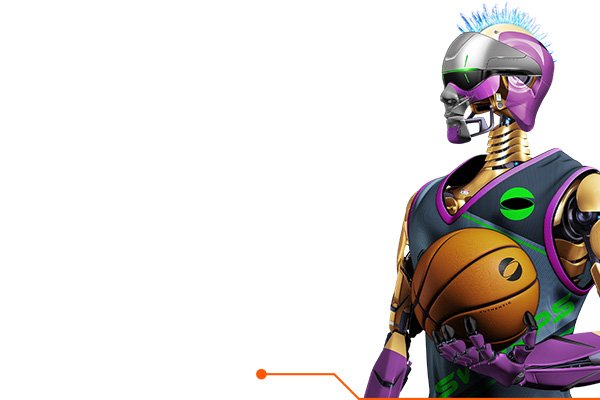
Swoops: For it to be successful, Swoops can’t just be a small niche basketball Web3 product. It has to go a little bit bigger than that.
As you mentioned, you launched it at the beginning of 2023. Your audience continues to grow each week. Through that, you’ve been getting a lot of feedback and a lot of different parts of the game mechanics that could be improved, pieces that could make the gameplay faster, or different elements that get people wanting to come and play more. One of the product features that was brought up was the free-to-play. I know that’s been something heavy on a lot of the team’s mind of implementing and bringing that, and you’ve now done that. That’s coming out soon. Can you tell us a little bit more about that and some of the mechanics behind it?
That’s a pretty big and exciting inflection point for us. The first seven months of our company were focused on the core user, our 500 owners, making sure we nail product and retention before we think about growth and acquisition. To get to scale, we need to think about growth. To date, we have gated play by needing to own one of our player NFTs. The only two ways to get a player NFT are 1) Our seasonal mints, which are every thirteen weeks, which isn’t the best way to learn and enter the game. 2) Buy off of open seats, which also isn’t the best way.
I think about when I was a kid. If I never got to see or test out a gaming system or a game to then go and drop $50, $60 on it, it’s a tough value proposition. Now, we’re going to open up that gate and open up free-to-play so somebody can come in, test the game, see the community, get addicted, and then slowly and gradually get deeper into the game.
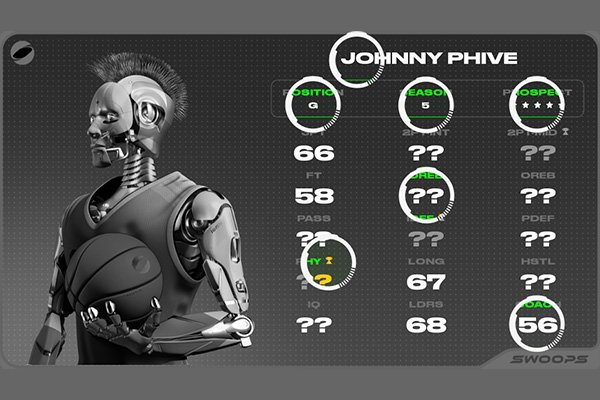
Swoops: We’re going to open up that gate and open up free to play, so somebody can come in, test the game, see the community, get addicted, and then slowly and gradually get deeper and deeper into the game.
The way that that works is that when someone comes on, they go through a very quick tutorial, and they are given an off-chain player. They get to experience the game as if they own this player. They can name them, they get to understand the stats and the data, and they put them in games and tournaments like everybody else. After a certain amount of time, it’s a week’s worth of playtime. They can upgrade that player from an off-chain player to an on-chain player, which means now they have true ownership and agency over that player.
That’s the nuance of the innovation that I’m so impressed with because I, as a player, go through the process of managing our team, naming our team, playing a different game, and seeing our team upgrade. You guys have thought about so many little details around that onboarding experience. You could have done that 20 other ways, but you chose to do it that way. Is there a secret gaming engineer that has worked on 100 games in your crew that came up with this idea or is this a bunch of brainstorming?
It’s a little bit of both. Our VP of marketing spent about half of his fifteen-year career at Adidas, so he understands sports. The other half is at Ubisoft. He spent a lot of time in the gaming world. I think he worked on Assassin’s Creed and a couple of others. He also worked at Sleeper, the fantasy sports app. He’s pushed us pretty hard into this world. Surprisingly, he is the one that comes with the least Web3 experience. That’s been super helpful as a counterpoint of view to some of the Web3 enthusiasts like myself. You need to think about and put yourself in the shoes of your future customers, not just the first couple of core users that got you there.
That’s a great segue to something I wanted to get into, which is your macro perspective on where we’re at with Web3. As an investor, a builder in the space, and a founder in the space now with your community, where do you see this current moment in time? How do you see Web3 evolving over the next few quarters?
It’s no secret that we are in a bear market. Hopefully, we’re somewhere near the low. The way that I think about it is we had this exciting false start. Everyone’s excited about the prospects of blockchain technology and Web3 and what that could mean. However, because of the excitement and because of a lot of those early abilities to make money, we got ahead of our skis a little bit. We were a small community predominantly focused on financial returns, which is not the long-term scalable real solutions we’re here for.
We need to see our way through that or churn out some of the folks who were here for the wrong reasons and get back to building things that are inspirational long-term. Also, to unlock things that we couldn’t do without that technology. I don’t know exactly where we are in that cycle. I think there’s probably another one, maybe two quarters of a little bit of cleanup or two steps forward, one step back, but then give it a couple of quarters and I think we’ll be set up for a real bull run. I don’t mean financially, but I mean in terms of seeing real builders and real innovation.
Do you see that bull run happening under the auspices of NFTs and Web3 from a localized level with emerging projects like yours? Do you see a lot more big brand collaborations and big brand dominance?
Where I hope it comes from and where I think it will come from is more from infrastructure and underlying technology. I am starting to see real innovations beyond basic NFTs, PFPs, and some of the base use cases, defi-finance that we’re seeing now. Things that I don’t know about that I’m not thinking of that will unlock dozens, hundreds, thousands of companies and projects that emanate from it. With that being said, there will certainly be plenty of localized winners, though I don’t think we’re going to see another bull run in the PFP space.
On that one point, we’ve seen this rise of friend tech. If you’ve missed it, you haven’t been on Twitter, but it could be another version of BitCloud. We don’t know where it’s going, but these things happen quickly and some of them don’t stop ever. Axie Infinity had a long run and it catapulted so many different permutations in the industry. To your point, these things happen when you least expect it and the confluence of those types of projects creates a new paradigm for the industry.
I’m totally with you. My only concern with projects like Friend. Tech and Axie back in the day, the majority of people you spoke to who were trying to explain what it is early on were about the money they were making. Their growth was fueled by speculators, which is fine if there’s a long-term plan to transition to something real, but if that goes on for too long, we know what happens when that party stops and the party has to stop. That’s where we’ve been left with a lot of these projects that didn’t think about their second act.
With Mocaverse, for example, they were just on the show. They’re launching their first season of a new ecosystem game. It’s totally about having fun. It’s not about sort of the financial side.
You made a comment about the waves of popular trends within this domain and PFPs being a part of it and maybe the end of an era there. Of course, certain things will stick around culturally. Tell us a little bit more about why you see utility, which you’ve baked in clearly as part of this, as the essential element you can play without anything being on the chain. Why is that so important in the realm of gaming and elsewhere?
I’m going to take it from a different direction. I think gaming has inherent utility. Whether there are assets attached to the game are Web2 or Web3 is a little bit of a different question. When it comes from a basis of NFTs and assets, without utility, you’re only left with a couple of different values. One, it’s pride, status symbols, and collection. I believe that’s a pretty small market when you start narrowing it down to these niche communities and digital collectibles only. Also, you have entertainment, which is pretty powerful but also can only take you so far.
I think we’re only scratching the surface of what actual utility means. It’s pretty basic of, “I can do something with this other than sell it to somebody else for more capital.” I’m super excited to understand what that means and ideally how it connects to the non-Web3 and the digital world. What utility does it have potentially in the real world? That’s what I’m excited to see.
Sure.
I just signed a deal to sell my car.
Fill and help.
That’s for sure.
Thank you so much.
Thanks a lot, David.
Multiplied.
Rich is a gamer. What do you think, Richard?
It’s @ManishSinhaha.
Nice.
Early mornings, baby. Let’s get it.
Important Links
-
Twitter - @ManishSinhaha
-
Twitter - @DavidRGoldberg
-
@EdgeOf_AI - Twitter
-
LinkedIn - Edge of AI Podcast
-
iTunes - Edge of NFT
-
Spotify - Edge of NFT