Top Podcasts
Stephan Nilsson Of UNISOT - The Supply Chain Sustainability Company Utilizing Blockchain, Plus: Moonbirds Signs With Hollywood Talent Agents UTA, Logan Paul's Cryptozoo Mess, And More...
The supply chain aspect of blockchain may not be the sexiest of them all, but it might be the most memorable one. Stephan Nilsson acknowledges this rarely discussed fact, serving as the main driver for him to start his company, UNISOT. He joins Jeff Kelley, Eathan Janney, and Josh Kriger to talk about the story behind the first enterprise public blockchain solution in the world. Stephan explains how they help make supply chains more transparent, efficient, and sustainable through a centralized data system with zero barrier to entry. For this episode’s Hot Topics, they talk about Moonbirds partnership with Hollywood talent agent UTA and Logan Paul’s recent mess with CryptoZoo NFT project, which allegedly turned out to be a scam.
Listen to the podcast here
Stephan Nilsson Of UNISOT - The Supply Chain Sustainability Company Utilizing Blockchain, Plus: Moonbirds Signs With Hollywood Talent Agents UTA, Logan Paul’s Cryptozoo Mess, And More…
Hi. This is Stephan Nilsson of UNISOT, the revolutionary Web3 supply chain sustainability platform. I’m on the show that brings you all the best intel of the blockchain revolution. Keep reading.
Stay tuned to this episode to learn why the supply chain on the blockchain may not be sexy, but it might be the most memorable element of blockchain out there now.
Also, how our guest knows for certain who Satoshi Nakamoto is.
How Moonbirds is going Hollywood by signing with a world-class talent agency. All this and more on this episode.
Finally, NFT LA 2022 was a blast. It was also a blast off in a giant plume of bright burning rocket fuel Web3, NFTs, blockchain, decentralization, and a sweet of immersive new tech developments that have exploded onto the canvas of life. Outer Edge is the theme of this year’s event dedicated to those of you building with us at the outer edges, making the future happen.
The community-centric gathering returns to Los Angeles from March 20th to the 23rd, 2024 to uplift creators and technologists through interactive experiences. There will be a wide variety of discussions and presentations and entertaining surprises that transport participants to the outer edge of what’s possible when we co-create a new paradigm. Embracing the decentralized web, artificial intelligence, extended reality, and more. To register to attend or learn how to co-create an experience on the outer edge, head over to OuterEdge.live. The event is being organized by the Edge Of company and us founders of the Edge of NFT show.
This episode features Stephan Nilsson, Cofounder and CEO of UNISOT, the first enterprise public blockchain solution that makes supply chains more transparent, efficient, and sustainable through global traceability. Stephan has 30 years of professional and international IT experience, 20 years of technical SAP experience, and 5 years of experience as a Mechanical Automation Engineer and Technical Instructor.
UNISOT is a revolutionary Web3 supply chain sustainability platform, built on over 30 years of experience from enterprise business integrations aiming to change the way global supply chains operate. It emerged from the well-established business processes in enterprise resource planning systems like SAP and is revolutionizing the field. Stephan, it’s a pleasure to have you here on the show for this special sponsored episode. Welcome.
Thank you very much. Looking forward to having a chat with you guys and talking about NFTs.
You guys are helping leverage these P2P blockchain benefits and making services more traceable. Can you explain exactly how that works and how it came into being?
I don’t have 30-plus, 20-plus, or 5. I think I started working in the ‘80s, so I have many years of experience. I’m not 100 years old yet. For the last several years, I’ve been working as an SAP Integration Architect. SAP is the biggest ERP backend system that all big companies are using. I was then working on building interfaces between companies that have SAP for their customers and clients and suppliers and other partners in the supply chain.
I have always been working with this integration one way or another and I realized that after a couple of years in that profession, I came back to the same customers over and over again to rebuild the interface because they have changed the supplier or they have changed the distribution partner or something. I have to go in there again, design a new interface, test firewalls, permissions, and all of this. That could take from a couple of weeks to a couple of months, very expensive, time-consuming, and unsecured.
What that leads to is that companies now are not exchanging as much information as they could. It’s not like we humans. We can use Facebook, Twitter, Google, and all of that and exchange tons of information back and forth. Companies do that. They need secure communication. I thought that there must be a better way than to build point-to-point interfaces between systems.
I read this white paper from a strange guy called Satoshi Nakamoto about Bitcoin and blockchain and I got this blow-my-mind event that what if we could use this decentralized blockchain as a global data layer for every company in global supply chains where they can connect without having to ask permission to anyone but connect to this data layer and exchange information on that?
Back in 2014, I got an opportunity for a new job in Norway. I’m from Sweden myself and got this opportunity for a job in Norway. When I went to an interview for this job here, I was talking a lot about how I wanted to integrate this SAP system with the public blockchain and they had no idea what blockchain was and needed this SAP or anyone else more or less.
I got a job. I took the family, moved to Norway, and started working on a proof of concept where I built a vending machine home in my garage here, a wooden box with a Raspberry Pi computer on it, a touchscreen, and two servers so I could pay with Bitcoin to that machine. I got a box of sweets out. The interesting thing was I had also built a module inside of SAP that was connecting to the blockchain and monitoring.
When I paid for this machine with a Bitcoin, I got the box of sweets out, but then SAP created a sales order and SAP also kept track of the magazine level in that vending machine. When the magazine went to empty, SAP created a replenishment order. By doing that, I proved to myself that I could integrate this super-decentralized SAP system with this super-decentralized blockchain.
I worked on that for a couple of years in my free time and holidays and so on. After a while, I realized that I have a solution here. I have something I can go to market with. I quit my job at Ernst & Young and got some funding and built a team and then we built this platform that is then called UNISOT. UNISOT is short for Universal Source Of Truth. It’s a grand name, but we see this public blockchain as the universal source of truth that every company can use.
We work like you have an internet service provider where you can connect to the internet. We are more like a blockchain service provider where we can connect companies, business systems, production systems, or accounting systems to this public blockchain. This is how we started and that’s now what we are providing in this. I can keep it short here and then you have more questions.
It’s impressive. I can imagine your neighbors coming over and saying, “You built the machine. You can get it out. You don’t have to pay Bitcoin for your thing.” Meanwhile, you’re revolutionizing supply chain management. I’m also curious from the perspective of fun with the project. Did you have raspberry pies in there as the actual sweet that you can eat?
I get that misunderstanding sometimes. No, it was a Raspberry Pi computer. It was a small box of sweets.
That is impressive and fun. I wish you were my neighbor.
The first time I was able to, I was sitting on my desk having all this Raspberry Pi computer connected to some smaller servers and stuff. When I then made a Bitcoin payment, waited two seconds, and then suddenly, my server was moving and like, “It works.” Connecting that, building the module in SAP, and getting that to get work together. Now I had this SAP, I had a vending machine that I called an autonomous machine and a blockchain and to get all of that work was mind-blowing time for me, which now has resulted in the three companies that you see there.
This is one of those use cases we like to talk about where we say, “There are so many cool things happening on the blockchain,” and it’s not a sexy one. It’s not the one that’s going to get the glitz and glamor.
I think it’s sexy.
It’s not the one that they’re going to cover in the press normally, but it’s one of the best use cases.
It’s a little bit, not my problem, but you get so much press for all of these Bored Monkeys and that stuff. Here I’m working and I have the world-revolutionizing thing that is helping the world to make a supply chain more sufficient or efficient and nobody talks about it.
We do it on the show here or there. We do appreciate that. We did try to elevate and of course, we’re happy to talk to you. There’s one part of your vision here that we want to dive into a little bit more. That’s the idea of this being a zero barrier to entry. What does that mean to you and how will that impact the future of your work?
Since I worked as this integration architect helping the company to integrate, I realized that we have to make a system that is very easy and cost-efficient to connect to. Normal companies are not interested in putting up a node, running a node, or putting together a consortium with other companies, and trying to decide about a consensus mechanism. They don’t care about that. They have a problem that they need to solve their efficiency in the supply chain or the food or product security. They don’t care about that.
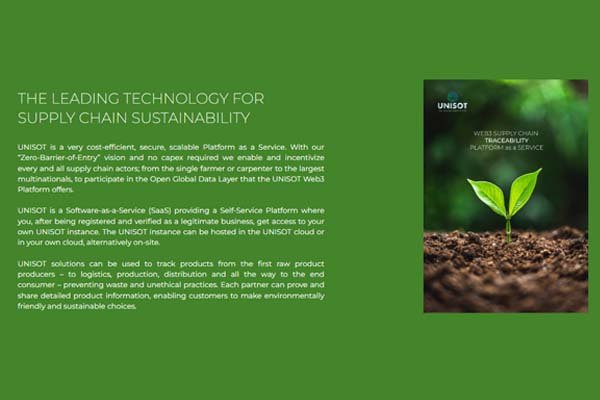
Supply Chain: Normal companies are not interested in putting up and running a node, or setting up a consortium with other companies to decide about consensus mechanism.
What we mean by this zero barrier of entry is that it should be super simple, quick, and cheap to start connecting your system to the blockchain. We have a plugin for SAP. Since I started building this in SAP, now I have taken out the main system. That’s now a system by itself. I still have this module in SAP. When we come to a customer who has an SAP system, we say, “Here’s a plugin. Plug it into your system. Now you’re connected to the blockchain. Done.” It’s done in a couple of hours and then we can extend on what functionality and so they want to use and how they want to exchange information with other companies.
Making it easy. The easy button.
A plugin. Here you are. You’re done.
What tools does UNISOT use to offer access to a reliable and secure universal source of truth so that all parties can tap into that and handle the challenges?
As I said, regarding the plugin that we have for SAP, we also started working on a plugin for Microsoft and we realized that we cannot build a plugin for all systems. That’s our goal to have plugins for every single system out there, but that’s going to take too long. We are looking for consulting partners who are already working with Oracle or some other system that our customers are using and build these plugins together with them.
We have an API so a company can connect with the API. We are selling the services either as software as a service or a platform as a service, whether they connect to the backend API. We also have an SDK the company can use to connect our system to the blockchain. We have an IPA with a number of blockchain functionalities where we then can create what we call smart digital twins, which is NFT technology but maybe a more advanced way.
Let’s talk about that a little bit. We’ve heard the phrase digital twins used here or there in lieu of NFTs. How does that impact your work?
The digital twin is an old term that has been used in SAP and other big systems before in the construction industry and everything. You create a digital twin in a database or in our case with we create a digital twin of a physical object in the blockchain. We are using the public blockchain where we can use smart contracts. We call it smart digital twin because we can put some scripting in there. I don’t like the term smart contract because they’re not smart and they are not contracts. They’re a script that executes some payments or you can run whole programs here.
We call them smart digital twins because we also trying to stay away from the NFT craze with the crypto industry. That’s exactly a big problem for us when we go out to companies and we are describing it. Here, you have a system that can make your supply chain much more efficient. We are cost-efficient and so on. When they start asking us how we do this and we talk about blockchain and then it comes up directly, crypto, blockchain, NFT, and all these. We have to spend some time explaining what all of this is. It’s not crypto, it’s not NFTs, it’s something else. That’s why we call it smart digital twins instead of NFT because it raises so many questions.
It’s fascinating and it’s useful to have perspectives like this, whether we think it’s sexy or not. I also find it exciting. I could imagine myself. I’m building this thing in my garage. They got the Raspberry Pi and everybody’s like, “What’s that?” The thing about it is that despite the controversies around blockchain, the reason you’re selling this to people is not because of this blockchain, it’s in spite of it. It’s because there’s a business use case. People would not be paying for this unless it was saving them money, making their business more efficient, or generating their money.
For our customers, it doesn’t matter if it’s a blockchain or whatever we are using in the backend, but it’s the characteristics and the functionality that this global public blockchain can provide. That was my dream. Before I thought about blockchain or so, I thought the dream scenario in an enterprise world with supply chains should be to have one central global database to that everybody is connected to. Everybody had the same data in this central database, but a lot of company has been trying to do that.
SAP, Microsoft, Oracle, IBM, everybody has been trying to build this centralized data system or database that everybody connects up to, but probably it hasn’t worked for the last ten years. They did the same mistake with trying to implement private blockchains. Specifically, IBM now with TradeLens and their system as they’re trying to put in a private blockchain.
I used to say that there is no such thing as a private blockchain. If you have a private blockchain, it is a replicated database with a fancy replication mechanism. It’s replicated database point. A blockchain, per definition, has to be public. That was the invention that Satoshi Nakamoto presented to us to have this distributed database. It is public and that is the security that it is public that nobody can go back and change anything. There we are.
You’re calling it a universal source of truth. That’s why you can have that via the public nature of it. We have this term supply chain sustainability. I know about supply chains and sustainability, but what does this full term entail and how are you making use of it?
Often people think supply chain is some truck driving around, but supply chain is everything. It’s everything you own. Your clothes, your electronics, your computer, your food, everything that you haven’t grown in your garden or built in your garage comes from a supply chain. Someone produced it, someone transported, someone changed it, someone stored it, and someone sold it. There’s always this huge supply chain of different companies working together.
Chain is also a bad word because it’s not like one chain, it’s a whole network, just like blockchain is a whole network. Every supply chain nowadays where we think from seed to plate or from fish to plate or the whole line has a global efficiency of less than 20%. Eighty percent is waste in any supply chain now. The best country in this is China. They are the best. They are on 20%. Second best countries, of course, Germany on 17%. The rest of the world’s supply chains have less efficiency than 17%, which means 80%, 85%, 90% is waste in any supply chain. As we know with food, 50% of all food that is created is destroyed or not used.
Can we break this down a little bit? All of the places where you lose that efficiency, I’m thinking of that, but I’d love for you with more expertise in this. I’m thinking there’s the packaging. I’ve got packaging and gas. I’ve got even the time and energy of someone putting it in the packaging and unloading it for the packaging. I shipped this head of broccoli and nobody’s going to eat that stem. They’re going to cut it off and throw it in the compost or whatever. Am I coming up with all the right ingredients there or are there others that I’m missing when we think about the number that goes into that efficiency?
If we’re talking food, there is a lot of waste. As you said, in fruit, vegetables, and everything, the bad part is cut away or the whole thing is too bad, so they throw it away. We produce so much food that it’s crazy. The biggest problem is that every company nowadays is very efficient by itself. Every company now is working with blinders. They only get information from their immediate customer supplier and they give information to the immediate customer.
Outside of that, they have no idea what’s happening. It’s a black universe out there. I can be a producer and I don’t know what’s going to hit me because I only get information from my immediate supplier. I don’t have information from his suppliers. The same thing, if I can make a product that has super good quality, but I only have control of this quality until it leaves my warehouse when comes onto a truck and so on. I have no idea what happens there.
This is exactly where we can help with the global public blockchain. With this system, I can now, as a producer of a product, subscribe to information from a supplier and I can follow my product through this distribution and supply chain and so on. A good example is since we are based in Norway, we built this solution called Seafood Chain for the seafood industry. Let’s say you can be a very good producer of Norwegian salmon. It can be the top quality in your warehouse. However, if you send it out with an airplane to Asia or somewhere in Japan or so maybe this cargo is standing in a hot airport for four hours and you have no idea and half of it is rotten when it comes to the destination.
By using our system, you can integrate an IOT sensor. We put the IOT sensors on the fish boxes, for example, which register the temperature all the way. Now a producer can have control of the temperature on the cargo the whole way, even when it has left their physical control. They still have digital control of that. What’s missing now is communication between companies. That does not exist or it’s very little. Blockchain can help with that.
What we provide with our solution with the public blockchain are two things. I mentioned this. The global data layer that blockchain is. The second thing we provide is the monetization of information. We can allow a company now to start selling and buying micro information for a microtransaction. They can start selling one temperature or one location or one weight for tenths of a cent or $0.01 or hundreds of a cent to anyone else in the supply chain who could benefit from that information.
That’s so much waste. I had no idea.
Me neither before. It’s incredible.
Yes.
It’s a Commodore 64. That dates me a little bit.
I have no Google things at all.
What do you use? Is there a standard system?
Do you experiment with like autopilot?
Yeah, it works wonderfully. It’s incredible.
I don’t believe you. I think you’re lying.
It’s a hard one.
Who’s the creator? Satoshi Nakamoto?
Yes.
We don’t know who it’s. We have to dive in there.
Is there another name that we should know?
Time will tell. We don’t know that for sure.
House is losing too. Everybody gets consumed.
That’s it for our Hot Topics.
Sorry for ripping them.
Thank you very much.
Important Links
-
Theory of Bitcoin – YouTube
-
LinkedIn – UNISOT
-
Twitter – UNISOT
-
@BitcoinDevotee – Stephan Nilsson Twitter
-
Spotify – Edge of NFT
-
iTunes – Edge of NFT
-
Instagram – UNISOT
-
Facebook - UNISOT