Top Podcasts
Shelly Palmer Of Metacademy, Where You Earn To Learn About Blockchain, Plus: Amazon’s Rumored NFTs, And More…
Want to learn about blockchain and NFTs the risk-free way? That is what Metacademy is all about. Today’s guest is Shelly Palmer and he has been helping educate the masses about the meaning and possibilities of Web3, the metaverse, AI and much more. In this conversation, he explains how the free educational platform he co-founded does what it does best. He also shares incredibly informed analyses on the emergence of advanced AI tools like ChatGPT and what it means for the future of the industry. Plus, Shelly and our hosts trade their thoughts on Amazon’s rumored NFTs. All of these and more in this episode of Edge of NFT!
Listen to the podcast here
Shelly Palmer Of Metacademy, Where You Earn To Learn About Blockchain, Plus: Amazon’s Rumored NFTs, And More…
I’m Shelly Palmer of Metacademy, the platform where you can learn about all things NFT risk-free. I’m here at the Edge of NFT where you can educate yourself on what’s cutting-edge now and beyond.
NFT-curious readers, stay tuned for this episode and learn how our guest is helping to educate the masses about the meaning and capabilities of Web3, the metaverse, AI, and much more, why our guest thinks Amazon is like an alien with acid for blood that can take on any new challenge and come out ahead, and why the only grudge you want to keep is against grudges themselves. All this and more on this episode.
Finally, NFT LA 2022 was a blast. It was also a blast-off in a giant plume of bright burning rocket fuel. Web3, NFTs, blockchain, decentralization, and a suite of immersive new tech developments have exploded onto the canvas of life. Outer Edge is the theme of 2023’s event dedicated to those of you building with us at the outer edges, making the future happen.
The community-centric gathering returns to Los Angeles from March 20th to the 23rd, 2023 to uplift creators and technologists through interactive experiences, a wide variety of discussions, presentations, and entertaining surprises that transport participants to the outer edge of what’s possible when we co-create a new paradigm, embracing the decentralized web, artificial intelligence, extended reality, and more. To register to attend or learn how to co-create an experience on the Outer Edge, head over to OuterEdge.live. The event is being organized by the Edge of Company and us, the founders of the Edge of NFT. See you there.
This episode features Shelly Palmer, the Cofounder of Metacademy, the world’s first platform where you can earn while you learn about cryptocurrency and NFTs. Shelly is the Professor of Advanced Media in residence at Syracuse University SI Newhouse School of Public Communications, CEO of The Palmer Group, a consulting practice that helps Fortune 500 companies with technology, media, and marketing, and Cofounder of Metacademy, a free educational platform that teaches practical applications of blockchain, crypto, NFTs, Web3, and the metaverse. Shelly, welcome to the show.
Thank you. What a nice intro. I’m going to record that for my wife. Put that in the loop.
Shelly is a great guy. Give him a break.
That’s some great subject matter. It’s all stuff near and dear to our hearts. Shelly authored a couple of big books like Blockchain - Cryptocurrency, NFTs, & Smart Contracts: An Executive Guide to the World of Decentralized Finance and also Television Disrupted. Even though they’re different subjects, there are a lot of commonalities and some of the underlying themes there, especially as it applies to the world that we’re in or the current market, which is evolving so quickly. We would love to start there and get a sense of insights from those texts into our world and this market. Everything is moving so rapidly.
First of all, thanks for mentioning the books. Realistically, everybody is a content company. Everybody is a media company. All communication now fits into one big bucket. It doesn’t matter if it’s just you and your smartphone or you and a film crew. You have one job, and one job only. Oddly enough, it’s the same job. Forty-five thousand years ago in a cave in Spain, someone took some red goo and put their handprint on a wall. The job of that media was to be seen. Whoever did that wanted someone else to see it. First, they wanted to enjoy it for themselves or they wouldn’t have done it, and then they wanted other people to see it.
Realistically, everybody is a content company. Everybody is a media company. Click To Tweet
The technology they had at the time was red goo on their hand, and you had to go into the cave to see it. Now, anybody with a smartphone can do anything they want. It’s available to every 1 of 4 billion people on Earth almost instantaneously and the other 2.5 to 3 billion that could potentially see it who are conscious enough and old enough and could get to it at a certain point. You go from, “I must go in the cave to see the technology displayed,” to, “I can reach every person on Earth that’s connected.”
The change isn’t what. It’s how. Everybody forgets that first and foremost, you need to have something to say. You have to want people to understand what you’re feeling and realize that in a way that they can feel and understand what you are feeling or understand. The idea of the right person, the right place, the right message, and the right time has never changed. All of my books are about that, first and foremost. The methodologies, the workflow, and the process you will use in the modern era or in what’s coming over the horizon will change the way you think you should do it and help you do it in a more efficient and effective way. That’s what the books are about.
We have to talk about ChatGPT if Shelly is on the show at some point. That’s a good teaser right there.
We will get there.
It’s a favorite subject, as you can imagine.
It’s on our roadmap for the day. That’s a well-crafted answer, Shelly, as the university professor that you are. It’s delivered concisely.
I teach in the Master’s program at the Newhouse School. I teach a course called Advanced Media Business. There’s a Master’s degree called Advanced Media Business there. They hired me to help teach it.
I like Nassim Nicholas Taleb’s approach to professorship. He’s a quarter-time or a halftime professor or something like that. He says that’s all he wants. He wants a nice academic environment and all that but not all the logistical responsibilities and politics of the whole system.
I can’t imagine politics at a university.
It’s certainly there. Whether it’s inside of the traditional academy or outside, education is important to you. I’m sure that’s a big part of what’s behind founding Metacademy. People can learn about how blockchain works and how to send crypto, mint NFTs, and lots more stuff. How did this come into being? Why do you feel it’s such a powerful tool here for the future?
It’s such an interesting story to me. In 2018, I’ve collected a bunch of essays. I write a newsletter every day. It’s a very large mailing list. I’m lucky. We have been doing it since 1996 every single day. During the week, it’s a rant and synopsis of the news stories that have my attention. On Saturdays, it’s either a full day of AI. It’s either AI Saturday or Web3 Saturday. It’s a synopsis of those interesting stories. Saturdays are off, to tell you the truth. I grab all the things that were good for the week. On Sundays, I write a thought leadership piece. That’s what I do on Saturday. I spend a couple of three hours writing 1,500 words or something like that about something that I care about.
By 2018, I had written a bunch of fairly good essays about blockchain, cryptocurrency, smart contracts, and pretty much the whole world of DeFi. I wasn’t thinking much about it, but I had these essays. They were all on ShellyPalmer.com online. I had collected them. We were going to make an eBook, and then we got busy doing something else. At the end of 2019 and early 2020 or the year of crypto, everybody was crypto-crazy. NFTs exploded. We went back and said, “We should probably collect the writings and throw an eBook online so that people know that we know what this is.”
We have been doing supply chain, fraud prevention, and all the things you do with tokenized content for our media company clients. NFTs were the same tech but a different animal. They had a lot of consumer hype around it. I thought I would put together the book. Thank you for mentioning Blockchain - Cryptocurrency, NFTs, & Smart Contracts: An Executive Guide to the World of Decentralized Finance. I was going to give it away for free. That was my plan. I collected it, made a little cover, and did the whole thing you’re supposed to do. I thought, “Make an eBook on Amazon KDP. I’ll put it in Kindle Publishing.”
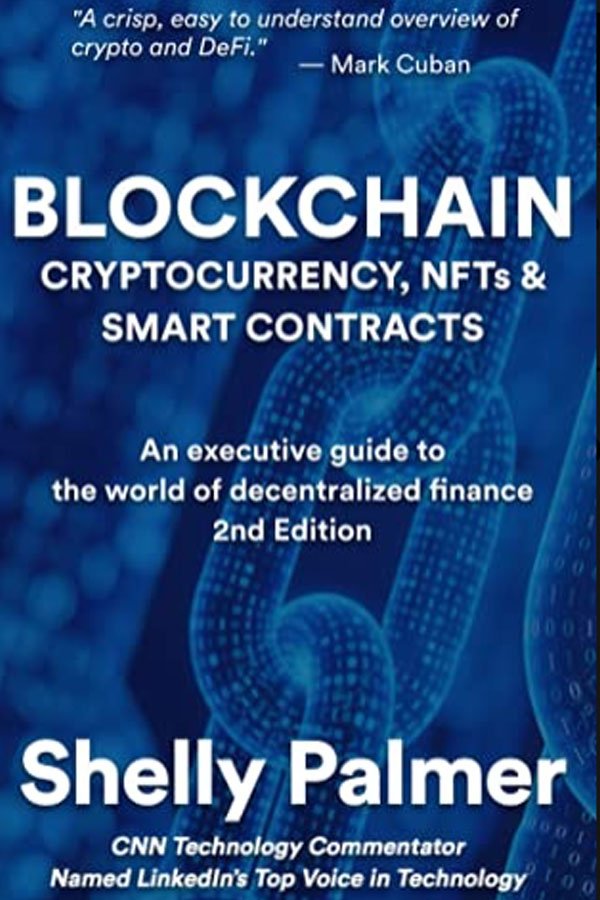
Blockchain - Cryptocurrency, NFTs & Smart Contracts: An executive guide to the world of decentralized finance
I’m up there and I’m uploading the thing. I do the cover and everything you’re supposed to do. It starts asking for SEO. I’m like, “I teach SEO. I do it for a living.” I spend an hour. I have all my tools and everything I know how to do to SEO this to death. I change the title slightly and put it up there. Amazon says, “What’s the price?” I’m thinking, “Free.” Amazon is not thinking, “Free.” It’s $2.99 or $7.99, “I’ll put a number.” I put a number, go to sleep, and don’t think about it anymore. I woke up the next morning, and we sold 35,000 copies. The book was number one in three categories. I’m like, “What?” This was 100% about the title. Honest to God, if I was trying to do this, I would have failed miserably.
All I wanted to do was put a value on this. I figured, “You’re getting a $7.99 book for free or a $2.99 eBook for free. It’s good marketing to give away something that has value.” The first moment I put it up, I needed to do the second edition because things had changed that week, and I needed to update them. Updating an eBook is no problem at all but updating a little paperback requires new pagination. They have to approve it. On Amazon, that is a week-long process of pain. I was like, “I’ll do this second edition.” We’re in the 19th edition but it’s still called the 2nd edition because we’re having an argument with Amazon about the cover.
Why am I telling you this story? It occurred to me that all this content ought to live on in a learning management system, so I could keep it updated every single day and that when something changed overnight, it would take me 30 seconds to go into the CMS and change it. We could use it as a teaching tool for all of our executive clients. We do workshops and seminars for our Fortune 500 clients. We can work right off the screen. They don’t have to have the book. The book doesn’t have to be out of date. I can give them a blank notebook to take notes that they don’t want to take notes on their PC. That’s how Metacademy was born.
It’s an easier way to keep stuff up to date. That’s the whole purpose. We’ve got a bunch of courses. The NFT and crypto are up as are a bunch of others. We’re about to put up Web3 and the metaverse. We’ve got another course of study that’s a little more eclectic called Prompt Crafting, which is about properly crafting prompts for generative AI, whether it’s AI or pre-trained transformers like ChatGPT where you’re learning to coach it and give you the best possible most efficient outputs. That’s what Metacademy is for so that we can teach the most current information all of the time.
That makes so much sense too. Every time the concept of the metaverse and what it’s going to look like comes up, I’m always like, “It’s going to look like what works for people. Usually, it’s going to not look like what we already do.” The answer to the metaverse is not a lecture hall in the metaverse. You can have a lecture hall in real life. In the metaverse, it’s better to have people up close and not pretend like you’re in this huge room with an echo in it or something.
We have a very different set of thoughts about the word metaverse, which is undefined in every way. Web3 is also undefined. If you ask anybody, they’re going to tell you what they think the metaverse means. That’s not good for anybody, to be fair. We define this every time we talk about it. The way we look at it is what I call the observable metaverse. The observable metaverse goes from augmented reality on one side. Augmented reality starts with a heads-up display in your car, or maybe holding your phone up and seeing something superimposed over the image that your phone camera is showing you.
Some data is being surfaced that augments your experience. That’s one side. We move closer to extended or mixed reality where there may be haptic feedback. You may be in a retail environment. Maybe the end cap is changing. It doesn’t need to be with goggles or glasses. Maybe it’s a projector or a screen. The key part of this is that there are a bunch of different data sets. There’s batch data in the CRM system at the client that has a single view of the customer.
There’s the network topology of the wide area network. It understands where you are and what you’re doing. There’s the local area network that is very much attached to you and your device. There’s whatever you’re using for edge computing, whether that’s goggles or your headset. All of these data sets have to be brought together in near real-time to surface the data that’s going to build the experience that we’re talking about. In our world, the observable metaverse starts at AR, goes to mixed reality and extended reality, which have similar definitions, and then ends up in virtual reality or virtual worlds.
When most people say metaverse, they mean virtual worlds. We have what we call the standard model of the metaverse, which is all the technologies in columns that you need to create everything we described from augmented through virtual reality. All of this is usually conflated rightly or wrongly because there’s no accepted and agreed-upon definition. All of this is usually conflated with some weirded-out definition of Web3. There’s no agreed-upon def, but the way we think about Web3 is a decentralized platform that will allow both users and creators to share in the value they create.
That’s a pretty broad way to describe it, but the key there is decentralization. If you’re saying to me that metaverse means Roblox, first of all, it’s Web2. It’s fully centralized. It’s in a browser. There’s nothing Web3 or metaverse about it. If that’s your definition, then your definition is an online graphics game that’s world-building where you’re building virtual worlds. Virtual worlds don’t need to be decentralized to be played. It’s not what you find a point in it. We try to be very precise when we define these things because we’re building for clients with real money for real outcomes.
You say, “I need a decentralized environment to do what.” Most brands are central authorities. Where does decentralization come in? You would like the secondary market for NFTs to be capable of being traded in a trustless environment. I would like that. If you are going to put together a DAO or some kind of ownership model, you might need to be able to trade in a decentralized way. If there’s decentralized governance, there are a bunch of good reasons to think about the decentralization of your business model, but most of our clients are central authorities. They’re big brands.
What makes them essential authorities is that you trust them. It’s not a trustless environment. It’s exactly the opposite. If you’re a big sports league or if you’re Top Shot, the NBA is the central authority in the United States about basketball. The NHL is hockey. The NFL is football. There’s no bigger central authority in football than the NFL. What is decentralized now exactly that you want to do? Come and bring me your use case and the business outcome you’re trying to achieve.
That’s why I feel like everyone is using these terms all over the place and pretending they know what they’re talking about. Every time I say to somebody, “What do you mean? What are you trying to achieve?” I get a lot of word salad back because these are definitions that you need to state when you start the convo. For us, the metaverse as we look at it is a data play. Turning those data sets into action and surfacing these experiences is the future.
How you do it is way more complicated than how I said it. From a Web3 perspective, the key there in Web3 versus Web2 is decentralization. If you don’t have the decentralization schema that you need, then you might as well do it with a well-structured database and a secure password in Web2. It will be faster, cheaper, and more bulletproof by definition. I sit in a different place than most of our friends that are deeply into the word salad and less into the business outcomes, to be fair.
That’s very useful too. Part of the reason I brought up the concept, in general, was around the function. Functionality is what’s most important in all of these things. People sometimes miss it. My point, too, is when you talked about how you’re releasing this book and turning it into online courseware, I’ve seen this. Look at Malcolm Gladwell. He puts out an audiobook. It’s got recorded quotes from the people instead of him reading the quotes. Why not do that?
It’s wonderful.
Why not add music and all these things? That’s what you’re doing. Think outside of the box and create what you can that’s most functional for what the users want out of it. It’s beautiful and elegant.
Learn About Blockchain: Think outside of the box and create what you can that’s most functional for what the users want out of it.
I’m a big fan of Metacademy personally. I’ve recommended it to a number of folks. Oftentimes, I’ve been asked the question of speaking and various things, “Where do people go to learn?” There’s a lot to unpack here. Metacademy is a great learning environment that you’ve created. I appreciate what you’re doing there. There’s another set of definitions we should unpack while we have the professor on our show. Why not? That’s about synthetic media, which is a topic that you’ve spoken about quite a lot. I would love to delve into what’s different or similar about it to generative synthetic media.
We are very familiar with synthetic media. Everyone is an expert in it, to be fair. Whether you know you’re an expert in it or not, everybody is from the first time you saw anybody in a science fiction movie or TV show and went, “That looks fake.” As soon as you said, “That looks fake,” what you were doing is you were criticizing the people who created the synthetic media. In 1977 in Episode IV - A New Hope in the opening scene, the Star Destroyer is coming over your head. You are out of your mind when you see it in the theater for the first time. You don’t even know what to do.
I was sitting in the third row because we got there late. We might have been sitting in the second row. I had never seen anything like it. Lucas filmed it with motion control. That media can’t exist outside of that experience. You needed to be watching it on a screen. There are no Star Destroyers, and they don’t fly over your head normally. We’re all experts in synthetic media. The way you create something synthetically now is very well understood.
You will use every tool you can get your hands on. You will use digital audio workstations and digital video workstations. You will use AI-assisted or generative adversarial network tools to build whatever it is you’re building. You will animate. You will use computers and everything you can to build these experiences for people to see. The original movie Avatar or the first one is a synthetic world. It’s gorgeous. It’s unbelievable how much time and energy they spent making this thing.
I’m doing this tongue firmly in cheek.
It’s with great feedback loops too.
That has awesome written all over it.
A fellow musician is Eathan.
I worked at Sam Ash for a while out of college.
It’s the enemy.
I didn’t. I bought it from a wholesaler.
From the enemy.
It’s my house in Vermont.
It’s getting colder over there.
It’s a little chilly.
It’s time to sell Vermont, folks.
I’m a piano player.
Insatiable curiosity.
Grudge holding. That’s easy.
That’s a good one.
I like that one too.
That’s a big one.
It’s not that I’m too much of a Star Wars nerd.
I’m you planning to be out there.
I’m in.
It will be awesome. Scott Page is on saxophone.
What a gut punch.
I hope not.
I couldn’t have said it better.
ShellyPalmer.com is the easiest place. Go there and sign up for the newsletter. You can get to Metacademy there. It’s at Courses.ShellyPalmer.com. We would love to have you get our newsletter. I do a bunch of streaming events and other things that you can partake of. There’s plenty of free stuff there. Go to the website or follow me on Twitter @ShellyPalmer or Instagram. I’m easy to find.
I’ll check it out.
I love it.
Important Links
-
Orange Comet - Previous episode
-
Amazon may launch NFT Initiative soon - Article
-
@ShellyPalmer - Twitter
-
Instagram - Shelly Palmer
-
Spotify - Edge of NFT
-
iTunes - Edge of NFT