Top Podcasts
Robbie Ferguson Of Immutable — Australia’s Fastest Growing Tech Startup, Plus: Toni Thai Sterrett Of Bad Grrls Creative Club, And More…
Oneof the unique thingsGet to hear about Australia’s fastest growing tech startup as RobbieFerguson of Immutable joins JeffKelley, Eathan Janney, Josh Kriger on the podcast. Robbie started Immutable in2017 when he was 21 years old. Because of that, he was featured in Forbes 30 Under30. Immutable is an NFT platform that aims to bring asset ownership andcommerce alive in digital worlds. Robbie sees it as his mission to ensure that thedigital worlds we will soon live in will be as economically meaningful as theone we currently inhabit. Tune in as he gives us a glimpse of how Immutable isrevolutionizing the Web3 gaming experience as well as the game developmentspace. Robbie also explains why he sees gaming as a prototype for how we wouldbring about universal digital asset ownership for everything else. Plus payattention to Toni Thai as she talks about Bad Grrls Creative Club. All theseand more in this episode of Edge of NFT Podcast.
Listen to the podcast
Robbie Ferguson Of Immutable — Australia’s Fastest Growing TechStartup, Plus: Toni Thai Sterrett Of Bad Grrls Creative Club, And More…
NFT curious readers, stay tuned for this episode to learn what you canorder when you are at the Burning Man Hug Deli.
How our guest’s sauna might be strengthening the power of his alreadytoo-powerful brain.
How NFT street teams can act as community gorilla marketing. Don’tforget that we put together a gathering called NFT LA that brought outthousands of the world’s most innovative doers in the NFT space. Head on overto NFTLA.live to get tickets to ourbigger, bolder, and better but also as intimate and impactful event happeningin Los Angeles from March 20th through the 23rd, 2023. We will see you there.
—
This episode features Robbie Ferguson, President, and Cofounder of Immutable, a rapid-growth techstartup hailing from Australia. He started Immutable in 2018 at the ripe age of21 and has been featured as a part of Forbes 30 Under 30. Notably, Robbie wasalso awarded the Thiel Fellowship in 2020. Immutable is a $2.5 billion NFTplatform that has raised more than $300 billion from Temasek, Tencent, GalaxyDigital, and Coinbase.
As a global blockchain technology company, its mission is to bring assetownership and commerce alive in digital worlds through the power of Immutable,AKA unchangeable NFTs. Robbie previously built an automated capital gains taxplatform at KPMG, which was licensed to Australia’s largest cryptocurrencyexchange. After graduating high school as the equal-highest-ranked student inAustralia with a perfect ATAR, which is the Australian Tertiary Admission Rank,he has become obsessed with Ethereum. In 2015, he dropped out of a ComputerScience/Law degree at the University of Sydney to fund Immutable.
The Immutable Group is advancing the world of NFTs through ImmutableX,an industry-leading Layer 2 NFT minting and trading platform, plus Immutable Studio, an NFT gamedevelopment studio with leading titles Gods Unchained and Guild ofGuardians. Finally, Robbie believes that futuregenerations will spend most of their working hours in virtual reality and wantsto ensure that the digital worlds they live in are as economically meaningfulas the ones we currently inhabit. Robbie Ferguson, welcome to the show. It’s apleasure to have you here.
Thanks so much. I’m glad to be here.
In 2022, you launched a whopping $500 million fund to boost gaming onImmutableX. Can you share some project highlights and favorite moments sinceembarking on this journey to build true in-game economies?
That was a big moment for us and hopefully for the industry in terms ofsupporting high-quality games with true economies, which is what we have alwaysbeen focused on. Honestly, 2021 has been pretty insane for the company. We havegone from 80 people to over 300 full-time. We have gone from about 5 gamesbuilding in our platform to over 100 meaningful funded deals and then thousandsin our testing environment.
Over half of those have been in the last quarter. The trajectory of thisis steep. I probably can’t go over all the individual games that I’m excitedabout but there are a ton from publishers that are super exciting, whether it’sEmber Sword, Illuvium, which is one of the biggest Web3 games in the world, PlanetQuest, or IMVU, which is one of the largest legacy gray marketplaceeconomies in the world. One of the cool things I love about IMVU is that all ofthe monetizations have been through secondary clips.
They have been trying to recreate in Web2 what the future of a lot ofmonetization in Web3 is going to be for gaming, which is instead of selling assets,depreciating those assets later, and having this exploitative cycle, it createsa valuable economy over time, takes clips on it, and have the same incentivesas your players. They are migrating all future assets over to IMX, which isexciting. It will be one of the most played games from day one as soon as thattransition is complete over the next few months.
We have the CEO of Riot Games Asia dropping out and making a MOBA startup on Immutable, which is superexciting. We now have four MOBAs on the platform. That’s leading to competingwith some of the biggest Web2 titles. We have some pretty open economics andmetaverse plays as well, which I’m excited about, probably the more long-termuser-generated content-building perspective. I can dive into any of those butoverall, there has been a huge amount of games building on the platform, whichI’m excited to support.
It started with a card game, and then it’s 50-plus in Q3. That’s huge.
It’s 50-plus, which is more than the rest of the lifetime of the companycombined. Our goal is to build a product that is completely permissionless.Anyone can come and build a game. Aglet, which has hundreds of thousands or even millions of players, is builton our server. We didn’t even know they were building on us until we found outabout their usage. We went in to buy and started supporting them. That’s thepower of making it ridiculously easy to build on but then all of these gamesthat we have won are games that we are going out and deliberately believingwill have a successful future.
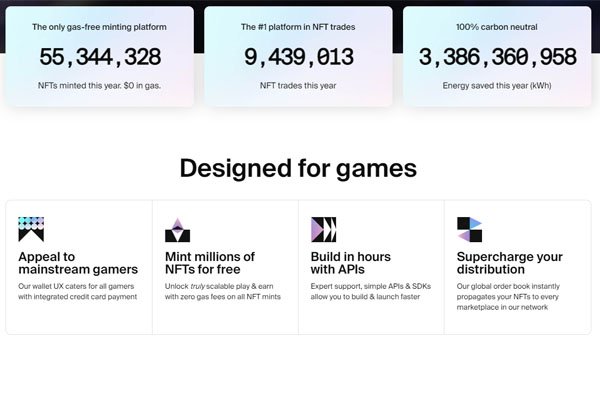
FastestGrowing Tech Startup: The goal is to build a product that is completely permissionless soanyone can come and build a game.
Ultimately, gaming is power law-driven, which means that the mostsuccessful game will have more players or revenue typically than the rest combined.That’s generally how gaming economics fall out. Web3 is going to be that biteven more. The first few games, which should have a million daily active playerbases, will define the economics, the game design, and the playbooks thateveryone else is going to follow. It’s an important precedent-setting moment.We want to make sure those games do it right, and we want to help them succeed.
You have been hands-on with that.
Let me take a quick minute because I realized we have to introduce ourcohosts here. We had a nice full introduction of Robbie. That was Ben Noble of Howl Labs. They are a Web3 labthat has done all kinds of wonderful stuff in helping to build projects andspread the word about them. We do have another cohost, Zach Sekar, who is ourHead of Production at NFT LA. We are happy to have them here participating. Jeff and Josh couldn’tmake it. Ben, we found out after inviting him to join us that you have a past relationshipwith Robbie. Can you explain a little bit about how you came across himpreviously?
I herald him every time I’m in a space, and somebody is like, “Howdid you fall in love with NFTs?” I’m like, “I talked to Robbie.”I was at a conference. I was listening to him talk. I came up to him and waslike, “I want to do your PR.” He was going through Gods Unchained anddemonstrating the first iteration of what he saw as a valuable economic systemwithin this Web3 universe. It’s the first one that, to me, made sense. Wetalked a lot about how other games could get involved in some of the thingsthat I had doubts about in my mind. He filled in those gaps.
To anybody who’s reading, this is probably one of the best minds toprobe, especially if you are in the play-and-earn space. How are we framing itnow? We have changed the dialogue in that since we last discussed it as well. Ido see you at the forefront of this. I have been excited to bring projects overto your platform and then even platforms that are struggling with existingblockchains. I’ve seen them migrating over to you as you do a great job walkingthem through the process.
Likewise, I have known Ben for a while. He has been awesome to workwith. There are many labels. The fact that we have so much discussion aboutlabels is a counter signal. Ultimately, it shouldn’t have to be calledanything. It should be the tech that’s running under the hood. Whatevercategory the industry refers to is fine. Gamers don’t need to know this. Theyjust need to understand the value.
You have been great about debunking some of the jargon that we use ingetting right to the brass tacks of what it does and why it is interesting.
Calling it blockchain gaming puts it in a box, whereas gamers want tohave a great time. After about twelve years in the startup software innovationworld, what I’ve found is that almost always, it’s the game developers who knowwhat’s happening first. More likely, they are making it happen. It sounds likea frivolous world of video games. It might not be the most serious area butit’s almost always where a lot of the innovation happens first. It’s fun tohave someone like Robbie on here to talk to.
There’s gaming in the military domain, interestingly enough.
It’s the same thing in the simulation.
They pushed that for a while. The marketing engine of the military wantsgamers now because gamers are flying drones and stuff. It speaks to howmultifaceted you have to be to step into gaming and figure out all thedifferent components that make something successful. Can you speak to that,Robbie? Talk about the games that you are onboarding. What are they doing toinvoke that mass adoption? How are they getting and drilling into those pointsthat make people go, “This is something I want to be involved with.”
There are probably a few ways. The first is the user experience beingextremely accessible. Our view as a company and of a lot of the games you areputting on us is that they are extremely expensive large collectibles. Allthese emergent financial ecosystems will happen, and they are very meaningfulbut it’s putting the cart before the horse to have them be first. What mustcome first is actual utility and players trading items that they want to use inthe game because it looks awesome, gives them power, and allows them to createguilds, interact or have fun.
That means we have to make it ridiculously easy to onboard to earn yourfirst assets without even knowing it’s crypto. The economy that you arebuilding this with has to be completely secure because the only couple ofexamples of viral growth we have had have suffered some collapse at some pointin time because they are reliant on demand that was propped up on future demandrather than being inherently sustainable. The other thing a lot of these gamesare doing is leveraging the community to create content or growth. This isexciting.
One of the key value propositions of Web3 isempowering user-generated content to create future forms of games. We will seelimited use cases of this over the next couple of years but over time, thiswill grow. If you look at the fastest-growing platforms or games of the lastcouple of decades, they are platforms. They are games like Roblox or Minecraft.I bet Microsoft is going down the path of Roblox because it’s proving that moreflexible economics and toolsets for people to build games are a long-termsuperior business model because you can capture so much value in a developerecosystem.
One of the key value propositions of Web3 is empowering user generatedcontent to create future forms of games.
There are some games that are going to go down that path over time.Games like Illuvium, where they are sharing not only IP but also asseteconomics between multiple instances of games, are interesting examples ofsolving these problems. That would be the final piece. Gaming is traditionallylimited by the added cap. If you make the best game in the world, how large isthe demand of that genre from the audience for that genre?
Web3 is solving this because we can have multiple games and genres allsharing underlying assets and intellectual property, which means you can nowhave megaverses, megagames, or IVGs, which is what the Illuvium team calls themore interactive and interoperable blockchain games where the same asseteconomies can be used to power multiple ones. These are a few of the tactics weare seeing games do to take things mainstream.
With the big mega universes, it’s funny because we are starting to seethem built out. It feels like they are independent but I’m excited to see thosecross-ecosystem dynamics play out. Do you think that also has a lot of power fromretention? The way I’ve thought about video games in the past is yourplatforming and deplatforming. Your audience has to leave and come back in. Youare creating friction points.
As soon as you get rid of those friction points and say, “You cannavigate from one location to the other.” You can take more measuredmarketing that converts to sales and economics but how does that play intothings like microtransactions? How big are the price tags on theseenvironments? What is a realistic entry point for people getting involved? Do Istart free and then start to build? How are we going about that?
You’ve said two very good points there, which I will touch on. The firstis how we solve the problem of transferring users from one gaming property to another.This is one of the biggest problems the Web2 industry faces. Supercell can make a multibillion-dollar hit, whichcompletely makes them mainstream mobile developers. They can struggle to make anew one because little of that audience will transfer over. The power ofaggregators like the App Store or Steam is that they own the user experience ofthe discovery of new content. They make it frictionless for users to transferbetween games but they don’t make it tremendously easy for developers tomigrate those audiences.
One of the key problems this solves is that, traditionally, games have alifetime. This is the reality of games. Few games have longevity beyond 5 to 10years. The majority of these would be MMORPGs, which are live, updated, andservice-based games and economies. The problem is that this means inherently,the money you spend, even if it’s real and tradable, will have some terminalvalue. We will have some endpoint to when people will want to find demand orutility for those assets.
Web3 can solve this adoption problem at the same time. If you have skinsor characters in Clash Royale or Clash of Clans, you can get them inSupercell’s new game, the latest version of The Sims or Call of Duty: Warzone2.0, where there was a controversy because they nuked the plan all of theassets from Warzone 1.0. That solves the problem of both how you createlongevity for economics but also how you transfer audiences.
Your second question is about the barrier to entry for these users.Ultimately, I have perspectives on this but this is where creators will createnew game designs. Web3 is not a particular game design. It is a principle ofproperty ownership and shared economic ownership for assets inside of games. Therewill be a huge spectrum of games built on this, from pretty limited subsets oftradable cosmetics in what is otherwise a fairly standard game to entire gameswhere 100% of the revenue is, for example, owned by players like Illuvium orall of the content is generated by the players, which are some of themetaverses being built.
FastestGrowing Tech Startup: Web3 is not a particular game design. It is a principle of propertyownership and shared economic ownership for assets inside of games.
There are even crazier versions where people could be purchasing studiosor running the governance for the creation of future games. Modernization isgoing to come down to what business model are you implementing. Personally, weare bullish on minimizing the barrier to entry as much as possible and creatingeconomics that is sustainable where you can be giving out value but ensuringthat value is completely sustained by the increase in retention, the loweringof acquisition costs, and the improvement in lifetime value spend of playersbecause they are getting value in these games rather than not.
That’s a bit of a long-winded answer but there are many approaches. Ingeneral, the approaches have been too heavy on upfront monetization andbarriers to entry. To prove this thesis, we need to have games with $10 millionDAO within the next eighteen months, which we will get to. That game will,quite frankly, be on. We have 3 or 5 on Immutable, which has that potential.
Something you said earlier struck me on how building on Immutable is, in effect, a permission list. People can build on there, and you wouldn’t evenknow it, much less that they had to ask you, which strikes me as such a divergence from what it would be like to build on Microsoft. We have also beenreading that some well-known games have been migrating from other chains onto ImmutableX. What do you think is making people make that switch, which can’t beeasy to do?
I will touch on the first piece first. Ethereum or any block chainplatform is by definition permissionless to build smart contracts on butpermissionlessness is only as useful as it is easy to build. Blockchains arethe most difficult programming platform to build on that has pretty much everbeen invented. The language is relatively simple but the concept to generatesecure smart contracts that achieve what you want with reasonable gasefficiency is an impossible task at scale.
If you are running a platform that requires people to learn Solidity or even new proprietary languages, as weare seeing with these new blockchains, you are running a 5% to 10% failure risk,where 5% to 10% of the games built on a platform are going to have some form ofsmart contract or security. It’s an inevitability. All of those user funds aregoing to be reputation losses for not just those games but that platform as well.
Our approach is that it’s important to be commissioners, and we are but it’s also incredibly important to make it as simple to build on as Stripe. The reason Stripe was able to grow is that they couldn’t talk to all of their customers. What they could do is make it so that they could get to their firstpayment or API call in five minutes. We have very similar goals. We have had marketplaces built in 2 days with 2 people working on a mutuals infrastructure.
That’s because it’s all completely API-based. You never have to touch a smar tcontract. Everything you are requesting is done by endpoints. We are exposing all these trade orders to any marketplace as well. We are sharing liquidity with anyone wanting to use the platform, which means everyone is constantly getting better prices rather than different forms of siloing occurring. Zach, what wasthe second question?
It was about people switching from other chains.
It comes down to a few main dot points. Security people are very muchpreferencing Ethereum and ZK rollups, especially in the world of FTX. There is no clearer deprecation of authority or fund-raised being a source of security.You have to go back to basics. Assume everything this going to fail. In that failure case, what is your security? What is your level of permissionlessness?Where are your user funds?
When games ask this to us, I say, “We could very well goaway.” We won’t. That’s not the plan but that’s what people should be asking. If Immutable goes away, what happens to our users’ assets and securityfunds? They can always withdraw to Ethereum these assets that live in Ethereum Layer 1 and via ZK rollups, which is the inherent security of Ethereum.
That’s a big number for one month.
We have been very happy.
I am ready.
Probably a pack of gum. It’s hard to remember.
I do remember this. It would have been a Neopet.
You started young.
It would be Ethereum.
You are doubling down.
My sauna.
Tell me about it.
I’m jealous.
Do you have an ice bath to go with that?
I do.
Optimism.
I could take his ATAR score and pass that down.
I was at the gym, which I do every morning.
I have a meeting.
Thank you. This is cool.
It’s a different view.
Important link
-
@BadGalRiri - Instagram
-
@ToniThai - Twitter
-
Instagram - Bad Grrls Creative Club
-
@BadGrrlsCC - Twitter
-
@Immutable - Twitter
-
@0xferg - RobbieFerguson
-
@EdgeOfNFT – Twitter
-
Spotify - Edge ofNFT
-
iTunes - Edge ofNFT