Top Podcasts
Mogul: The Next-Gen Platform Where DeFi And NFTs Meet Movies, Featuring Gorav Seth, Mogul's Co-Chair Of Film Financing
There seems to be no end to what’s possible in the NFT world. From art to real estate, and now onto the film industry, the growth opportunities are exponential. On today’s show, Eathan Janney and Josh Kriger are joined by Gorav Seth, Co-Chair of Film Financing at Mogul. Gorav has over 15 years in corporate finance and a background of over a decade working in the film and entertainment industry as a financier. He sees the vision and potential behind NFT in film and is now part of the team pioneering this development through Mogul. Gorav shares how NFT Film poses benefits not only for film buffs but, most importantly, for independent filmmakers in need of funding. There is more to know about this disruption in the film industry. Keep your ears glued to this episode to learn all about where NFTs meet movies for the cutting edge.
—
Listen to the podcast here
Mogul: The Next-Gen Platform Where DeFi And NFTs Meet Movies, Featuring Gorav Seth, Mogul’s Co-Chair Of Film Financing
**This spotlight episode is sponsored by Mogul. It features Gorav Seth, the Co-Chair of Film Financing at Mogul, a global NFT and DeFi platform for film and entertainment. In six months, they have become one of the world’s largest NFT platforms. Gorav has worked for many years in corporate finance and investment banking at leading independent investment dealers based in Toronto. **
During his career, Gorav has worked on over $4 billion of transactions successfully advising corporate clients on transactions ranging from M&A and restructuring to IPOs, RTOs and financings. Prior to his career in capital markets, Gorav has spent over a decade working in the film and television industry as an entertainment manager and financier. Gorav, welcome to Edge of NFT. It’s great to have you here.
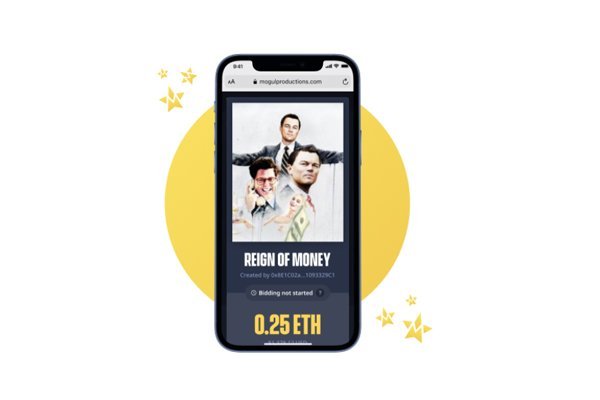
NFT In Film: It’s a decentralized kind of community that’s making decisions on what they want to see and be able to interact with the projects themselves.
It’s great to be here. It’s quite the intro.
It’s exciting to have you. Many different folks have told us that we had to get you guys on the show and learn about all the exciting stuff you’re doing. I’m an LA guy. I’ve been here for more than seven years and you can’t help but get a sense of the changing climate in the film industry. Eathan and I interact with a lot of folks that are in that industry. Your perspective, having been one of the first and only folks to leverage blockchain NFTs in a film so far is going to be helpful for our readers. I’m personally excited to have this conversation.
One thing about LA is that the climate there is pretty consistent.
As an aside from that, David Lynch was doing a daily weather report where he makes a five-minute YouTube video. He lives in LA and he goes on and makes a YouTube Live. He says, “It’s going to be sunny today.” That’s it. He makes a quick video and gets off. He draws random ping pong balls from a bucket and tells you what the number of the day is. It’s pretty awesome.
I tend to open my door and decide, “Do I wear a hoodie this day or no hoodie.” That’s the extent of my weather preparedness.
Luckily, that aside was relatively on topic with David Lynch being a famous film director. We want to talk about Mogul here a little bit more and start from the beginning here. How did the idea for Mogul come about?
The genesis for this platform was born from the story about how the movie Deadpool got made. The crux of it is that Ryan Reynolds had been trying to get Deadpool made for many years. All the studios had passed on getting that movie made partially because it was an R-rated movie in the comic book universe. Conventionally, the 15 to 24-year-old kids are your target audience. They said that would never work.
Ryan Reynolds is compelled to make this movie that he went out and made a trailer. He put that trailer online and the fans went nuts. Essentially, it forced the studio’s hand to make that movie. We all know the success of Deadpool. I’m a big fan of it. It’s done well at the box office. The idea there is that they were able to democratize the decision-making process on how that film got made by giving power back to the people that consume the content.
Usually, movies are made the other way around. They’ll have people that come up with ideas and scripts. There will be some people in an office somewhere that are screening for them and they’ll decide what they think is or is not commercially viable. They make that movie and at the end of it, they’ll do a screen test for audiences. They’ll say, “Was the ending too harsh? Should we not have killed the dog?” People hate dogs dying. I’m a big animal fan. That would not be something I’d like to see in a movie. They do those tests to audiences and they tweak the movie accordingly.
Whereas here with Mogul, the point is to leverage blockchain technology to give power back to the fans. Also, to let them take part in a place of those people where it’s a decentralized community that’s making decisions on what they want to see and be able to interact with the projects themselves, the cast and give feedback where you have this loop. That way, the creatives that are making this content have an aligned and well-versed audience that is going to create this network effect on anything that they do. It’s taking away those intermediaries that are notorious for taking advantage of both the people behind the camera, the business people, and even the fans themselves.
Why blockchain? Why not crowdfunding? I think I know the answer to this question but I’m curious.
I talked about that circular loop and one of the best things that I’ve learned through my experience of crypto is that you need to engage when you embrace crypto and utilize all the functionality and capabilities of it. Having a decentralized platform, we have some technology, quadratic voting so people can’t take advantage of the votes. We’re trying to level the playing field and provide that information, that circular loop where people can take place, earn and get involved in some of these projects that get made, which you wouldn’t have conventionally in crowdfunding. I looked at that as a very one-way street.
It’s more of a transactional relationship and you have some engagement. You’re updating the fans but there’s not as much of a connectivity tissue to that format is what I’m getting from what you shared. That leads to the next question which is, tell us more about Mogul’s NFT marketplace. When’s it being launched? What can we expect there in terms of the kinds of NFTs that it may include?
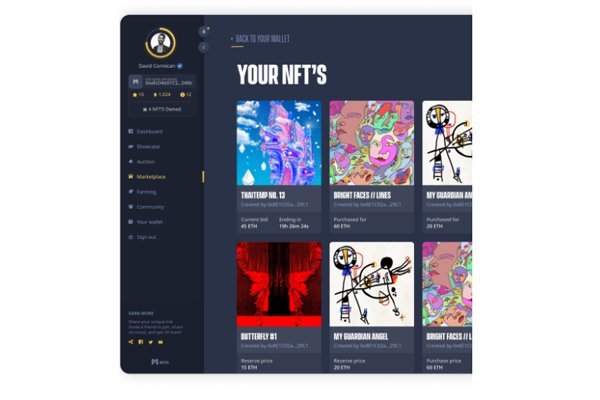
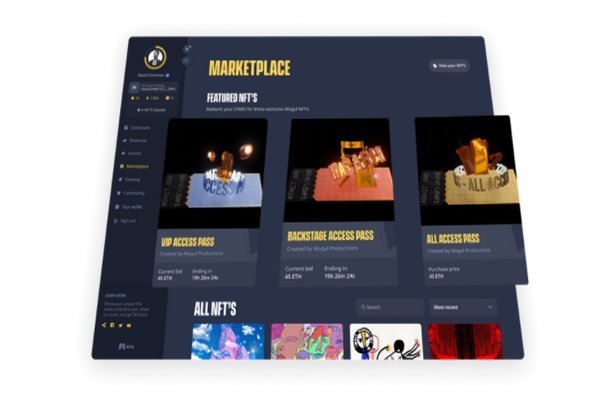
Aside from our DeFi platform, we’re launching this full NFT marketplace targeted towards the entertainment industry. That is happening in mid-September of 2021. In conjunction with the launch of our marketplace, we have an NFT drop, a series of NFTs. We’ve collaborated with a company on a film called Reboot Camp. They have a number of different well-known personalities in there. We have Ja Rule. I’m sure everybody’s seen in the Fyre Festival documentary.
He’s all over NFTs though. That guy loves NFTs.
He became a meme with the entire Fyre Festival phenomenon that happened.
The sandwich.
He sees the power of NFTs to do the right thing by crowd creation and community building. He was on stage when the DINOMONKS launched their NFT drop and saw him hanging out with Roman Tirone, one of our friends who has been on the show. Anyway, that’s a little bit of a tangent.
We have him. We have David Koechner from Anchorman and a few other great casts. We have an adult film star named Nikki Andersson. She’s also doing an NFT drop. What we’re doing is we’re collaborating with the filmmaker to create NFTs out of behind-the-scenes or deleted scenes from the film and turning those into NFTs, and building some rewards and experiences for the fans.
There’s a premiere taking place at the Chinese Theatre on Hollywood Boulevard. It’s where the Academy Awards and everything takes place. They’re doing an event there where all the casts are going to join. Anybody that bids and wins NFT will be able to go there and attend for themselves, meet the cast and interact with them to make this 2D to a 3D type of dimensional experience. That’s pretty interesting. There’s some art that was made in the film that we’re turning into NFTs. People who have been on those NFTs will be able to get the physical piece as well.
It’s great to see people pushing the boundaries and seeing what you can do. I want to dive in even deeper here about how Mogul will impact some things. You could think of three key elements in the film industry, you got production, distribution and fan participation. How would you say you guys are going to affect each of those elements?
I’ve had quite a bit of experience in the film business and on the capital funding side as a banker. For the creatives in the industry, it’s very much of a top-down centralized decision-making process for how films get made and they get distributed. Hollywood is all about stars and there are a few people that have a lot of power. You have the studios that make their big films. You have independent producers that are trying to make their own projects.
Let’s take the perspective of an independent producer or a creative from that aside. If you’re trying a make a film or some type of creative work and you’re trying to raise capital for that project, you’re doing it very much in a vacuum so you don’t know what is and what is not going to do well. You have to build an audience and get distribution. Raising capital is difficult because the people on the other side or the investors have no data points on whether this film will do well or not. They don’t know how this film compares to other projects with a similar budget, cast and return profile.
By putting this on the blockchain and onto our platform where the users can interact, the filmmakers get to tap the global audience of potential investors and participants or consumers of that content. You know now that as a producer of content, there’s going to be a bunch of people who are going to care about it and support it with their wallets, and they’re going to tell their friends about it. That’s powerful because instead of trying to scrape together capital and make a movie that may or may not resonate with the audience, you have a lot more visibility that way.
NFT In Film: There’s a lot of really cool things that you can do with the NFT space. It can be anything from IP to static images, to motion, to video, to music, whatever it may be. That poses a really interesting opportunity for creatives.
From the other side or from the fans or the consumers of content, there’s a lot of stuff that’s made for all these streaming platforms. You have Netflix, Amazon and Apple, which are trying to churn content given the way they make money. They make money from subscriber growth and they need to have more and more content. That content is getting churned out. I find myself in this paralysis of analysis. I’m sitting at home trying to watch something and I have no idea what to watch. I’ll scroll and scroll.
I care very little about any of these projects. I don’t know what’s good and what isn’t. It may be on a subject matter or a topic that I don’t care about. Whereas as a fan like with the Deadpool effect, people can influence what they want to see get made and care about it. I know that if I was involved in getting a film made with the filmmakers and the casts or the types of content and be able to interact with this, I’d be a lot more inclined to watch it, tell my friends about it and support it.
It reminds me of a lot of the NFT drops that are going on as of late. People are getting a taste for a model that works well and that is definitely around community and people feeling invested in the project. It’s not just that they spent their money on it, but they want to co-create it and have fun with it. They’re already engaged and involved. I could see you’re working with static NFTs in these communities. Clearly, it could work in the film industry.
It’s a more ubiquitous use case in a lot of ways than these static NFTs allow because fandom and Hollywood have gone together like peanut butter and jelly since the very beginning. The question for me around the genres is it sounds like you’re open-minded to the whole spectrum. You talked about everything from G-rated to maybe R-rated content that you’re doing from a traditional Hollywood rating system. Are you thinking about documentaries and all sorts of different types of late movies and shorts? Are you saying, “I’m wide open here. Let’s do cool stuff.” Where do you put the bumpers at this point?
We are agnostic in terms of what we’re going to do. At the same time, we’re still a relatively new project. We’re trying to disrupt a relatively archaic industry. The challenge for us at this point is trying to define some boundaries on what we are capable of and what works for our community. A case in point is we’ve had some great projects submitted to us that are not even in script form. They might be a five-page script for a movie.
To get into script development, it could be three years for you to finish a script. Who knows where the industry is going to be then? Crypto is a 24/7 marketplace where communities are interacting and engaging from around the world in different time zones. To have our community wait for three years for a script to get made and another year to get a movie made isn’t viable for us at this point.
Another thing is we want to avoid anything offensive for obvious purposes. The other thing would be financial constraints. If somebody wants to make a movie with Tom Cruise in space blowing up a whole bunch of stuff, it’s going to cost $300 million. That’s not something that we’re able to do at this point. I hope that point is near. Given the way how quickly crypto moves, it could be around the corner but at this point, we have to put some boundaries on what we accept before moving on to the platform.
We got an idea for a movie when you do get to that point. That’s Tom Cruise going into actual outer space and maybe even blowing up some planets or something. It would be awesome.
You can even race Elon Musk and Jeff Bezos.
Eathan’s working on a script. He should have it to you within the next few months, at least according to the commitment that he gave us about when it’s going to be ready. It’s something to look forward to. It’s on a topic that you never would have expected.
I’ll take a wild guess and say it’s not about cats and dogs.
No. Let’s say that the film industry is craving the next or first movie about the politics of the piano-tuning community. That’s where this is coming from.
I look forward to watching it. One thing I neglected to mention, which is important because we did talk about the NFT marketplace, is we’re creating this NFT marketplace catered towards the entertainment space. We’re doing this series of drops now with these celebrities in this movie. There are a lot of cool things that you can do with the NFT space. It can be everything from IP to static images, to motion video, to music, to whatever that may be. That poses an interesting opportunity for the creatives. Traditionally, if you’re a filmmaker or a music artist and you’re making content, you have very linear methods to distribute and monetize on that.
One of the best examples that I learned about how you could utilize NFTs is let’s say you have a filmmaker that has fans online and he’s done some stuff. He’s talented but unknown. Let’s say it’s George Lucas 25 or 40 years ago and he makes a short film and he needs $100,000 to do it. It will be tough to get $100,000 to fund a short film that may or not get distributed anywhere. That was in the present and we made a limited edition NFT for that short film for 100 copies or whatever it is. We sold those. He gets funded and he makes his project. He goes on to do Star Wars or some Academy Award.
The secondary market for those NFTs for that short film would benefit the users because now there is a much greater bid and there’s value. Imagine having the first piece of work from George Lucas prior to Star Wars or the Scorsese before the Godfather or any of these types of films. In a sense, you’re helping that filmmaker get to the next level by getting that short film made. As he bears success, so does a community that holds those NFTs.
Back to the filmmaker, instead of having to deal with an intermediary, he could build into the smart contract a royalty for those short films every time they transact. Now he has a revenue stream that’s helping him to make more work. He’s also engaging with the audience and communicating his vision for things, getting feedback from the community. It’s a lot more immersive and a powerful thing without anybody getting taken advantage of.
You hear very often about Hollywood accounting practices being much opaque in nature. People don’t know how the money’s being moved around. Movies make hundreds of millions of dollars at the box office but fail to make a profit when it comes down to paying out distributions, royalties and things like that. Blockchain is very powerful for that.
It’s fascinating. Having talked to some directors and producers about what goes into making a movie, I feel like they’re miracle workers at the end of the day, oftentimes with ridiculous, unknowns thrown at them every second. I’m sure when you add in blockchain in what you’re doing, while it brings additional benefits, there are also additional challenges and complexities. Can you talk a little bit about what you’ve run into and what you’re still trying to navigate?
The first thing that is the largest challenge or friction is the learning curve. DeFis, NFTs and crypto, once you’re immersed in it, I can tell you firsthand that it’s not that complicated but it looks complicated for somebody who’s not necessarily technical savvy or seeing this for the first time. Most people in the general public know crypto or blockchain from Bitcoin, Ethereum and Dogecoin. The proliferation of use cases for the blockchain has become a lot more apparent in a society of companies like Tesla and major institutional investors coming into the space.
For the most part, the average person doesn’t know much about blockchain, crypto, DeFi or NFTs. We’re speaking in a different language than them. A lot of the people that we may be interacting with have been doing the same thing for over 30 years. Now we need to shift that, disrupt it completely and say, “We’re going to try to take as much off-chain stuff, put it on-chain and interact with this community. We’re going to use Telegram.” “What’s Telegram? What’s Discord? How to use that? What’s this wallet address thing?” “You’re going to fund the movie. Are you going to give me fake internet money?”
How do we pay the actors and the union? There are many different variables that we have to educate these people on before they can fully embrace them. The success that we’ve had is that everybody we’ve been able to connect with and show them the tech that we’ve built and how they can navigate the ecosystem and the potential has more than embraced it. That’s very time-consuming.
Success breeds success and you’ve had some victories so far. What was the biggest one to date?
We sold $10 million of NFTs at the launch of our platform, it must have been back in April 2021. We had an NFT drop from a Marvel artist named Rob Prior. He is a talented guy. You guys have to check him out if you haven’t seen him already. He can paint with both hands at the same time. It’s savant-like capabilities and he makes cool art for all the studios and has a big fan following himself.
I am.
Does it turn your mouth green or something?
Yeah.
What are you, 70? What’s going on?
O-Pee-Chee and Topps are still around.
Milk for my daughter, 3%.
I didn’t know they had 3%.
I like 7.25% myself.
I think I tend to overanalyze things.
I had that thought process in my head.
It’s like, “Is this a good answer?”
I got this Mogul hat on.
I like that hat.
Thanks again for sharing your time with us.
Important Links:
-
Roman Tirone – Past Episode
-
Telegram – Mogul Productions
-
Discord – Mogul Productions
-
Twitter – @MogulOfficial_
-
iTunes – Edge of NFT
-
@EdgeOfNFT – Twitter