Top Podcasts
Miko Matsumura & Gabby Dizon Of Yield Guild Games - The Play To Earn Gaming Guild, Plus Azukis NFT, NFT VAT Fraud, Fayre’s $3.8M Raise, And More...
Did you know that you could earn money while playing video games? Yield Guild Games gives people a way to access the crypto economy so that they can play to earn. Join Jeff Kelley, Eathan Janney, Josh Kriger as they talk to Miko Matsumura and Gabby Dizon of Yield Guild Games. Discover how the guild system works and how they recruit gamers from around the world. Find out how the gaming industry just keeps getting bigger and bigger. And, learn how NFTs aren’t ruining the game experience but enhancing it by giving benefits. Plus Azukis NFT, NFT VAT Fraud, Fayre’s $3.8M Raise, and more in today’s episode!
—
Listen to the podcast here
Miko Matsumura & Gabby Dizon Of Yield Guild Games – The Play To Earn Gaming Guild, Plus Azukis NFT, NFT VAT Fraud, Fayre’s $3.8M Raise, And More…
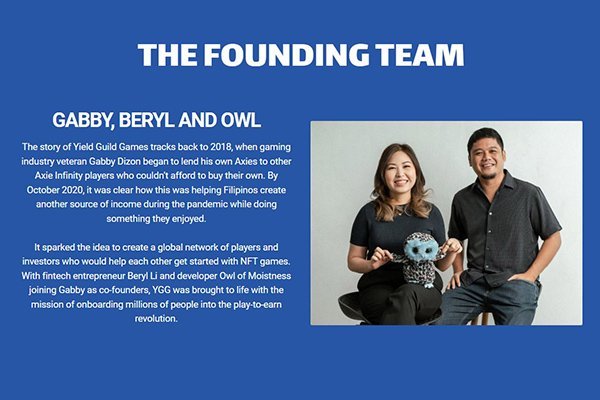
This episode features guests Miko Matsumura and Gabby Dizon of Yield Guild Games. Let’s talk about Gabby first though. He’s a startup entrepreneur and a veteran of the gaming industry in Southeast Asia. Gabby is the Cofounder of YGG, a play-to-earn gaming guild. YGG invests in yield-producing NFTs, games and virtual worlds and organizes its player community from around the world to earn an income from playing these games. He has been making games since 2003 and has shipped twenty-plus games on mobile and PC platforms.
He is also the Cofounder and CEO of Altitude Games, a mobile and crypto game developer and Chairman of Alto.io, a platform that connects games to the blockchain. These days, he is most excited about the various applications of blockchain for the game industry. Gabby is also a Founding Member and former President of the Game Developers Association of the Philippines and former Coordinator of the IGDA Manila Chapter. Yield Guild is a play-to-earn gaming guild, bringing players together to earn blockchain-based economies. They are settlers of a new world in the metaverse.
Let’s get a little bit about Miko, who is here too. He’s a General Partner with gCC, gumi Cryptos Capital, a Silicon Valley investment fund with over $500 million in assets, including early-stage investments in unicorns like OpenSea, Yield Guild Games, Celsius Network, Vega Protocol, Qredo, Agoric, Astar and 1inch Network. Miko fell in love with open source software years ago as Chief Developer Evangelist for the Java Programming Language and Platform at Sun Microsystems.
Since then, he has been building open source software startups in Silicon Valley, including raising over $50 million in venture capital for developer platform companies such as Gradle and financial infrastructure companies like Hazelcast. He has participated in multiple exits, including Infravio, webMethods, and db4o. He is an advisor in successful startups like Celsius, Idle Finance, Pundi X and Keyless. He holds a Master’s degree in Neuroscience from Yale University, where he worked on abstract computational neural networks. Welcome to the program. It’s great to have you.
Thanks for having me.
It’s nice being here.
The first question is super important. This is for Miko. Sally’s or Pepe’s?
It’s Pepe’s for sure.
I’m just making sure. We’re in good company here. We’re in good shape. That’s pizza insider stuff for New Haven, Connecticut. Welcome. We’re so excited to have you here. We want to start our readers at the beginning of Yield Guild Games. Tell us about the origin story. Gabby, how did this idea come about? How did you bring it all together?
My background is as a game developer but I got into crypto in 2017. I’ve heard about Bitcoin a few years prior but the main use case in the Philippines was around remittances. I wasn’t so interested in that because I was a game developer. It wasn’t around 2017 when we heard about Ethereum and smart contracts. That’s what got us interested in looking into crypto. We were playing around Solidity to see how the concept of programmable money could eventually make its way to games.
While we were doing that, CryptoKitties came out. I don’t know if you remember this. In late 2017, it crashed the Ethereum network and popularized the NFT. That was the holy shit moment for me like, “NFTs are going to change everything. Let’s dive deep into it.” Since then, in early 2018, I got deep into NFTs. It turns out that NFTs wouldn’t change the world for a few more years but those were a few educational years trying to figure out everything I could about NFTs.
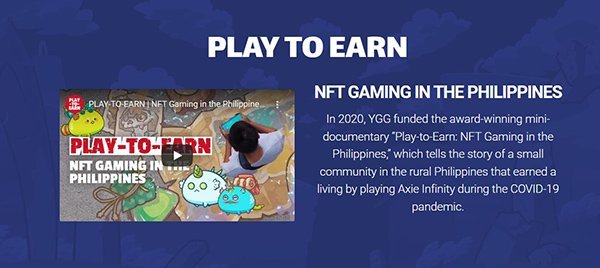
I started playing Axie Infinity in late 2018. Fast-forward to 2020, I was still playing Axie. This was during the early part of the COVID lockdown. People in my country started discovering the game as a way to earn some income during the lockdown. A lot of people lost their jobs, were at home and didn’t have any money. They were using Axie Infinity as a way to earn money during the lockdown. These are people who didn’t have any prior crypto experience. They were gamers who wanted to use their gaming scale as a way to earn.
We saw that it was something that we could scale to players around the world with games like Axie to have a play-to-earn component. You need to have the NFTs to play. You have to buy the NFTs but a lot of people can’t afford them. We started Yield Guild as a way to provide access to people around the world to the crypto economy by aggregating the NFTs and then lending them out to people who can play them and earn an income.
What a game-changer for so many people out there, it’s the ability to make a living out of playing these games on the blockchain. People have been in competitive gaming for a while and earning a living but you got to work your way into that. It’s a whole other level of competition. To be able to do it and access it at your fingertips if you’re willing to take that step is a change that we have experienced.
That’s also interesting the parallels of your journey and the journey of Axie Infinity and the play-to-earn market. It would also be great to learn a little bit more about Miko, how your story intersected with YGG and why did it intersect after all. There are a lot of different things that you’ve been involved in. Clearly, something about what Gabby was doing caught your attention.
We’re founder-first investors. I had been circling the globe looking for genius founder entrepreneurs. I met Gabby at various points around the world prior. That’s a super qualifying thing, so I was immediately attracted to his entrepreneurship. It was exciting because I had also met with Beryl, who is his Cofounder under a different context with different friends. I had already connected with them in different ways. I was already intrigued. When Gabby explained what he was doing, I couldn’t be more excited because, for me, it hearkens back to being a World of Warcraft player and thinking about guilds.
If you go back to guilds, the only thing that can ruin a guild is what I call loot drama, which is the unfairness of getting rewards. One of the things that I knew deep in my heart is that Gabby is in a way destined to be the fair leader. We need someone who has this sense of justice and is coming from a great place. To me, the goal is to make a guild that can change the world. The amount of fairness that you need to scale to that size is pretty impressive because it’s so easy to become corrupted by all of the power. The core thesis for us is like, “This is the right team.”
The funny thing about what Miko was saying was that if you had experience playing games like World of Warcraft and being part of a guild, it directly contributed to the genesis of the startup. When we pitched the idea to Miko, he got the concept immediately. It was because he was in World of Warcraft and an MMO player. That was cool.
Let’s get into the details a little bit here about how Yield Games is onboarding the next $1 billion through play-to-earn and scholarships. How does that happen?
We’re set up as a community. We have what we call Scholarship Managers or Community Managers that are all over the world. They have access to our assets, be they Axies, Fancy Birds or other NFTs. They go out and recruit players in their local communities. These community members are not employees of the Yield Guild. They’re part of the community that has access to our assets. They go out, recruit and train people from the local communities that then start playing the game to earn an income. In this way, we can grow and scale throughout the world.
Now, we have player communities in the Philippines where we started. We have Indonesia, Thailand, Malaysia, India, Venezuela, Columbia and Brazil. It’s pretty much growing in many places around the world, especially in developing countries where earning a couple of hundred dollars a month extra is life-changing. You can use that extra income first to pay for food but later on to become more of an investor to own crypto assets. Our goal is to turn all of these gamers into investors and be in control of their financial destinies.
It’s so cool that we get a chance to speak about it on the show. The topic comes up quite a bit and we have various touchpoints about it. Clearly, you are one of the most on the ground on this movement. It’s cool to see how you’re making it happen. Also, it’s cool that this is going on.
I was impressed by the CoinMarketCap. It’s $3 billion. Is that correct?
It’s at $3 billion FDV.
That’s $3 billion of value created in a relatively short amount of time.
It has been a crazy ride.
Yield Guild Games: Yield Guild was started as a way to give people around the world access to the crypto economy. They would group the NFTs and then lend them out to people who can play them and earn an income.
One of the things that I talk about a lot and I get excited about to that point is when we think about what was happening in 2017 and 2018, there was a lot of paper value being created. That can dry up pretty quickly and it did based on a number of things that came together. What we’re talking about is a different type of value being created now. There’s real revenue and real impact being created in definitively measurable ways. That to me is what’s cool about this iteration of crypto, blockchain and all the fun things that are happening.
It goes to a question I have around the year-end retrospective and the stats that you released coming through to the end of 2021. I’m curious about that. Are those metrics that you track throughout the year and talk about within the community, how do you feel about transparency around performance and various key statistics that you track internally? What are your thoughts on that overall? What was the inspiration for sharing this information?
We’re a community-based project, first and foremost. We feel that transparency is important for the community to know exactly how the guild is doing. We don’t see ourselves as something like a hedge fund or a financial company. How we perform is what we do. We do it in the service of the players that we have all over the world. We owe the transparency to our players so that they know exactly what’s happening with the fun stuff we have raised, where it’s going and how we’re serving the community.
To call out a couple of them, I was looking at 10,000-plus Axie Infinity scholars and 100,000 members in the Discord community. That’s insane.
That’s over 16,000 now. We have grown quite a bit since the end of December 2021.
There are so many cool statistics across the board there and measurable value creation. This is a different age of blockchain, gaming and all the fun things that are happening there. As we look ahead, you can’t do this alone. It’s about the community to a large degree and community within the folks that are participating in the guild directly and partnerships to help you grow. Could you tell me a little bit about how you form those partnerships? What’s forthcoming on that front? Is there anything exciting that you can share with our readers?
First of all, on the game side, we have bought assets of over 30 games already. These are games that have different types of mechanics that will allow our player community to enjoy the games and have a chance to earn some income. They’re games like Fancy Birds, CyBall and Big Time. There’s an incredible amount of games that are coming in the next couple of years. The landscape has been dominated by Axie in 2021. Axie is even releasing a new version of the gameplay. There’s going to be a huge amount of content for people to go through and different kinds of virtual economies. That’s super exciting.
On the DAO front, we are creating our regional DAOs that will serve as user acquisition deep into the local communities. For example, we started YGG Southeast Asia late in 2021, which is going deep into Indonesia, Thailand, Vietnam and Malaysia. We have IndiGG in partnership with the Polygon folks, which is bringing play-to-earn deep into India and Ola, which is in Latam.
We invested in BAYZ, which is a guild out of Brazil. The idea is that we wanted to partner with folks who knew the ground deeply because with what we’re doing, we want to go deep into each village, town or city and get people access to assets that play-to-earn. We wanted to partner with the best people on the ground.
That’s such an impact. Miko, I do want to ask from your perspective as you’re seeing this rocket ship continue to grow and take off. We talked about metrics before. What is it that you’re seeing that you get excited about that is measurable and that you can take from this experience and what you’re seeing with YGG? I know it’s hard to judge other folks that want to do similar things. Can you apply what you’re seeing and learning here?
The only thing that can ruin a Guild is loot drama. Click To Tweet
There’s no question. We think about the entrepreneurs first. The team is everything. Once we get through that, then the thing we focus hard on is the problem and the solution. The question is, “What problem are you solving?” If you look at the way Gabby described the problem, he described problems like, “COVID hit and there’s not that much employment. People need to survive and feed their families.” Is that a real problem? That is a real problem.
Asking silly questions like, “Can the player learn how to use MetaMask?” They’re going to do everything because that’s what they need to do. They have a serious problem. To me, it’s hard for GameFi people to talk about problems that they solve because a lot of times, they’re solving problems like, “I’m bored,” which is okay. It’s beautiful to help people feel better in the world and entertain people. For me, the beating heart is like, “Is this a serious problem with a serious solution?” That’s my perspective.
There are over three billion gamers in the world. There’s the fact that you can use games as a way for people to get into crypto and earn money. The interesting thing about our community is that most of the time, when our players get recruited, they don’t know anything about MetaMask, Ronin Wallet or anything about crypto, but they know how to play a game and they want to make money while playing a game. They get onboarded to the community and start learning how to play Axie. Two weeks later, when it’s cashout time, you can bet that they will learn how to use their wallets quickly.
We came out of this world where, as kids, you can play video games. If you got good, maybe you could make money out of it. Even that was mind-blowing to our parents saying, “You can’t make money playing video games.” You do have to be pretty good to do it and all that stuff. This is completely flipping it on its head. It’s a whole other level. Anybody can come in and do that. You dedicate your time and effort to it but you don’t have to necessarily be the rockstar or ninja when it comes to gaming. It’s such a cool iteration of gaming and blockchain.
Remember when eSports was early and people were winning huge cash prizes. There was a lot of pushback like, “Games aren’t sports. That’s not real.” There was so much resistance to it. We’re seeing it now with play-to-earn as well, “Is that even a real game? Is it doing anything good for society?” If you look at how many people it’s reaching with the ability to earn via these virtual economies, the answer is yes.
I got to ask Gabby with regard to that transition to play-to-earn and you have been in the gaming industry for so long, how do you respond to the naysayers that talk about this tension with traditional gamers? How do you think all that’s going to play out?
A lot of this is tension. Miko and I talked about this. We had a wonderful conversation about this. A lot of people who play games use it as a form of escapism. A lot of the time, they want to separate playing the game from the commercial part, especially from these people who have felt like the publishers have been squeezing them for money to play the games that they enjoy. They see NFTs inside games as a way to overt financialization of the games. If you look at the people who are enjoying these games and benefiting, there’s a massive benefit.
People in the provinces of the Philippines aren’t asking, “Is play-to-earn ruining my game experience?” They’re playing it and enjoying it. It’s making their lives better at the same time. Honestly, I don’t think that games that you will play for pure enjoyment will ever go away. It’s a different type of game with an added purpose, which is a pretty noble one and one that can spread gaming to more people around the world because people can feel productive earning money while learning skills and doing it. This will continue to grow over time.
Everything will coexist. Speaking of purpose, you did some pretty major relief efforts around Typhoon Odette. Is that correct?
That’s right. In December 2021, a huge typhoon rolled around the Philippines, where a huge part of our player community is at. This is the week before Christmas 2021. A lot of people pretty much lost their homes. We helped coordinate the efforts of the community and raised $1.5 million from the crypto NFT play-to-earn communities to help with the relief efforts. We were able to channel that towards various aid organizations on the ground to help people get back on their feet.
You are used to organizing in a decentralized way for a clear purpose. It’s a great way to pivot that energy of the community.
Honestly, I never thought that it would be part of our job description to organize aid and relief efforts but it turned out raising money from the crypto community that wanted to help other players was something that we could do.
I hear there’s a subDAO strategy for international rollout and rapid expansion here. It sounds like another implementation of your fantastic abilities here. Can you tell us a little bit more about that?
Yield Guild Games: Yield Guild community managers recruit, and train gamers around the world. Then these gamers start playing the games to earn an income. So, the Yield Guild is continuing to grow throughout the world.
The subDAOs are regionalized versions of YGG that are implementing specific strategies for spreading play-to-earn across different parts of the world. There’s no one-size-fits-all strategy to expansion, especially with different countries, cultures and languages. The way that you’re spreading play-to-earn, for example, in Indonesia is going to be different than India, which is going to be different from Brazil.
The subDAO is a way of us creating the guild structure in different parts of the world and finding the best partners. For example, the BAYZ guys in Brazil know the ground pretty well and what games would work well with the Brazilian market. They have a heavy focus on mobile eSports because most of the people there own Android phones and love to play these competitive games. That’s an example of us personalizing so that we can relate better to the players in those countries.
That’s our first stamp collector.
No, I don’t. I wish.
It’s NBA Cards. I was doing it for lunch money.
How about you, Miko?
I sold a GI Joe to my brother.
There’s a lot of family arbitrage on this show.
I got AirPods Pro for my wife.
I’m holding that couch forever.
It’s my crypto wallet.
Miko, what do you have your eye on?
It’s curiosity.
It’s my short attention span.
I just woke up.
How about you, Miko?
Coffee.
I have 5 of the top 100 rarities of these.
Are there any other thoughts on this one?
For me, it’s Twitter @MikoJava.
Important Links:
-
How Azukis Suddenly Became The World’s Best-Selling NFT Collection
-
Matt Kalish – Previous episode
-
British authorities just seized NFTs for the first time, in a £1.4 million fraud probe
-
Fayre raised $3.8 million to help brands create and manage NFT communities
-
Julian Rodriguez – Previous episode
-
@MikoJava – Twitter
-
Spotify – Edge of NFT Podcast
-
iTunes – Edge of NFT Podcast
About Miko Matsumura

Miko is a General Partner with gCC Gumi Cryptos Capital, a Silcon Valley investment fund with over $400M in assets including early-stage investments in unicorns like OpenSea, Yield Guild Games, Celsius Network, VEGA Protocol, Qredo, 1Inch Network and Agoric.
Miko fell in love with open source software 25 years ago as chief Developer Evangelist for the Java Programming Language and Platform at Sun Microsystems. Since then he has been building open source software startups in Silicon Valley including raising over $50 million in venture capital for developer platform companies such as Gradle and financial infrastructure companies like Hazelcast and has participated in multiple exits including INFRAVIO, webMethods, and Db4O. He is an advisor in successful startups like Celsius (CeFi Lending), Idle Finance (DeFi Yield Aggregator), Pundi X (Payments), and KEYLESS (ID infrastructure). He holds a Master’s degree in Neuroscience from Yale University where he worked on abstract computational neural networks.
About Gabby Dizon

Gabby is a startup entrepreneur and a 15-year veteran of the game industry in Southeast Asia.
Gabby has been making games since 2003 and have shipped 20+ games on mobile and PC platforms. He is currently the co-founder and CEO of Altitude Games, a mobile and crypto game developer, and Chairman of Alto.io, a platform that connects games to the blockchain. These days, Gabby most excited about the various applications of blockchain for the game industry.
Gabby is a founding member and former president of the Game Developers Association of the Philippines (GDAP) and former coordinator of the IGDA Manila chapter.