Top Podcasts
Michael Gord Of Metaverse Group On The Digital Real Estate Boom, Plus: Teens Cashing In On NFTs, Louis Vuitton NFT Game, Fortune Mag NFT Sale Update, And More...
There’s a whole world of NFTs out there you may not have explored yet. Literally. NFT real estate is an emerging market that foresees exponential growth in ROI in the upcoming years. In today’s episode, Eathan Janney, Jeff Kelley & Josh Kriger are joined by one of the pioneers of the NFT real estate game. Michael Gord is the Co-Founder of the Metaverse Group, the world’s first virtual real estate company. Michael is also co-founder and CEO of GDA Capital and MLG Blockchain and has advised on over 20.5 billion in digital asset offerings to help secure over five billion in asset placements into the blockchain. He’s here to share the Metaverse Group’s vision of real estate in the virtual world naming the benefits of scooping some sweet digital properties now rather than later. Keep your ears glued as they also discuss how teens are now dipping their toes in NFT to fund their teenage lifestyle, Louis Vuitton hitting 500,000 downloads on their mobile NFT game, and a follow-up on what’s next after Fortune Magazine’s successful NFT cover.
—
Listen to the podcast here
Michael Gord Of Metaverse Group On The Digital Real Estate Boom, Plus: Teens Cashing In On NFTs, Louis Vuitton NFT Game, Fortune Mag NFT Sale Update, And More…
This episode features Michael Gord, co-founder of Metaverse Group, the first vertically integrated real estate company focused on the metaverse economy in the world. He is also the Cofounder and CEO of the GDA Group of Companies, which are focused across capital markets verticals in the blockchain industry. In addition, he is the Managing Director of the DigitalBits Foundation, the leading blockchain protocol focused on consumer digital assets.
Michael has advised on over $20.5 billion in digital asset offerings. He helped to secure over $5 billion in asset placements onto the blockchain and has worked with Fortune 500 companies and global governments. Michael was one of the first advocates for digital assets in Canada, built the first university communities for blockchains in Canada, and was the first enterprise blockchain developer that TD Bank hired. Through his initiatives, Michael has introduced digital assets to tens of thousands of people worldwide, and now he will introduce them to our audience. Welcome, Michael.
Thanks for the introduction. Thanks for having me.
It’s a pleasure. This is a show that we’ve been excited about because one of our co-hosts, Jeff, has been in real estate his whole career. I wanted to see what crazy conversation you guys had. We heard about this initiative when the press release first came out and it seems crazy at the time. Over the past few months, this is happening now. Why not? It’s super cool to learn more about what you have cooking on.
I have the same sentiment. When we introduced this to the market, it was purely because we were bullish. We believed that at some time in the future, it would become valuable and that it would become desirable to participate. The speed that it has is surprising to me as well.
You’ve been in and around finance, blockchain and investing for much of your career. How did you get interested in the metaverse? What led to the actual formation of the Metaverse Group?
I’ve been into blockchains and digital assets for my entire professional career. I diversified across the fungible side of the market but I was fortunate to be at the ETHWaterloo hackathon when CryptoKitties was announced in 2017. I became familiar with NFTs at the time that they came to market initially. When that first happened, I was convinced that, eventually, NFTs were going to become popular. I was certainly not convinced of the usefulness and the applications.
My business partner, the other cofounder of the Metaverse Group, his name is Jason Cassidy. He was also at that hackathon. We’ve been friends and colleagues on various projects for a while. He was investing quite heavily into NFTs and the metaverse. His description of Decentraland, Sandbox, and Somnium and his perspective on the future of the metaverse and virtual worlds was compelling and convinced me that it was worth getting some exposure in.
Who knows where things like that are going to lead? Let’s get a little bit more detail about that. I want to break it down a little bit for our readers. How is Metaverse Group structured? What services are you offering?
We are essentially a holding company of assets and that was throwing a dart on the wall. We believe that the future value of metaverse real estate will increase. The long-term goal is to build out a Brookfield-type business model for the metaverse. Initially, I thought that a good place to start would be to have a RE/MAX type model, helping people buy and sell virtual land. We didn’t have a clear model as far as the economics. We just wanted to help people.
Is it like a traditional real estate closing where the buyers and sellers sit down with a closing agent and a bottle of wine at the end of the transaction? What’s this look like?
We quickly realized that the real estate business model of making 2.5% on transactions was not interesting for either of us. When we first started, that was $500, $1,000, $2,000. We both are gainfully employed with our core businesses and that is quite distracting. If people were in our network and looking for support, then we would provide them with that advice. We’re considering that eventually. The metaverse real estate has been a boom and we’ll have a brand positioned in the middle of it. The value of metaverse real estate went up exponentially so our relatively small portfolio of metaverse assets turned into quite a large portfolio of metaverse assets. The types of conversations that we started to have were with larger investors, real estate companies and high net worth individuals looking to participate.
It’s a case of a very well intentional right place at the right time. You got in when you needed to get in to stake your claim in the space.
We wanted to be first and we didn’t know where we were going to take the business. The brand, Metaverse, we can take into every metaverse vertical. We want to be the first one to introduce that brand, Metaverse, and then we can take in different directions. As we started to have these conversations, we identified that there are all these larger investors that are looking to participate. The value of buying estates is quite high. It’s no longer a couple of hundred bucks or a couple of thousand bucks. It’s now tens of thousands or hundreds of thousands of dollars and it’ll soon be millions of dollars per estate.
NFT Real Estate: In the metaverse, land has historically gone up exponentially and it’s likely to continue appreciating faster than traditional real estate.
The potential risk that people are putting on the table is higher. People that are putting that amount of capital on the table want to get exposure to the metaverse but not manage their lands, maintain their land, build on their land, and generate revenue from their land. We’ve been in this space for quite a while now and we have a bunch of lands that we can securitize into an investment product. Instead of these high-net-worth individuals or real estate funds or venture capitalists wanting to buy and hold land but not build on it, they could invest in us to acquire land, build on our land. Also, to generate revenue through the buildings or experiences that we create, and then return a portion of that revenue to the investors in our model. What we are excited about doing is introducing the first fully metaverse-backed real estate investment trust.
What does that look like in reality? How is it similar or different from a standard real estate investment trust? Give us a sense of the number of parcels of land you’re purchasing, the relationship with the investors, and the things that you think about on a day-to-day basis with this project.
The intention is for it to look as similar as possible. With a traditional REIT, you’re investing in real estate developers who have a track record of generating consistent annual yields to generate income through the buildings. Oftentimes, there are already buildings that are generating a consistent yield for a decade. The difference is that this is way more of a venture capital type REIT model where in theory the metaverse assets or the worlds could go to zero. Whereas in the real world if you’re buying a New York City REIT, a Canada REIT or REIT in the real world, it’s reasonably likely that you’ll earn your 3%, 4% or 5% for developing economies yields.
For us, it’s more of a venture investment where we anticipate that not only it could go to zero, which I don’t think is possible but it is possible. Whereas traditional REITs, you’re looking at 3%, 4%, 5%, 6%, 7%, depending on your risk tolerance. With the metaverse, historically, the lands have gone up exponentially. It’s likely that it continues to appreciate faster than traditional real estate. As the number of users in the metaverse increases from 10,000 per month. It’s the next frontier of the internet. The internet has about a billion users per day. The metaverse will also have about a billion users per day.
On the land appreciation side, I’m curious how the appreciation of land has occurred relative to the appreciation of the tokens around that land. For example, Decentraland is around $0.80 to $0.90. It’s done quite a lot in 2021. Is the land within these metaverses appreciating faster? How do you get that return? Do you sell the land? Do you rent out the land? Are you building theme parks on the land? Should we host the Edge of NFT show there? Tell us a little bit more about the economics and the appreciation.
That’s something that we think about and talk about a lot. To the last question, should you host your show there? For sure. There’s a bunch of buildings in Decentraland, specifically the Crypto Convention Center in Crypto Valley. Decentraland has screens that are available. In theory, we could share this Zoom link to the Crypto Convention Center. We can share on Twitter any domain name. It could be EdgeOfNFT.xyz. The .xyz domain name is going to be popular for the metaverse. It could be EdgeOfNFT.com/metaverse or /decentraland or anything. That link can bring you directly into the Crypto Convention Center.
In the Crypto Convention Center, we could have the same Zoom call and people can be listening live, which is a good idea. The value of MANA for Decentraland, Sandbox and CUBEs for Somnium Space, the appreciation opportunity as opposed to the land asset is a great question. Simply put, they mirror each other. Let’s use the real world as a case study. If you’re investing in foreign exchange like if you’re holding the US Dollar versus the Vietnam Dong versus the dirham in the UAE versus the Pound, you’ll generate revenue based on the foreign exchange transactions.
If the US does well and you’re holding US Dollars, then you’ll earn a return on your income by holding US Dollars if you’re invested into a REIT as well. That’s maybe a closer example. You’ll earn a good ROI as a result of your REIT doing well. Fiat currency or REITs, especially public REITs or MANA or SAND or CUBEs are liquid. You can hold $10 of MANA. You can hold $1,000 of MANA. You can hold $1,000 of REIT. You can hold $1,000 or $10 of US Dollars or Vietnamese Dong or whatever asset class.
You talked about renting a little bit. What the heck does it mean to rent in the metaverse? What does that look like?
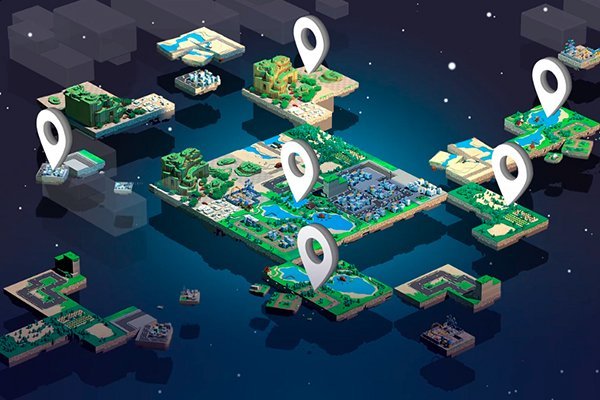
The land is very scarce. If you want to buy land, using Decentraland as an example, the map of Decentraland is about the size of Washington, DC in terms of square feet and meters. If you bought land before Washington, DC became a city, then you’d be able to get blocks of land downtown or you’d be able to get blocks of land where the universities, schools or shopping malls are. After Washington, DC is built, then there are landowners and they will do joint ventures oftentimes with the builders.
If you’re an investor looking to buy a block of real estate in Downtown Washington, it’s not available. If you’re looking to buy a shopping mall, it’s not available because it’s generating income. Back to the value of MANA, the value will approximately mirror each other, the value of land versus the value of the currency. By the way, if you’re trying to sell a block of land in Downtown Washington, there are also few buyers, so it takes you some time. The land is more scarce than MANA.
Using Decentraland as an example, you have to participate early. To buy a block of land in Downtown Washington, you need to have started before Washington was built. Otherwise, if you want to build in Washington, then there are the landowners and real estate developers. The landowners won’t sell their land because it’s generating income for them and you can’t participate. You can buy a REIT for Washington. That explains it.
I did buy a lot of commercial real estate properties in Washington, DC. It is complex. There’s no question about that.
As far as renting, now that land is quite expensive. Especially for most businesses, I don’t think they’re going to want to buy enough land to build an office building or to build the financial district because they’re not going to be betting fully on the metaverse. To put $100 or $200 into getting exposure, it’s more reasonable for a lot of businesses to start participating.
Invest into the future rather than wait for the future to exist. Click To Tweet
Why do a REIT and not just buy the token? Is it because there’s going to be a point where the scarcity of land kicks into overdrive and the land is going to disengage from the token value at that point?
I think so. It’s less liquid but you’re able to earn a significant ROI from it. Our intention is to build financial districts, shopping malls, arts and entertainment districts, and bring enterprises into the metaverse through our land where they will not be able to purchase land because the land will not be available. In Washington, very often, there are single parcels of land that get sold. If you’re trying to buy enough land for a shopping mall, you’re going to be in the boonies unless maybe once a decade, there’s a big transaction like that. We want to be the landowners that have those experiences like financial districts and shopping malls. You have to hold land to do that stuff.
What’s super cool with Decentraland is when land first came out, there was only an X and Y coordinate. You can get a parcel that was 100 X coordinate, 76 Y coordinate or whatever numbers. Now there’s a Z coordinate as well, which is if you build the building, you can still be 176 coordinates or whatever. There’s a Z coordinate for different floors, so you can have someone rent out a floor where they have ownership of the experience on that floor in the building or on that piece of the parcel, piece of the estate for whatever amount of time. They can do whatever they want with that piece of real estate for whatever amount of time, which is a big innovation.
Are we talking about air rights there where someone could get multiple owners vertically, or is it still a single owner up into the vertical space?
Multiple owners vertically. You could have an entire commercial building or a residential apartment building or a shopping mall. Ten floors of your building, you have either ten owners, one owner of each floor, or you could break up the floor into different sections. The ownership metrics of real estate are becoming a lot more granular which creates the renting market a lot easier.
I have to interject with this question. We’re bullish on this stuff and we love this conversation. Josh and I went on an outdoor hike with some good friends and I heard a guy talking about how he thinks it’s productive to be on the computer for a while. He then realizes he got to get out and go for a run or a walk or something. There are revenue streams coming in here. I’m curious about your perspective on people having to tend to use screens. It’s a digital world and they are maybe getting tired of that, and getting in and out of the “real world.” How does this play into this? Why is this stuff maybe still valuable even if people don’t want to spend all of their time in that metaverse world? Any thoughts on that?
I am terrified of the ramifications of this. With that said, I recognize that the world is going in this direction and I’d rather be invested in the future than wait for the future to exist, whether I’m participating or not. In fact, if I’m invested then I can perhaps alter it in whatever way it can provide value to the world. The reason why I’m bullish on this becoming mainstream is that billions of people in the world live on $1, $2 or $3 a day. They don’t know where their next dollar or meal is going to come from.
In Decentraland, Somnium Space, Sandbox or whatever metaverse, there’s going to be conferences, events, meetups and festivals going on 24/7. There are going to be entirely new business models that are created for participating in these business models. For example, if an event organizer is organizing 100 events a year and you go to each event, you can get proof of attendance NFT. If you go to all 100 of those events and you collect all 100 or all 10 or all 200, you guys can start to consider the flexibilities and the economics here. All 100 NFTs can be redeemed for a gram of gold or an ounce of gold or food. Each proof of attendance represents food for the day. That’s how valuable is an eyeball.
If a conference organizer or a meetup organizer or a festival organizer is getting eyeballs around the world and people are participating, it’s likely that people will be able to earn a much better income living in the metaverse than they will be able to be living in whatever country or whatever situation they happened to be in, which is valuable. Another fundamental reason is that I’m fortunate to be from Toronto and born in Canada, which has a developed capital market and a good standard of living.
The internet has democratized access to communications. In theory, anyone in the world can send an email to investors in Silicon Valley, New York, Toronto, London or anywhere. If you’re fortunate to live in Silicon Valley, New York, Toronto or to have a passport that can take you to these cities, you can show up and knock on an investor’s door, employer’s door or someone’s door. That adds tremendous value. If you’re from one of these cities and you send an email on LinkedIn, then it’s reasonably likely that if you’re in the same city as someone that they’re going to respond to you.
If you were born in a country that doesn’t have the same economic power and doesn’t have the same passport that can take you to these cities or don’t have the ability to go to these cities. Although they have the same democratized access to communication and they can send the same LinkedIn message to the same person in the same city as I can or as you guys can, it’s much less likely that that person will respond just given the world. They don’t have the luxury of being able to show up.
The metaverse democratizes access to showing up so you could live anywhere in the world. You might not be able to hop on a plane and knock on the door, but you can certainly get access to a computer. On that computer, you can show up to an investor’s office in the metaverse and you can knock on their door in Decentraland which that democratized access to showing up is valuable.
I see where you’re going with this. I enjoy working with young people. I’ve noticed I’ve got people I’m working with that are in India, Turkey, Africa and China through the internet. I can see that they’re getting access to a lot of great stuff through the internet. I see where you’re going with the Metaverse
A gum, a candy.
The Hubba Bubba gum and the $0.05 sour candies.
Candy.
We’re detecting a theme.
A candy dealer.
What’s that?
Crypto.
My life.
Thinking.
I’m going to go with distracted.
I drove from Como to Milan.
Sure.
It’s quite possible.
It’s not good. It’s a terrible game.
You’ve played it?
Yes, I tried it.
This is a good follow-up.
She’s savvy.
I have nothing to add. It sounds good.
Twitter is probably the best, I’m @BitGord.
iTunes**, rate us and say something cool. Go to EdgeOfNFT.comContact@EdgeOfNFT.com or tweet at us, **@EdgeOfNFT
Important Links:
-
@BitGord – Twitter
-
iTunes – Edge Of NFT
-
@EdgeOfNFT – Twitter
About Michael Gord

Michael has advised on over $20.5 Billion in digital asset offerings, helped to secure over $5 Billion in asset placements and has worked with Fortune 500 companies and global governments. Michael was one of the first advocates for digital assets in Canada, built the first university communities for blockchains in Canada and was the first enterprise blockchain developer that TD Bank hired. Michael has introduced digital assets to tens of thousands of people through his initiatives.