Top Podcasts
Michael Brooks Of Flake Art DAO — Plus, The Immortal Museum, Vitalik Buterik NFT Portrait, Flash Movie NFT, Human Readable Blockchain NFT, And More…
The NFT space has become a hub for emerging talents to showcase their creativity in the vast and ever-growing digital landscape. Michael Brooks of Flake Art DAO is on a mission to give them a platform to feature their works for the entire world to see and be preserved for posterity’s sake. Joining Jeff Kelley, Eathan Janney, and Josh Kriger, Michael talks about his project The Immortal Museum, where digital art can be exhibited to gather comments and votes from viewers, helping artists improve their creative process. For this episode’s Hot Topics, the group discussed Proof’s new NFT collection that expands on the Moobirds’s universe and the integration of NFTs into the new Flash movie. For the Shoutout segment, Michael salutes a new artist in the NFT space who created the Nightfall Flake Series.
Listen to the podcast here
Michael Brooks Of Flake Art DAO — Plus, The Immortal Museum, Vitalik Buterik NFT Portrait, Flash Movie NFT, Human Readable Blockchain NFT, And More…
This is Michael Brooks from Flake Art DAO, the platform preserving today’s digital cultural artifacts for tomorrow. You’re tuning in to the Edge of NFT, the go-to show where each episode is a precious artifact. Keep tuning in.
---
NFT-curious listeners, stay tuned for this episode to learn how one white-hat cypherpunk breached security with his resume to land a job at one of the top social networking platforms. Plus how accidentally shutting down their high school’s phone service ended up being our guest’s first hack. Hear about how Moonbirds’ newest collection, the Mythics, is hatching a unique minting experience backed by some deep lore.
Finally, dive into the captivating world of artificial intelligence with the Edge of AI podcast. Join us as we explore the frontiers of AI and its impact on our lives. Subscribe now on your favorite podcast platform and follow us on Twitter and LinkedIn for exciting updates and insights. Don’t miss our exclusive launch event if you’re in LA. It’s going to be on August 2nd in Venice Beach. You can get your tickets and be at the forefront of the AI revolution. Check our socials and newsletter for more details.
---
This sponsored episode features Michael Brooks of Flake Art DAO, also known as Rook. Michael is a seasoned cryptographer and a penetration tester with twenty years of experience, earning him recognition from the Department of Homeland Security. Committed to advancing cryptography and information security, Michael’s mission is to promote a free and just society. His expertise doesn’t stop at cryptography. Michael has artfully intertwined his technical prowess with his love for art to create Flake, a pioneering project that explores the intersection of cryptography, machine learning, and AI art.
Flake Art DAO offers a unique platform for artists to leave their mark on the world. It empowers the creators with their very own Artist’s Corner on the Flake website, the cost-free digital gallery to display their creations. Open to everyone, the creation process is completely free and invites art from all corners of the world. If the DAO approves the artwork, it transforms into Flake NFT and takes its permanent place in the Immortal Museum. Stay with us as we peel back the layers of the exciting world of Flake Art DAO with Michael. Michael, welcome to Edge of NFT.
It’s good to be here.
It has been great getting to know you through the inner web of Web3 and AI that’s booming in Venice, California. I’m excited to have you on the show.
Silicon Beach is the place to be.
If anyone hasn’t got a chance to get over to LA for Outer Edge or check out what’s going on, come on by. There’s a lot of good building going on across the whole emerging tech space. Let’s jump into it, Michael, because you have an interesting story, which we want to unpack here. The obvious first question is this. When did you get into crypto?
I got into crypto in middle school. In 1998, I wrote my first encryption algorithm. It was a homework assignment in science class. Everyone was given a week to come up with an encryption algorithm, and then the teacher would break our algorithm. It was more fun for him. When he got to mine, he couldn’t break it. He asked for more time and came back. He is like, “I don’t get it.” What I did is I used a key rotation cypher, which is in the same family as Enigma. It’s not as advanced as Enigma but it stumped him. It showed the power of math and being able to protect the message very early on in my life.
You threw out an interesting word there, cypher, which evokes the whole cypherpunk movement. I’m curious. How do you relate to that world in terms of who you are?
I’m a cypherpunk. We use technology, math, and science at our disposal to ensure a free society and bring about fairness in the world. More broadly, Cryptography is the study of algorithms and systems to protect messages and also the people behind them. As a cypherpunk in the modern era, we have a lot of the same tools as governments but we can use it for our ends.
Emerging Talents: Cipher punk in the modern era has many of the same tools as the government, but now available to use for personal purposes.
That’s very interesting. For a lot of reasons, cypherpunks unfortunately got the nefarious title of being evil and doing some evil things on the dark web to do things like the Silk Road and other things but I don’t think that’s always the case. Can you talk through that?
Some of the louder voices get more attention. There’s also some media fearmongering but there is an element of what’s called culture jamming where you’re using some of the technology, and you might be breaking the law. That’s something that we saw with Anonymous and LulzSec. That’s not a good way forward. Those people were all tracked and found. If you wanted to create something that lasts and has a real change, you need to be law-abiding. You can be fully legal and still be a cypherpunk.
That makes sense. That’s what draws a lot of people to crypto. It started as this nefarious thing, but the fundamental root of crypto is that balance between privacy and transparency. It feels like a juxtaposition but when we peel it back, there are layers of nuance to those two worlds that can be bridged together. We’re doing an interesting job of accomplishing that every day.
One thing I would like to call out here is the advent of cryptocurrency came from a cypherpunk in 1993. They talked about the Cypherpunk Manifesto. You can look that up. It’s exactly that. It’s using this for freedom, all of its flavors and forms.
Fast forward a little bit, you’re on Snapchat. How did that happen? What did you do for Snapchat? Did you ever get Snaps?
How I got my job at Snapchat is I spoke at Black Hat and found a vulnerability that was internet-wide. It affected Akamai and all of its clients that relied on video distribution. I spoke at Black Hat, and they had a booth there. I wasn’t looking for a job at Snapchat but the CISO handed me his business card, and I found a vulnerability in their email system.
It was in Vegas. It was at DEF CON. They had a bug bounty program. I reported it to them through the bug bounty program by sending my resume through their email system to their security team, at which point, I immediately got a text from their CISO. He says, “That was pretty good. Come meet me for a drink in the bar.” From there, he hired me. We created the Offensive Security Team at Snapchat. I was the head of the Red Team. We handled company acquisitions, as well as taking the role of a nation-state attacker who’s going after Snaps at Snapchat.
The other part of that question is, “Did I ever get Snaps?” To my knowledge, and I still know people who work there, my team is the only team that was able to get access to both the Snaps and the encryption keys for Snaps. How we did that is a few things. This was earlier on at Snapchat. The thing is security back then wasn’t as good as is now. Now, there’s end-to-end encryption, which is useful. Signal has end-to-end encryption like WhatsApp.
In early Snapchat, it wasn’t end-to-end encrypted. There was a master encryption key out there. That made it more possible. In getting that encryption key, you still had to be cloud admin over all of Snapchat. You still had to be king of the land. That’s where we put together an attack chain. Based on previous breach history at Snapchat, they were hacked during holidays. We attacked them on Thanksgiving and successfully got the full cloud. I didn’t decrypt any Snaps. That’s a fireable offense and also against the ethos. It’s all about privacy.
What I did is I showed a bit of the cypher text, have access to the file, and the encryption key so that there would be no doubt that I could have decrypted it. That was enough. That report spurred interest in adopting end-to-end encryption at Snapchat. Ultimately, that helped expedite and improve security overall. That’s the point of these types of engagements and my work as the head of the Red Team.
There are two big takeaways I got from that. Number one is it’s okay to be bold in the environment where you’re seeking an opportunity and to go for it. The second is to be safe out there because who knows what people can get access to these days without proper safety measures in place, and why hackers are good ultimately for a lot of companies to make sure their vulnerabilities don’t come to the surface. I’m sure before you were at Snapchat, I remember there were some big things that first came out before all of that. It wasn’t great but it slowly got better. It’s only continued to improve over time. I now know that I can help attribute that to you. That’s cool to be one of the first power Snapchat users back in my day.
I want to call out that security is very important at Snapchat. It comes from the top. Evan Spiegel takes it seriously. They have a secure product including having end-to-end encryption and defending your privacy against government and government snooping. I put Snapchat as one of the more secure platforms. It was great working there.
Another fast forward, you go from doing that at Snapchat, and here we are now. Your next big experiment is called the Immortal Museum. What is that? How do we get here? I’m excited to learn more.
How we got here is a bit roundabout as life is. I was traveling in Southeast Asia, and I got very sick. This happens when you’re outside of the country for a while. I was outside of the country for part of a year. I was in Japan. I suddenly was sicker than I had ever been. I was so ill that I was just sitting in a bathhouse. I’ve never been that sick in my life. I thought, “This could easily be my last day.” It wasn’t. I did end up getting better but that was in the thick of it.
I’m sitting in this Japanese bathhouse older than America or this onsen in the water up to my neck. I’m thinking, “If today is my last day, what would I do with my life? Do I put a blog post to say how cool I am? I’ll be forgotten. It doesn’t matter.” What I did the next day is I volunteered. I picked up trash in Kamikatsu, Japan, the trashless city. I knew at that time, I could make the world more beautiful, and that was more meaningful than anything else.
While this was happening though, my grandmother was passing. Not only am I dealing with my own mortality. My grandmother who I’ve loved dearly was passing from Alzheimer’s. I get a message that says, “You need to come back to the States.” I knew then that I had an amazing gift to give her. She was part of the Silent Generation. She was a painter. Not even her own children saw her paintings, so much so that when she was being moved out of her apartment, there were going to be thrown away.
I archived over 200 of her works. I worked out a deal with the church where her funeral was at, and three different framing studios. I got 30 of them framed, and I had an art show for my grandmother. Even when her own children saw it, my aunts and uncles cried seeing it. One last thing is I’m a computer scientist. I went to the school for CS. My sophomore year textbook was Data Structures, which is by Donald Knuth.
Donald Knuth attends that church. My grandfather was Donald Knuth’s pastor, and he knew my grandmother. This juggernaut or icon in computer science, Dr. Knuth, collected two of my grandmother’s paintings, which would have been thrown out. Taking this into consideration, amazing cultural artifacts are being created every day. It’s important for us to recognize that and hold onto it because one day, they will be worth a lot more. That is where the Immortal Museum came from.
What a story. It puts all entrepreneurs in check. Have a reason to do what you do and make sure you love it and that it means something to you. The word immortal is powerful. It has to do with this history with your grandma and what you did there but also the immutability of blockchain, digital assets, and digital art. What exactly is the Immortal Museum? What are some of the mechanics of how it’s going to operate?
You hit the nail on the head. Why we call it immortal is that immutability. We can make our mark. Before, there was always a chance that the machine would break down, but the blockchain is a very unique distributed ledger. It rebuilds itself like a mycelial network. Everything goes to zero. There is heat death ultimately, but we should still think about building something that lasts. We should think about how we want to contribute to something that will live on much longer than us.
One thing that comes to me is we found these cave paintings from people that were very early on. They were painting early life, and they had no idea what came next would see that. The same thing goes here. We don’t know what comes next. It may be that we’re replaced by computers in this transhumanist future. AI is changing our perception of the world. Maybe these AI would like to see what humans had created before they were replaced.
I dig it. Why wouldn’t AI want that? We have a new podcast we’re starting, Edge of AI. We want to shine a light on what you can do with AI that can make the world better. You can’t have a conversation about AI without also talking about the challenges. There are a lot of interesting possibilities that can be done, similar to how you approach cryptography and the goodness that comes from looking at it that way. It seems like there are a lot of analogies. Recognizing the early nature of the Immortal Museum, it’s a little bit earlier than some of the projects that we have on the show. This is a time when we need to pay homage to the builders that are thinking out of the box. What are some of the unique aspects of how you’re looking at building your community?
Thank you for featuring us. This project is what the community needs in terms of being an on-ramp for artists. If you want to experience what we’re about, our subreddit r/Flake is the beta test of what we’re doing. Anyone can submit art, vote on it, and be able to feature artists. It’s about using Web3 to create new types of communities. Traditionally, when you’re selling an NFT, your major signal is who’s collected you. Those are who your fans are.
We’re creating another signal. Who’s voting on you? Who wants to see you succeed? Who’s commenting on your work? Who wants to help guide your creative process? We want to create a stronger community between curators who ultimately are their fan base and collectors, and between new artists. Established artists could make use of Flake, but the benefit goes more to people who have yet to be discovered.
That’s very well said. You want to be able to bring emerging talent out and give them the tools to be successful. One of the things that is coming up very frequently now is the conversation around AI. There are a lot of these tools, and people haven’t wrapped their heads around what’s going on. In a lot of ways, it’s being merged into art. The Immortal Museum is aiming to curate some standout AI art. How are you looking to accomplish this? Could you briefly explain generative adversarial networks and their role in creating that?
Talking about the word generative adversarial network, this is creating a relationship between two AI or intelligence. One is a generator. One creates all of this amazing new work. You need a judge. We call that an adversary in this case. One way to think of our museum and our voting process is we are the curation GAN of all creative forces. It could be from humans or various AIs. It all bubbles up. We wanted to pick what is the best, coolest, and most interesting work that is being created.
Emerging Talents: Generative adversarial network is about creating a relationship between two AI intelligences. One is a generator of amazing new work and another an adversary who plays as the judge.
We can’t depart from this part of the conversation without asking what exactly is a Flake.
A Flake represents a wall in our museum. One Flake token, how you find it, is guaranteed one position in our museum. It is an unusual token. It has special powers built into it. It is an NFT with great utility, and that utility is there to help facilitate the trade of Flake and make it easier to make your art marketable.
As you were explaining, I’m sure a lot of audiences want to know, even myself. How can they get involved with your launch as you’re bringing Flake DAO out to the world?
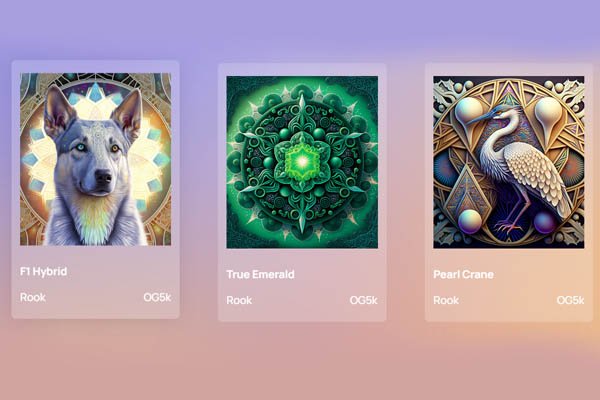
You can join our subreddit if you’re an artist and start submitting your work. You can follow us on Threads or Twitter if you want to see some of the work that we’re putting out. We have an art drop. The first artist that we’re exhibiting is our very own Eduardo Gomes. He has a unique collection of NFTs that were made by hand. These are not AI art. They’re beautifully rendered 4,000 glistening snowflakes. It’s called the Nightfall Flake series.
That’s July 20th, 2023. Folks will be tuning in to this after the drop but you will have a chance to check it out and see what it’s all about. Hopefully, we will share that on social. If our active audiences are checking out our social, they will get the alpha here. That’s exciting. Where do we go from here, recognizing the evolution nature of Web3 and how roadmaps are? They have a slightly different definition than other types of organizations like Snap for example. What are some of the features and collaborations down the pike?
We’re in the middle of NFT winter, and we’re a winter-themed company. It couldn’t be a better time to launch this project. Things are going to improve, particularly in the art market. What we have seen here about bringing amazing creators to the space will only continue. We have some amazing creators yet to be announced on our platform. We are working with some bright minds in the space and putting out some new work that you won’t find on other platforms.
You’ve given us a lot of alpha and a lot of awesome things to hear but, Josh, it might be time for some Quick Hitters.
I’m curious with this guy what comes out of this segment. Michael, are you ready?
I’m ready.
Edge Quick Hitters is a fun and quick way to get to know you a little better. There are going to be ten questions. We’re looking for a short, single-word, or a few-word response but feel free to expand if you have the urge. We already established it. He’s ready. Number one, what is the first thing you remember ever purchasing in your life?
I believe it was a Snickers bar in 7-Eleven.
That’s a very good computer programming default treat there back in the ’80s or so, not to date you. What is the first thing you remember ever selling in your life?
A 14-inch MacBook with the M2 chip. I love it.
What is the most recent thing you sold?
I sold some Flake.
Have you spent some time in the rainforest?
Kindness.
How about self-blame or needless shame?
Those are all pretty awesome.
Important Links
-
Twitter - Edge of AI
-
LinkedIn - Edge of AI
-
r/Flake - Reddit
-
Threads - Flake Art DAO
-
Twitter - Flake Art DAO
-
Flash the movie as NFTs spark excitement and skepticism - Article
-
Spotify - Edge of NFT
-
iTunes - Edge of NFT