Top Podcasts
Leonidas Of Ord.io — The Platform That Allows You To Explore Bitcoin Like Never Before
For quite some time Bitcoin has been left out of the race as its competitors dominate the NFT and Web3 space. It seems like that is about to change as innovators in the Bitcoin universe are starting to explore more possibilities. In this episode of Edge of NFT, our special guest shares how Ordinals are making it possible to create NFTs through Bitcoin. Leonidas, the passionate ordinal collector and visionary behind Ord.io, a revolutionary platform that takes your Bitcoin exploration to a whole new level. The trailblazer of The Ordinal Show, Leonidas is also renowned for the Leonidas Collection, a treasure trove of historically significant NFTs from the era of 2011 to 2020. Leonidas shares how Ord.io presents a unique opportunity to search, browse and cast or vote on ordinal inscriptions in an unprecedented manner. Tune in and join him as he delves into the captivating world of Bitcoin and NFTs!
Listen to the podcast here
Leonidas Of Ord.io — The Platform That Allows You To Explore Bitcoin Like Never Before
NFT-curious readers, stay tuned for this episode to learn all you wished you’d already known about ordinals, a new way to create NFTs through Bitcoin.
What classic collector’s item our guest first started getting into through the local farmer’s market.
Finally, explore the extraordinary world of primitive digital artifacts revealing a captivating narrative of innovation and culture. Before we move on, don’t forget our Outer Edge LA event returned to LA in March of 2023. You can now catch up on all the discussions, presentations and more by heading over to Watch.OuterEdge.live and register with just your email address. You’ll have access to over 60 captivating conversations and performances. Binge watchers are welcome. See you inside.
---
Our episode features Leonidas King, the passionate ordinal collector and visionary behind Ord.io, a revolutionary platform that takes your Bitcoin exploration to a whole new level. The trailblazer of The Ordinal Show, Leonidas is also renowned for the Leonidas Collection, a treasure trove of historically significant NFTs from the era of 2011 to 2020. Much like prehistoric cave paintings.
These primitive digital artifacts permanently etched into blockchains will serve as timeless relics for future generations. These pieces narrate a tale of innovation, culture, and empowerment and honor the early pioneers whose groundbreaking creations became the bedrock for modern NFTs. Ord.io presents a unique opportunity to search, browse and cast or vote on ordinal inscriptions in an unprecedented manner. Tune in and join them as they delve into the captivating world of Bitcoin and NFTs. We’re talking to Leonidas. How are you doing?
Eathan, how’s it going? I’m doing great.
Awesome. Great to have you.
It’s great to have you on. My Twitter alerts are always going off with all the content that you’re doing about this whole ordinals movement. We thought what better than have the Lion King himself on the show to break it down for us?
I appreciate that. I’m pumped to be here.
We are too. We want to start at the beginning here. We have very informed readers that are very curious about ordinals and BRC-20 but for a lot of them, this is going to be very new. At the very beginning, how did this movement come about and what’s its essence, then we’ll go into details.
This all started with this guy, Casey Rodarmor. He’s a Bitcoin core developer who came up with this interesting way to take an SAT. A SAT, also known as a Satoshi, is the smallest denomination of a Bitcoin. You can split every Bitcoin into 100 million sats, so you end up with 2.1 quadrillion sats in potential total circulation.
He assigns a number to these through this unique first-in, first-out indexing method that he created and essentially allows you to track all of these sats like individually as they move around the Bitcoin network. This was an innovation. Probably in 2022, he was starting to formalize this. He ended up creating a protocol called Ordinals and came up with this second innovation. This guy is full of magic tricks where you can take any file. Upload it to the Bitcoin blockchain and store data on Bitcoin or any arbitrary data. When you combine these two things together, you end up with a fully on-chain NFT primitive. That’s what we call ordinals and ordinal inscriptions.
When you say it like that, it all is pretty straightforward. What do you think, Eathan?
I’ve been following along with this. We’re good friends with Trevor from The Ordinal Show as well. He’s been into this quite heavily and watching it from a distance. There’s a bit of a buzz around it like I’m alluding to. The essence seemingly brings in Bitcoin and more into this whole Web3 ethos, which Ethereum is sitting in and other tokens are but maybe Bitcoin is seen as outside of it. Tell us a little bit about this. Demystify how things are different at this moment here.
It’s a very weird melting pot of, we’ve got Solana people, Ethereum people, NFTD gens mixing with these Bitcoiners, who I would call reformed laser eye maxis. They might have been the laser eye cult of Bitcoin maxis, who essentially is a bit of a generalization but they believe that you use blockchains for currency. That’s the only valid use case for blockchains. Everything else is to some degree unethical. They don’t like the Web3 activity and all the innovation on Ethereum and these other chains.
My general question was about the development of the culture here of Web3 over Bitcoin whereas it has been in existence within these other chains. It’s a little bit more heavily represented by Ethereum or Solana or other things. You’re mentioning that the Bitcoin maxis were a segment of culture that maybe wasn’t as into the rest of the ecosystem or thought of Bitcoin as a currency layer or tradable store of value, yes?
Basically, that Web3 culture ended up moving to these other chains. It started on Bitcoin back in 2014 with a protocol called Counterparty. There were some interesting experiments there but Vitalik basically came along and said, “I want to do this stuff but the people on Bitcoin aren’t very friendly to experimentation and innovation.”
They ended up doing this blockchain called Ethereum and you get this explosion in, smart contracting and general-purpose blockchains. That’s been largely the exciting trend in this space for years. Bitcoin, in my opinion, got left behind from a technological perspective and experience a period of stagnation. Only with Casey’s ordinance protocol have we started to break down that cultural wall on Bitcoin of, “It’s only acceptable to do the currency use case.”
Now that we can do NFTs, we can do fungible tokens. People are doing meme coins and metaverse projects. Everything you can do on Ethereum, there’s some way you can probably hack it together on Bitcoin. It’s not always going to be the best use case. Ethereum is good because you do have these smart contracts. It’s going to be a lot better at certain things. Specifically for storing value, like, “I want to take this image and put it immutably fully on-chain with this fully on-chain protocol. I want to hold that. I want it to store value for the next hundred years.”
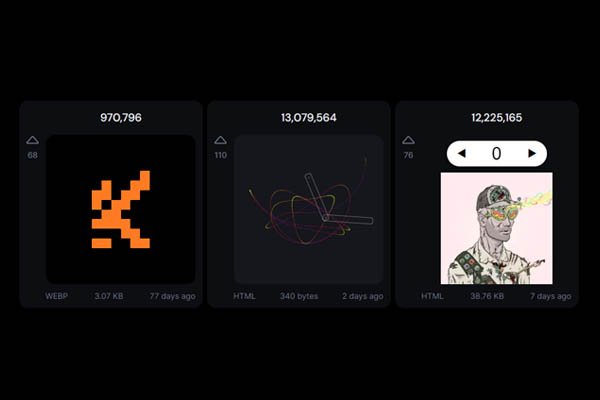
Bitcoin NFT: Everything you can do on Ethereum, there’s some way you can probably hack it together on Bitcoin. It’s not always going to be the best use case.
In my opinion, Bitcoin does that better than any other chain. For the reason, people value Bitcoin, the currency, for the security, immutability, and decentralization of the chain. People also value their art being stored here. What we’re seeing is this higher-end of the market coming over to Bitcoin. You’re not going to be doing these giant Solana-style projects with millions of people doing lots of transactions. You are going to see that higher-end of the market, which is a larger percentage of the market gravitate towards here. The thesis is the highest-value assets will want to be stored fully on-chain on Bitcoin because that’s the most secure way to store that value over time.
An analogy here might be folks have referred to Bitcoin as digital gold. In this case, what we’re talking about is engraving artifacts and digital gold where once that it’s engraved, it’s going to be there for a long time.
Since this data is immutable, you take that image and store it fully on-chain. It’s very simple. There’s nothing to do with it. You hold the asset. It turns out that that’s very ideal for certain collectors and assets. For example, on Ethereum, you have a lot of smart contracts that hold very valuable assets. There’s this expectation by the collectors of those assets that it’s going to be the same. We’ve seen some projects.
I won’t name the project but take that metadata and change it. They end up going to their gallery and seeing a middle finger is now the artwork. That’s because the metadata isn’t frozen, so it’s not a fully immutable primitive. Basically, taking the data and storing it on-chain then not being able to change that data seems like it might be a limitation but it turns out that’s a benefit for storing value and for certain assets. Your IPFS link won’t get unpinned in two years because you stopped paying the bills.
It’s stored fully on-chain. Your metadata is not going to get changed because there would be no way to change the metadata. It might be beneficial for certain projects to have that general-purpose smart contracting on Ethereum for specifically high-end NFT assets. For the Grail assets, you would imagine you want them to be the same. The Monalisa gets painted and we don’t want anything happening to it. That is what Bitcoin is good at storing.
I wanted to cover a few other technical areas of innovation that we were chatting about in the green room before to make sure that we dot our Is and cross our Ts. Speaking of innovation like rare sats and recursion, can you talk to us a little bit about these things as well?
Rare sats are basically taking these 2.1 quadrillion sats that we now can individually track and certain ones are being found more valuable than others by the market. I’ll give one example. Satoshi Nakamoto mined the sat and it was one of the sets of sats that he sent to somebody as a gift. It then got sent throughout the network over time and these sat hunters go and they sift through.
I know people who’ve sifted through billions of dollars of Bitcoin in their wallet extracting these rare sats. There’s a market for these because you can then inscribe on them. That’s an interesting thing for a collector. Now you can have an NFT and you have your image but it’s on a sat that was held in Satoshi’s wallet, which is this extra cool level of an NFT that you can’t do on another chain because of the way Bitcoin works.
That is the lowdown on rare sats we could dive into. There are absurd ideas I’ve heard like hitman sats from Ross Ulbricht’s arrest and all kinds of crazy sats that have been part of interesting moments in Bitcoin’s history. Pizza sats were part of the 10,000 Bitcoin transaction that bought two pizzas back in May 2010. The creator of ordinals, Casey Rodarmor, created this rarity index built into the ordinals protocol saying that the first sat in a block is uncommon specifying a bunch of these rare sats.
There are about 700,000 on commons. We saw that OKX started extracting theirs from their wallets, it looks like. Don’t quote me on that. This is what’s the buzz. We’re seeing miners also starting to pluck those out when they mine a block. They can get a little extra in addition to their reward. By taking those and selling those, they’re worth roughly $500 now. That’s rare sats.
Quick question about the sats in general. Can you trade a sat without it being in your wallet? Does it make sense? I might have sats in my wallet that somehow are attached to some previous transaction a long time ago. Is it that you’re trading something that’s almost like a collector’s card of that actual sat or do you have to have it in your wallet to have that SAT? I’m assuming it’s more like the collecting cards type of style thing or a little bit of both.
You could think about this and frame it in different ways. Casey calls this a collective delusion of like, “We now believe that these first in, first out indexing is how we’re going to trace these sats.” The way to think about it is say you have half a Bitcoin in your wallet. That’s 50 million sats. That’s probably going to be sats from 2009 and 2014 in hundreds of different places because it got sent all around the network. You got this mixed group of 50 million sats.
For each one of those sats, you could individually select it in your wallet and transfer that specific sat to another address. You are in that way like trading a specific sat. Again, this is all made-up indexing model that is not officially part of the Bitcoin protocol but because so many people believe in it, it becomes a thing, if that makes sense.
It makes sense. It creates numismatics around Bitcoin where there wasn’t one before. It’s up to the collectors what they find interesting or not. None of these has inherent value. It’s all human culture around, “This nickel was half made with copper or whatever it was so I’d love to have it.” Rarity is a common theme when it comes to numismatic and collectibles and things like that.
I also think as Bitcoin and being a very scarce asset becomes more scarce, this is foreshadowing a way of looking at the value of Bitcoin in a more granular fashion.
This is the analogy I’m using that I like that makes sense. Bitcoin is digital gold. The rare sats are digital diamonds. People are finding these little diamonds that are much more scarce than the 2.1 quadrillion sats. There’ll be some very small percentage of all Bitcoin that they can specify and have this narrative around, then trade those as if they’re non-fungible.
Bitcoin is digital gold. The rare SATs are digital diamonds. Click To Tweet
Did we cover recursion yet?
No. Recursion is this upgrade that we had to the ordinals protocol where, before this upgrade, you would inscribe a file. It sits on the full nodes all around the world. It is just a file and it doesn’t know anything about other files. In the new upgrade, you can use a certain standard of specifying in your inscription with code.
You can say, “I’m going to inscribe a bunch of HTML code and I want to pull this image from this other inscription that is stored on Bitcoin into my new inscription then place it on an HTML canvas,” for example. The way this works is, imagine you have a 10,000 profile pitcher collection. This would be extremely expensive to mint. On fully on-chain Bitcoin, storing those 10,000 JPEGs fully on-chain is not the cheapest thing.
People spent over $1 million inscribing the Bitcoin Apes, for example. With recursion, you could do that for 100 times less money. Let’s say you take 50 or 100 or however many traits there are in your collection. You take those, inscribe those transparent PNG files, then create 10,000 inscriptions of HTML or SVG code that says, “I want the data for inscription,” then you would do the ID for that inscription of this trait and, “I want this trait.” Bring those three traits and place them here, you end up with the on-chain art still. It’s the exact same image. If you’ll put it at the end of the day, you just stored it in a much more efficient manner. It’s essentially an efficiency upgrade that unlocks generative art basically.
It’s like Bitly. Instead of the full handle for the website, you have an abbreviation that still leads you to the end product.
That’s a great point. There’s a standard like Bitly to basically reference something else.
You’re totally allowed to use that analogy moving forward on the show without any attribution at all.
This is a new thing. People don’t necessarily know what to make of it. Full disclosure, could this come and go? We don’t know. I don’t know what’s going on here but maybe there are some people who are interested because they want to learn more and get into it. We’re talking about folks like digital art collectors, fine art collectors, or someone who wants to know if it’s going to affect them in some way. What is a great way for people to know more about it? Where would you have sent them?
I would tend to say go to Ordinals.com. This is the official explorer created by Casey. He has a handbook that he created there. I’d spend 30 minutes reading through that. That’s going to get you up to speed pretty fast. As far as getting fully onboarded from a practical perspective, you want to download what’s effectively the equivalent of the MetaMask for Bitcoin. Xverse and Hiro are two Chrome extensions that you can download to your extension.
It’s an identical experience using MetaMask. You can send Bitcoin into that from some other wallet address you have or from Coinbase or wherever. Now you have a wallet that you can start doing things with. Ethereum has dApps. Now Bitcoin has dApps. You would go to a website, connect your wallet, and then you could say, “I want to go to Magic Eden’s Ordinals Marketplace.”
You’d connect your Bitcoin wallet then you would buy your first Inscription. You could go to OrdinalsBot.com. You could take a file and drag and drop it. You could send that into the Bitcoin network and you’d pay the fee that it costs to inscribe. All of the things you’d want to do, there are websites and tools now where you can go connect your wallet and start interacting in this space. If you’re used to using MetaMask and OpenSea and all this stuff on Ethereum, this will feel pretty familiar to you. It wasn’t like this for the first month or so, but the tooling has gotten a lot better.
Quick follow-up there. I’m guessing people who are into NFTs, blockchain, crypto trading, and things like that are interested in this. They’re making a transition from, “I was trading this. Now I’m going to go over and get into this.” Are you seeing anybody going directly into this like, “I wasn’t into NFTs but I want to check out ordinals?” Is that a thing that you’re seeing? If so, what person would that be?
There are all kinds of weird situations like this. If you’re aware, Peter Schiff is this very outspoken critic of Bitcoin saying it holds zero value. He flooded crypto, Bitcoin, and NFTs for a very long time, then came out pro-ordinals. He thinks it’s pretty cool that you can store data fully on-chain from an art perspective on Bitcoin. He might not be super thrilled about some of the things that are going on but that’s an example of someone that I would personally would’ve never imagined we’d be orange peeling tether through ordinals.
There are people like that who, for whatever reason, the Bitcoin currency use case wasn’t interesting to them but they’re very interested in this stuff. Michael Saylor is an example as well of someone who wasn’t interested in Web3 on other chains but is a Bitcoiner who holds a very large percentage of the Bitcoin supply. He is now interested in Web3 because it’s happening on Bitcoin.
It attracts different people. There’s a crowd of Bitcoiners who find this interesting. They probably would’ve found Web3 interesting but because of their bags, they couldn’t justify going and using other chains, which to me is a little silly. Everyone should tip their toes into everything and experiment. There’s this group of people that you would not expect to be doing Web3 stuff but because it’s on Bitcoin, it’s now a little more socially acceptable for them to do that.
This Peter-ship thing is for real. It’s not a spoof. This is him doing this.
My cofounder met up with him at an Ordinal event in New York City and got him to put on an ordinals Ord.io hat and we inscribed that image. The guy is clearly interested in the art side of things, which I think is pretty fun. We were very welcoming people like Solana people, Ethereum people, and Paxos people. Bitcoin used to be a little bit adversarial to these groups. We’re very excited for these people to come here and for them to share what they learned in their Web3 experiences on other chains so that Bitcoin can grow and improve. We have to open our minds a little bit.
My co-founder, Zach, and I had this idea to take this explore experience, which at that time was this feed of every block that gets mined. You get a bunch of new inscriptions created in all these files and you could view them on Ordinals.com. We were like, “You can see this in the newest order.” We want to see the coolest inscriptions at any given time. We’re trying to think of ways to create a signal through all of that noise. What we ended up doing was creating Ord.io, which is an explorer for ordinal inscriptions.
We got a few here and there.
I’m ready.
What do they call that? The gambler’s fallacy.
That is true.
I would go for the bribe. It would be worth it.
They keep a tight shift but you never know.
I completely agree with that.
Twitter space, so lots of audio.
That is not fun.
He showed up too, though.
Give us a month.
Let me contact my guy.
Important Links
-
The Ordinal Show - Twitter
-
Casey Rodarmor - LinkedIn
-
@LeonidasNFT – Twitter
-
@Ord_io – Twitter
-
Spotify – Edge of NFT
-
iTunes – Edge of NFT