Top Podcasts
Jesse Dylan And Walter de Brouwer Of Snowcrash - Premier NFT Trading Platform Unifying Tech, Artists & Innovation, Plus: Spottie Wifi’s “Full Set” NFTs, And More…
What opportunities are there for musical artists and entertainers in the NFT space? Here to answer that are today’s guests, Jesse Dylan and Walter de Brouwer of Snowcrash. Snowcrash is a premier NFT trading platform that brings together diverse segments of technology, the creative arts, and digital innovation. Join Jeff Kelley, Eathan Janney, and Josh Kriger to discover how Snowcrash empowers incredible artists and partners with big brands and names to stretch what’s possible in art and entertainment. They share some exciting stuff they have in mind down the pipeline and their thoughts on the future of NFTs and Web3. Plus, your hosts chat with special guest Spottie Wifi on how he continues to push the boundaries of music and collaborations in Web3 as he teases a “Full Set” NFT collection.
—
Listen to the podcast here
Jesse Dylan And Walter de Brouwer Of Snowcrash – Premier NFT Trading Platform Unifying Tech, Artists & Innovation, Plus: Spottie Wifi’s “Full Set” NFTs, And More…
This is Jesse Dylan and Walter De Brouwer of Snowcrash, a platform through which we empower artists like never before. We are here on the Edge of NFT, the show that is out to empower you to do the next big thing.
—
NFT curious readers, stay tuned for this episode and find out how Snowcrash is empowering incredible artists and partnering with big brands and names like Bob Dylan and Miles Davis to stretch what’s possible in art and entertainment, how our guests bring together CCR, a donkey, and a passion for disobedience and disrespect in Quick Hitters, and finally how Spottie WiFi continues to push the boundaries of music and collaborations in Web3. All this and more on this episode.
Don’t forget that we put a little soiree called NFTLA that brought out thousands of the world’s most innovative doers in the NFT space. Head to 2023.NFTLA.live to get on the whitelist for tickets to our bigger, bolder, and better but also just as an intimate and impactful event happening in Los Angeles from March 20th to 23rd, 2023. See you there.
—
This episode features Jesse Dylan and Walter De Brouwer, Founders of Snowcrash, a premier NFT trading platform that brings together diverse segments of technology, the creative arts, and digital innovation. Jesse is a prolific director and storyteller dedicated to telling the stories of some of the world’s most innovative individuals and organizations including Gucci, the Guggenheim, Taschen, Sony Music, Vogue, the Open Society Foundations, National Institutes of Health, Harvard Medical School, the Council of Foreign Relations, IBM, MIT Media Lab, Milken Institute, One, Sundance, the Getty, TED, and more. He is also the Founder and CEO of Wondros.
Walter is an adjunct professor at Stanford University and the Chief Scientific Officer of Sharecare, Inc. He was an early investor in Bitcoin, Civic, Tokensoft, and Havvn, now Synthetix, the derivatives liquidity protocol. His interests are financial engineering, decentralized finance, and nonfungible tokens. Snowcrash empowers artists, cultural icons, content creators, influencers, celebrities, and brands to access the untapped creative and economic potentials of NFTs by harnessing latent value in already created properties, and by designing new digital assets and virtual experiences. Jesse and Walter, welcome to the show.
Thanks for having us.
It’s a privilege.
It’s great to see you.
It has been great getting to know you with our partnership at Superchief and having you over to NFTLA to see what we’re doing there. I keep hearing all the amazing things you are doing. We were excited to finally have you on the show to unpack what’s going on in your world.
Talk about a powerhouse team. We gave a glimpse into your background. We tried to keep it as short as we could but we could go on forever because you are truly so accomplished individually. It piqued our interest because of all these things that you’ve done and all these amazing projects that you’ve brought together over time. Why did you decide to form Snowcrash? How did it all come together?
We have been friends for a very long time. I’ve been looking for something to work on together. Walter has been a longtime crypto investor and me to a much lesser extent. When NFTs came up, I was buying some NFTs here and there. I felt like there was a missing space, which was the space for the musical artists, film artists, and different artists to be able to express themselves.
There had to be a connective tissue between artists. They’re not all Spottie WiFi who can see what it’s going to be before anybody else or look around a corner. It required some connective tissue. I thought that we could play a role in this space between what a conventional artist does and how they become a Web3 artist. I asked Walter about it. Walter thought it was a good idea, so off we went.
All these intersections mean so many relationships have formed over the years in your individual pursuits. You have this additional powerhouse support from Sony Music and Universal Music. How did that come together as part of this entire venture?
Like everybody else, they’re struggling with what this new medium means for their artists. Until crypto winter came, it was projected that the last two quarters would be all about how we move traditional musical artists into NFTs. They’re looking for ways to be current with the people who are buying their musical artists. They want to be in the right place. Everybody struggles with Web3.
As much as a lot of the ways the Web3 works are a super modern thing, it’s also a very arcane system. It takes a long time to learn how to move things in the space and not just drop things out, which nobody is going to buy or want to be invested in because they haven’t integrated themselves into the collection of people who want to participate with tokens.
NFT Trading Platform: There was a missing space which was a space for different artists to be able to express themselves. There had to be a connective tissue between artists.
To a degree, it seems like a lot of the larger music groups are, in some cases, trying to hold onto some semblance of control based on the existing system that has been around for many years. By the same token, others are embracing different elements and trying to find a way to collaborate with artists because if they don’t, they’re in trouble. There are all these opportunities coming up where artists can become more independent in a decentralized way. It’s cool to see those guys stepping up and collaborating with you on this project.
Artists are not just about the record companies. Artists can write a book or make a movie. There are all sorts of things that don’t involve record companies. In Web3, they have the opportunity to be everything that they express themselves as in one place. You will start to see different versions of what it means to be an artist. Walter, what are your thoughts on that?
If you look at the hip-hop industry, everyone wants to be Kanye West because he has, in a very business-like fashion, increased his brand equity over sneakers and producing music but also beverages. It’s a whole line where he gave his brand almost. That brand then exploded. He was number three before because Jay-Z was number one. Now Dr. Dre and Rihanna have come up. Most of these artists start to think in Web3 that they are more than just musicians. They can do other things. They can sell paintings, make beverages, or put their equity in other parts of the industry.
I believe that if you’re a fan of an artist, you will probably not only buy his music but you’re also going to all the things that he did. As we see on the data from Amazon, people that buy a book from one author mostly buy 2 to 3 books. From the moment they buy two books, they will buy all his books. The same goes for artists. They have seen or captured the revenue that they can have, which does not belong to the publishers. The publishers have bought the end product of a creative process. They have not bought the creative process, which has more than music. I believe it’s a very good thing for them.
That lawsuit between Miramax and Quentin Tarantino falls out because they think they bought some of his creative processes.
That’s a little different because it’s the actual assets themselves. They think they bought the actual assets they paid him to make. There are a million different ways these things are going to shape out. The other thing is that you can now be invested in the artists themselves. The artists can decide that they want to do something. Private equity can invest in a musical artist, whereas up to now, they have never been able to have a vehicle to be able to do that in a fluid or liquid way.
For the publishers and all of them, they have a lot of illiquid assets that nothing is happening with and nothing is going to happen with. Web3 gives them the opportunity to launch these things in a new and different way. If you like Nat King Cole, you might like the jacket he was wearing or the things he had in the hotel room he was staying in 50 years ago. Those are things that can be invested in as people start to see the metaverse come alive.
The way that things will be interacting with it will be very different from the way it is now. That’s what NFTs are good for. They become the currency of the metaverse. If there’s going to be a metaverse, it’s going to need NFTs to give us ways to move around in it and be able to open and close doors, and get things for our avatars, and to get the avatars themselves to all these things that artists are going to play a huge role in.
Spottie WiFi who’s going to come on later is wearing his avatar right on the screen. Soon everybody will be able to do that. Everybody could do that now. As we move around inside the metaverse, we can have that as our persona. If we’re not feeling well, we might switch to a different persona. If we’re feeling confident, there’s a different one. We might want to wear different clothes.
You will see all this customization and opportunity for customization in the metaverse, which is the way that artists can move forward. You also see lots of other things move forward like architecture. It’s like, “Where would I want to put my will? I’ll put it in the metaverse or someplace. I’ll put the deeds to my house and the loan for my car.” All those things can be dealt with in a new way as the world opens up. Everything that’s in this world will be in the metaverse and other things as well.
You think about where artists were before. You had concert and concert merchandise. That now feels so constraining based on the unlimited creativity that’s available now with these converging technologies. NFTs are the lubricant of this creator economy. It sounds like you are having a lot of fun doing what you’re doing.
You are storytellers by trade. You’ve worked with a lot of brands on their stories. I want to learn more about your mission or your North Star when it comes to how you align around who you work with and how you work with folks. I would love to learn a little bit more about your mission and approach to working with this industry, the mission for Snowcrash and then how you work with folks.
The mission for Snowcrash is the same as my personal mission, which is to always work with things that are excellent. NFT has a lot of excellence in it. I’ve been collecting for maybe a year, but then in doing Snowcrash, we have spent 2021 getting to know a lot of people. We have launched on Ethereum, Solana, and Crypto.com. We have had different collections on each platform. You learn a lot by seeing the different ways that people approach problems. Walter has all the technical knowledge. Walter, what have your impressions been?
The broader mission and what excited me is tokenizing showbiz. Showbiz is the old world for what we now call the media and entertainment business industry, which is a $1 trillion industry by 2023. If you launch derivatives into that industry on the IP that they have, this is something enormous. You can tokenize everything. This will be a ten-year process. It’s like mobile. Everyone is now mobile. We think we are using apps, but 34% of the apps are still browser-based.
It takes a while for people to go through that funnel and make them change. The tokenization of that complete industry is enormous. Imagine that. In 1995, everyone suddenly needed an email address. Otherwise, you wouldn’t find a date. In 2000, everyone needed a website. Although the dot-com was all done, they quickly needed a website. In 2010 and 2007, they all needed an iPhone. Remember the queues for mobiles.
In 2010, they suddenly needed social media accounts and a Facebook page. In 2015, suddenly they needed wallets and currency. In 2025, they will need the metaverse. They will need a world that they can link up to all the other worlds. We’re not building a metaverse altogether. We are building metagalaxies. That’s why Microsoft and Facebook are completely wrong. I’m looking forward to them failing because their agendas are biased.
It’s an interesting battleground these days when it comes to the established players. I noticed internal conflicts in myself of being so excited about Google many years ago, “All the world’s information is accessible to everyone.” It’s like, “It’s just my information that is accessible to everyone.” It’s going to be interesting to see how things play out. There’s a lot of hope here. At least, hopefully, something special can come out of these transitions. Let’s talk a little bit more specifically about some of your recent projects with Snowcrash. Are there any cool examples that we could roll through a little bit? Jesse?
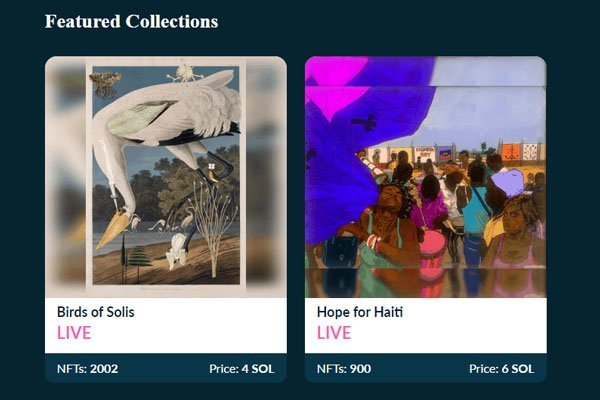
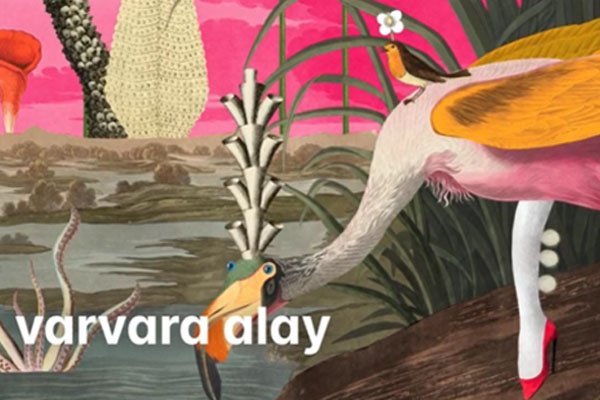
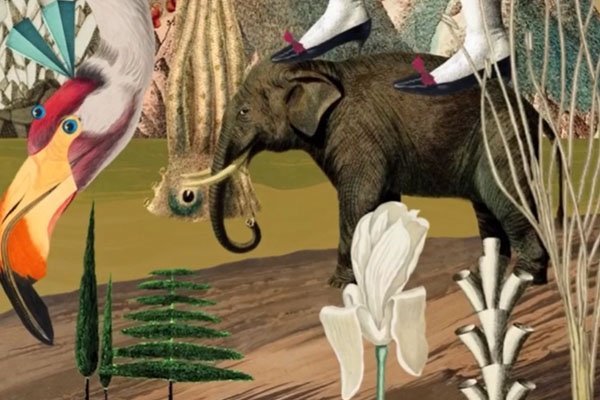
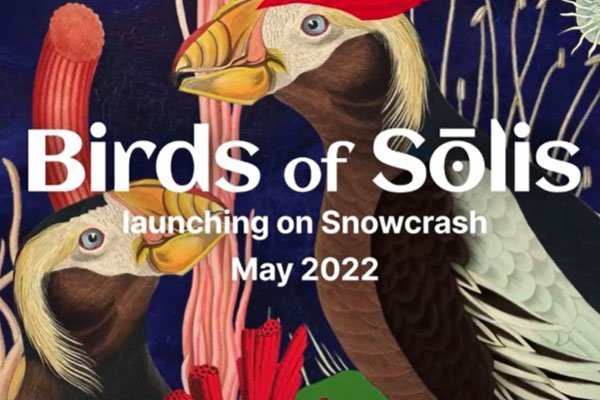
Birds of Sōlis is a project we’re super proud of with Varvara Alay who’s a crypto native artist from Russia. She came from Russia but she moved to Ukraine and Georgia. She’s a wonderful artist. We reached out to her very early on and then worked with her for about a year. We love the art. It’s beautiful art. That’s a pretty good collection.
How do you work with folks on projects like that? What’s the approach you take?
It’s different with each individual artist. On that particular one, I had an idea. She had done one little collection at that point. I reached out to her. She liked my idea, which was to combine the original Audubon print pictures and do her painting on top of them. She got excited about that. She was a great artist to work with.
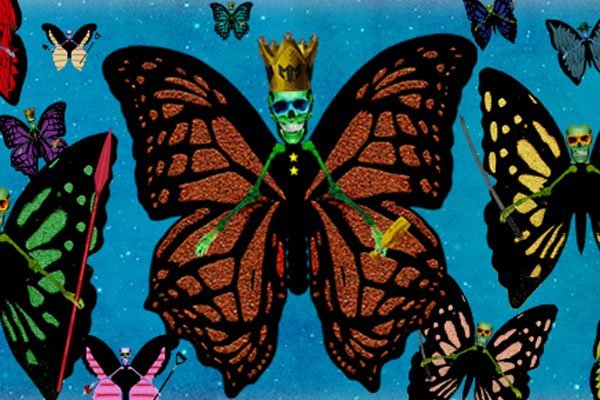
We did Maxim, who’s the lead singer of The Prodigy. He had done these butterflies and had an idea about butterflies but he didn’t know what it meant to be a crypto-native artist in Web3 or what that meant. It took us a while to work together to figure out what that would mean for him. We sold out his first collection. He has done a couple of other NFT things very early on. We sold out a collection with him, which was powerful and good storytelling, which is going to continue with more storytelling down the road as we go down the roadmap further.
The artwork is pretty awesome too. The lore of it and the whole story are super creative and cool. It sounds like you agree on that.
He’s talented in music. He goes to a fair one day where he’s thinking of buying some paintings for his house. He looks at the paintings and says, “I can do that.” He was great at that too. He’s newer to art but he’s a great artist.
We’re seeing a lot of that. We were talking about Gerard Way from My Chemical Romance, Umbrella Academy, and all that fun stuff. It runs deep in your DNA, creativity, storytelling, and how you bring it all together. You have some cool projects coming up. You’ve got Miles Davis and one with your pops, Bob Dylan, and some exciting stuff. Tell us about what you’ve got there in the pipeline.
We’re going to drop some artwork from my dad later in 2022. Afterward, we will do a drop with the estate of Miles Davis, which we’re pretty proud of doing. There are lots more after that but it hasn’t crystallized yet.
It’s probably different for each artist. What do you think about the different elements of utility? You are reaching into a bunch of different areas here for each of these collections you already mentioned. For these forthcoming ones, what construct do you put together around utility? How do you flesh that out?
We hear so much about utility these days. Walter, what do you think about utility?
We’re now in the Wild West. The NFT is the minimal viable product. It’s a very buggy Winchester revolver where we are going to prove Manifest Destiny. We’re only doing JPEGs. Soon everything will become IP even the JPEGs will become H.264 and H.265 MP4s. That means that these things that we are going to sell will be updatable. We will be able to push more stuff into it. They will give us access to things that we want to buy. It’s access to experiences. For me, that’s the utility.
There’s a utility from the standpoint where we see different versions of the artwork and then there’s utility where we see that maybe there will be a game or something else. We’re in the very early stages of thinking about what utility means from a storytelling perspective. I would like to see it mean more things where it keeps the audience engaged in a story that’s ongoing.
We’re beginning to see stories that work out like that. We have a project which isn’t fully fleshed out with Avi Loeb who’s the Head Astronomer at Harvard. He saw an asteroid go through our planetary alignment. Everybody thought it had an irregular orbit. He thought that it could be a piece of alien junk technology. We have a project that’s exploring what is that. Is it alien junk technology? Is it just a rock floating through space?
NFT Trading Platform: You’ll see all this opportunity for customization in the metaverse, which is the way that artists can move forward.
There are lots of ways that you can imagine. You talk about utility. A piece of that rock went into the ocean off of Papua New Guinea. He’s going to be taking a boat over there to see whether he can drop it down and pull a piece of it up. My thought about utility is that everybody could own a little piece of the asteroid. A utility has many meanings as you can think up at the moment.
My girlfriend is telling me that there’s all this space junk floating around Earth from all these launches. They were showing some pictures of it. It’s pretty gnarly up there. We haven’t even gotten started with all these space adventures to come. It could get a little messy up there in outer space.
I’m planning on staying here. I don’t know about you guys.
I like California.
I could think of some people who should volunteer for the trip to Mars but I’m not going to be going myself.
I’m good here on Earth as well. Walter, you started to talk about programmable NFTs. There’s a conversation that the first NFT standards were fast-tracked. They had to get out there. We have learned a lot about what we need in an NFT standard, especially from a video perspective when you get into holograms and start thinking about converging technologies like machine learning and the Internet of Things. You’re the perfect person to put it on a futurist hat for the moment and give us a little sense of what your thoughts are on the future of NFTs and Web3.
Especially for our clients, Universal, Sony and Disney, we have to convert everything they did in Web1 and Web2 to Web3. That means a lot of codes, integration and media players, which are software-oriented. We have to think for them to write protocols. They stream music or movies but also with certain conditions in the sense that they can stream them but at the same time, can they download them or not? It’s rent or buy, plus those geographic restrictions where we have to see on the satellite coordinates where these streaming are going and coming from.
Sure.
I bought a donkey.
We need to know more about this donkey.
It’s from my neighbor.
Are you sure these were Life Magazines, Jesse?
I wasn’t that clever.
Walter, this is very achievable.
Jesse?
They’re born with it.
Jesse, how about you?
It’s those combined. Jesse. How about you?
It’s anger. I want to have less anger out there.
I had a meeting with Jesse.
It was the meat and potatoes of the thing.
How about you, Jesse?
I’m going to lunch with my kids.
Spottie, can you play us a little of it?
You only collaborate with Bored Apes.
We’re trying to get over to Solana.
We will hook up with the DeGods or something.
Thank you for having us.
It’s my pleasure. Thank you, guys.
Thanks, Jason.
It’s @SnowcrashNFT on Twitter.
** Important Links**
-
Discord – Spottie WiFi
-
@SpottieWiFi – Twitter
-
@DotConnector – Instagram
-
Twitter – DotConnector NFT
-
@SnowcrashNFT – Twitter
-
Spotify – Edge of NFT
-
iTunes – Edge of NFT
About Jesse Dylan

Jesse Dylan is the founder and CEO of Wondros and the co-founder of Snowcrash.
Dylan has directed acclaimed feature films, documentaries, music videos, and advertisements. He’s behind some of the most successful campaigns in commercial television, print, and interactive advertising. In 2016, he started working for the National Institutes of Health All of Us research program, creating and launching campaigns to enroll one million Americans as partners in revolutionizing personalized medicine. He also created a narrative strategy for the Biden Cancer campaign #cancerFIERCE, that connects cancer communities to the resources they need. In 2008, he directed the Emmy Award-winning Obama viral campaign “Yes We Can.” In 2012, he directed the Black Keys music video “Lonely Boy.”
About Walter de Brouwer

I am the Chief Scientific Officer at Sharecare which went public on NASDAQ [SHCR] in 2021 after having merged with doc.ai, a Deep Learning company building AI-assembly lines for the healthcare industry. I run Glasgow3 LLC, a venture fund that invests in decentralizing technologies and am a general partner in the venture capital holding Emerald+.
I hold a Ph.D. in Computational Semiotics from the Catholic University of Tilburg (the Netherlands) and am the adjunct professor at Stanford University School of Medicine (CERC). I am the Chair of the IEEE-SA IC19-004-01 – Synthetic Control Arms with RWD -and a member of the American Mathematical Society.
My current interests are in Crypto-economies, MetaVerse, TinyML, DeFi, 6G and Micro-satellite constellations.