Top Podcasts
J.P. Alanís And Justin Alanís Of StoryCo - The Open Storytelling Platform
One of the great things about Web3 is how it enables creators and their communities to co-create projects that can benefit them both. This is what StoryCo aims to do. This innovative platform fosters collaboration between creators and avid fans, empowering them to co-create exceptional story franchises and share in their success. JP Alanís, an accomplished development executive, co-founded StoryCo after previously co-creating and leading Golf Media. Justin Alanís, the other co-founder of StoryCo, is a seasoned entrepreneur with expertise in technology and private equity. Taking advantage of their complementary skillsets, these siblings/cofounders are working on one of the coolest projects in the Web3 space, one that is set to change the way that IP is created and owned. Tune in and learn more! Plus, learn about the upcoming AURAS project, where Jeremy Cowart will create 10,000 project live in front of an audience from start to finish.
Listen to the podcast here
J.P. Alanís And Justin Alanís Of StoryCo - The Open Storytelling Platform
This is JP Alanís.
I’m Justin Alanís. We’re the Cofounders of StoryCo, the platform that’s changing the way that IP is created and owned.
We’re here on the Edge of NFT, the platform that’s leading the way to learn about the coolest projects at the outer edge of Web3.
NFT-curious readers, stay tuned for this episode to learn how StoryCo is an exciting platform that enables creators and their fans to collaborate and share in a story’s success.
Also, find out about the symmetry and shenanigans of two creative brotherly co-founders.
Learn how one ambitious creator plans to make a 10,000 PFP live in a twenty-minute time span. Finally, Outer Edge LA, our awesome community-centric gathering, returned to Los Angeles from March 20 to 23, 2023. If you think you missed out, there’s a way to catch up on all the interactive experiences, discussions, presentations, and more. You can do that simply by going to watch.OuterEdge.live. You can register with your email address and get a full recap of over 60 captivating conversations and performances. Binge watchers, welcome. Netflix, watch out. See you inside.
This episode features JP Alanís and Justin Alanís, the dynamic co-founders of StoryCo. This innovative platform fosters collaboration between creators and avid fans, empowering them to co-create exceptional story franchises and share in their success. JP Alanís, an accomplished development executive, co-founded StoryCo after previously co-creating and leading Golf Media.
As the direct-to-consumer media platform and production company founded by Tyler, The Creator, Golf Media saw JP overseeing content development, events, product and technology, and sales of incubated projects to linear television. With a BA in Business and Cinematic Arts from USC film school, JP played an instrumental role in the sale of The Jellies to Adult Swim and Nuts & Bolts to Viceland.
Justin Alanís, the other Cofounder of StoryCo, is a seasoned entrepreneur with expertise in technology and private equity. He is an active core community member at various decentralized organizations that invest in and nurture emerging Web3 technology companies. Justin’s experience includes founding and serving as CEO of a data analytics technology company, which was acquired in 2018.
In addition to his work with tech startups, Justin is a proactive investor in the startup ecosystem. Finally, StoryCo is a revolutionary open storytelling platform that allows storytellers to effortlessly create and publish multimedia stories. By engaging and cultivating a fan base, they can develop these stories into vast universes, harnessing the creativity and ideas of their community. Justin and JP, welcome.
Thanks. We’re excited to be here.
Thank you for having us.
We’re excited to have you here. We have been long-time fans of what you are doing. Thanks to Gordon for introducing us. It feels like a lot has happened in the space and your world and ours since then. I’m glad you could be part of Outer Edge LA as well.
We appreciate you. Thank you for having us on.
Where are you based?
We’re in different places. Justin and I are brothers if you couldn’t tell by the name or the difference in good looks also.
I got all the intelligence and charm.
I’m in LA and Justin is up in Oakland.
Eathan is in Chi-Town and I’m back in my previous home base, Washington, DC at the moment after a brief stop in Boston where I got to see the Celtics crush the Hawks in game two.
We will see you in the NBA Finals. It’s another Lakers-Celtics final.
We’re following it.
I’m into it. I love both teams at this point because I’ve been in LA for about eight years. That would be a fun story in the making. Speaking of stories, you are doing some things to revolutionize IP, the way it’s created, the way it’s owned, and how it moves from top to bottom, centralized closed-system to bottom-up, and decentralized, which is a word we like a lot when it matters in the space. We would love to hear more about the founding story and its implications. You don’t have to start it when you met at birth. Let’s stick to the actual company itself and how you came together here. It’s cool.
I’m happy to kick it off. Eathan talked a little bit about my background but when I got into Web3, I started to meet all these entrepreneurs and founders in the space and understand and realize the amount of innovation that was happening in the space and what the future of the space could offer in terms of new ownership models and new access models.
I started getting deep into the NFT space. I bought a couple of CryptoPunks, I minted a Bored Ape, and I got fixated on the future of what media could look through the face of NFTs. I could see toward the future also what was happening in the artificial intelligence space although that was still early in that space. My brother, JP, was a producer in Hollywood. We got to talking, and JP started seeing a lot of things that were happening within Hollywood that he could talk about quickly. Our mutual insights came together in a unique and interesting way to find StoryCo.
I never thought we were going to be able to work together. We worked in completely different sectors and different spaces. We’re great friends as brothers but never did I think that we would find something that we could work on together. This fits so perfectly in both of our skillsets. It has been such a pleasure working with my brother. It’s so nice because we do come from such different worlds, career-wise, that there’s not a lot of overlap. The great thing about a co-founder relationship is when you don’t have that overlap, you can operate in your verticals, and you’re complimentary. That has been fun.
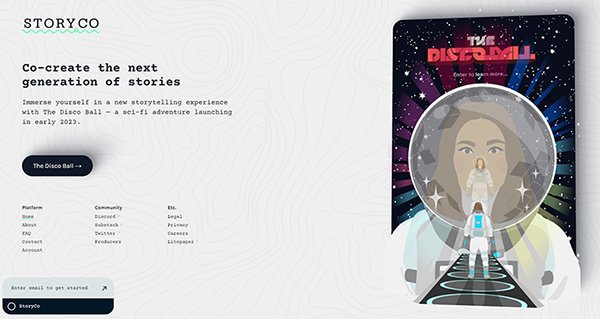
StoryCo: The great thing about a co-founder relationship is when you don’t have that overlap, you can operate in your verticals, and you’re complementary.
Congratulations on being able to work together as brothers because it could go either way.
There’s still time.
JP and I have never had a major argument. It’s pretty incredible. Throughout our entire life, we have never had a major argument.
Are there any disagreement that include a suplex or something like that? Are there any wrestling moves that you had to use to resolve disagreements?
There’s none of that.
I’m super curious about how many sibling companies have been founded. I could ask ChatGPT about that. I don’t have to ask you but it’s fascinating stuff here.
There are a few of them. The most notable is Stripe with the Collison brothers. I don’t even know what the value of that business is at this point. I was watching something that Sam Altman talked about that was non-AI related when he was running Y Combinator. He said that the most successful startups are founded by founders who intimately know each other. The relationship where you come together from a transactional nature and found a company together often dissolves or disintegrates because you can’t go through those complex or hard times together. The relationship is not stable enough. Having a brother or a best friend from early childhood tends to be the relationship and the business that thrive the best because you can withstand those hard times together.
The most successful startups are founded by founders who intimately know each other. Click to Tweet
That’s awesome. Let’s talk a little bit more about the result of StoryCo. You’ve got this collaborative storytelling focus in the Web3 domain, which is a very interesting place to explore. Can you give us an idea of the mechanics here of how storytelling gets achieved in a new creative way?
We can start by addressing some of the existing problems around IP generation as it exists in traditional media and then dive into how we’re trying to solve some of those problems. There are a lot of issues but let’s talk about two. The first one is that creating IP is a tough road to do it traditionally. There are a handful of gatekeepers that get to decide who gets to play. The pool of people that do get to play is gatekept as well. It’s hard to become a creator in Hollywood. You got to jump through a million geographical and socioeconomic hoops. It’s intense.
There’s a whole ladder to climb as well. It’s not just a ladder. I imagine it’s this Donkey Kong ladder where you climb the ladder. You got to jump over here and do this. You get bonked on the head by something.
You’ve got to make the decision to move to LA and then convince an agent to represent you. You start as an assistant making a non-liveable wage. If you have student loans, that’s probably not even viable for you. Who gets to play here? Very selected people get to play. That has no bearing on how creative you are and the ideas that you can come up with. It is not merit-based whatsoever. It’s merit-based once you get in at some point but to enter that ecosystem is not a meritocracy.
The other problem is in the last couple of decades, the gap between creator and fan has started to narrow. Fans want to be closer to the IP that they love. IP has become more ingrained into people’s identities. You see that at things like Comic-Con and the rise of cosplay and all these things. You see that in the rise of fan fiction. People want to be contributing to these big narrative universes. They want to feel like a part of it. How do we facilitate that closer relationship between artists and fans? At StoryCo, we strive to solve both of those problems. I can pass it to Justin to get into how we’re doing that.
Before you do, I have to add this funny facet of going back to climbing the ladder and doing low-wage internships. This has been around for a while. It’s a website. It’s called Stuff White People Like. It’s a blog. Number 105 is unpaid internships. It says, “In most of the world when a person works long hours without pay, it is referred to as slavery or forced labor. For White people, this process is referred to as an internship and is considered an essential stage in White development.” That applies to Hollywood to all races. That happens to the best of us. It’s an excellent description of how internships evolve.
It’s crazy when we interview people who come from traditional Hollywood and the nightmarish stories that they tell us of being an assistant to some producer who treats them horribly. This is the status quo in Hollywood. You saw what happened with Harvey Weinstein. This is the corrupt culture that exists within Hollywood outside of the nature of the people who get to go in. I even saw this whole thing about how all the actors’ kids are now the ones who are coming out and being the new stars, the new writers, and all of that. There’s a huge amount of nepotism within the industry as well.
One of our first artists is Kyle Killen. We will get into all this. He comes from Nigeria. He has a twenty-year-old school in Nigeria. Now he’s getting access to amazing actors and writers. He’s doing all the illustrations for one of the backstories for The Disco Ball. It’s this incredible experience that we have been able to witness. We’re starting to see the talent that exists out there and give them the deserved exposure that it warrants.
I appreciate all that. Web3 gives us some special superpowers when it comes to co-creation that weren’t around. Here’s a shout-out to Legion M, one of the early pioneers in trying to get fans involved in creating different types of things at a different level of engagement with what they’re doing relative to what you have cooked up here in much more making the sausage. I’m excited about how you’re creating this experience with The Disco Ball, which is one of the new things that you have been working on. I would love to understand more about it and how it functions.
The first thing to understand, going back to what JP talked about, is that we’re creating a platform first and foremost. We believe that the energy, the network, and the creative powers of all these people from around the globe should be expressed in a platformed environment where there’s a product that harnesses all of this energy and allows people to create new multimedia stories and distribute those stories in a front-end interface that feels like a motion comic.
It’s a multimedia comic where it’s a scrollable narrative experience that feels like a livable and breathable storyboard with audio and visual elements that come into this viewing experience. It layers in all sorts of other multimedia elements, live action, short animation, and things like that. It’s a new way to create and distribute but also the ability then to engage and bring fans into the fold, build an audience around that creation or that story, and then also bring those audience members in as co-creators and co-owners of that story to expand that universe. That’s the premise of what we’re doing.
The Disco Ball is our way of producing our first production or story and demonstrating to everyone the power that this platform can deliver to the art of storytelling and the future of storytelling. The Disco Ball is a multimedia immersive and interactive story. We have partnered with an amazing Hollywood creator, someone inside the gates, named Kyle Killen. He was the showrunner and producer of the Halo series on Paramount, the Fear Street series on Netflix, and a couple of network series on ABC and Fox.
We paired him with these amazing artists out of LA named Shelby and Sandy who are doing all the storyboarding, illustrations, and character design. We’re pairing them with these musicians named Superposition. They’re Grammy-nominated musicians who are doing all the soundscape and sound effects. We’re starting to bring all these multimedia elements to the table with these amazing creators. The idea behind The Disco Ball is that we’re taking our community on this amazing storytelling journey where they become a part of the story itself.
They’re actors almost in the story. They’re going to be finding clues, solving puzzles, going on this immersive IRL and digital journey, and also engaging in what would be an incredible television show or movie that would probably air on HBO or Showtime but it’s being told through the StoryCo platform. That’s the quality and the nature of the story that we’re developing here. The idea is that we’re slowly opening our gates to new production companies, co-producers, and creators to tell new and exciting stories and push the boundaries of storytelling on the platform as we open up these creator tools.
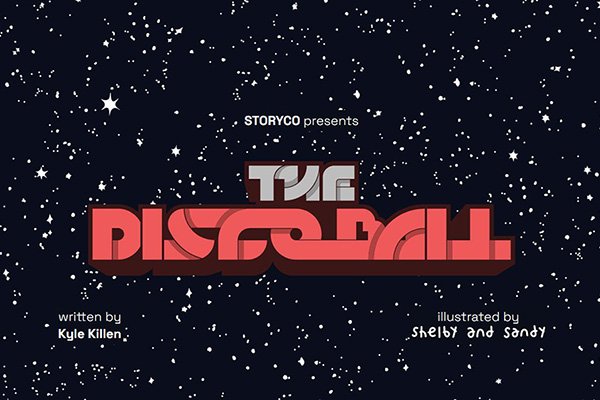
StoryCo: We’re slowly opening our gates to new production companies, co-producers, and creators to tell new and exciting stories and push the boundaries of storytelling.
Here’s a quick clarifying question. I’m trying to get a scope of the gravity of what we’re talking about here. How many creators or collaborators are getting together to pull this off?
For The Disco Ball, there are quite a few. It depends on what you mean by collaborators but we have an internal team working on the development of this. We have Kyle who’s writing the entire thing. He’s doing that himself. We have artists like Shelby and Sandy who are creating all of the artwork and musicians. We have amazing A-list actors doing a lot of the voices and performances for all of this. We have voice directors who are directing them.
All of these different creative elements are coming together to create this production because we believe that The Disco Ball is going to create this foundation for this narrative universe that people can start to build on top of once we tell this core narrative. We’re trying to prove a lot of those theses that we have around community co-creation early on. Justin alluded to this a little bit earlier. We have this major character in The Disco Ball. He’s our main antagonist. Kyle has written an entire backstory for that character. An A-list actor has recorded the VO for that backstory already.
We wanted to test some of our theories. We said, “Who’s going to create the art for this backstory? It’s not Shelby and Sandy because we are almost going into his past. Maybe the visual style is different. What if we could find someone who could possibly do this?” We put a bounty out there. We got tons of submissions from artists all over the world. We had our producer token holder community evaluate all of the submissions that came in. They narrowed it down to three. We had those three do a little bit of additional work that we presented to the producer token holder community. They picked a winner.
We couldn’t be happier with the artist that they picked. His name is Aanu. He’s twenty years old. He lives 15 to 20 minutes outside of Lagos, Nigeria. He’s an art student there. The things that he’s been coming back to us with are incredible. It’s a microcosm of what we believe. It’s the tip of the iceberg for us. It’s the first proof that there are all these amazing creators out there that have the ability to contribute meaningfully to Big IP because we have amazing Hollywood writers doing this. We have A-list actors doing this. We have Aanu. He’s fitting in like a glove. The things that he’s producing are incredible.
He’s not someone that would have necessarily come into the mix through the normal process. That’s cool. What do you think, Eathan?
Not necessarily at all. It reminds me of some of these Web2 stories of some kid in Africa who is making homemade helicopters from junkyard parts. He gets to go to MIT or something because somehow they found him more than they wouldn’t have previously. Let’s talk about this promise that Web3 is going to allow creators and fans to dominate. It’s exciting. It motivates us. It helps move the space forward but there was a Web2 promise that musicians would be able to take control of the production process and distribution process and cut out the middleman.
In a conversation at our closing talk on music at the main stage of Outer Edge, it was this idea that you listen to Spotify. I walk into a store. They’re playing some cool music. I say, “This is great. Who is this?” The person at the counter says, “I don’t know. It’s Spotify.” All of a sudden, Spotify gets all the credit and all the money. The creator in the background is making $0.02 a play. Briefly, because we have some other questions to cover, how much do you feel like this promise is going to be fulfilled with Web3 and AI? What do we have to worry about? How can we defend against the negatives that might occur here?
I was going to comment that Web3 is this enabling technology more so than the distribution engine for a lot of this. Traditional Web2-based products like a Spotify experience or what Audius is doing in the music space and Web3 are a little bit more what we’re going to see from a traditional distribution perspective. You still need to centralize that distribution in some way and have marketplaces of information and creativity. You talked a little bit about, “Are the creators going to take control of this process?” AI has this barbell effect to help us both take control of the process but also lose control at the same time.
I didn’t listen to that but I heard of it.
At least give me a recommendation or two.
Thanks for getting us back on track, Josh.
JP’s was probably Beanie Babies.
The show?
A la Warren Buffett’s early life.
I didn’t know Warren Buffett did that.
That’s what I did.
You’re making it hard to remember.
This is our ADU behind me.
Money is no object.
For sure, I would buy an NFL franchise.
What about you, JP?
My inability to focus on one thing.
Justin, what about you? Will you be calling JP?
Swashes.
It’s so much fun. Thanks so much.
I appreciate you. Thanks for having me.
Take care.
See you, Jeremy.
I was there. It was a great panel.
We have one more shout-out.
You don’t have to tell Josh twice.
We call it the double beef binge.
That’s the only way to watch it.
Eathan, you’re making JB hungry over here.
The oil it’s cooked in is not healthy.
Important Links
-
Kyle Killen - Instagram
-
Aanu Okereafor - Twitter
-
Gordon Gould - Previous episode
-
Discord - Block Queens
-
Lee Sung Jin - Instagram
-
@StoryCoHQ - Twitter
-
@DiscoBallHQ - Twitter
-
Spotify - Edge of NFT
-
iTunes - Edge of NFT