Top Podcasts
Emma-Jane MacKinnon-Lee: The Thriving Digital Fashion For Gamers In NFT, Plus - Bored Ape Yacht Club, Disaster Girl NFT, Digital Race Horses, 1st NFT-House Combo, And More
Day after day, especially during the pandemic, the gaming industry grows significantly and becomes more prominent than ever. Emma-Jane MacKinnon-Lee jumped into this thriving ecosystem and founded DIGITALAX, the first digital fashion NFT protocol and marketplace for eSports and gaming. Joining Eathan Janney, Jeff Kelley, and Josh Kriger, she explains how providing outfits to gamers give them a unique experience and opportunities to build brand and increase monetization. She also explains their role in reducing waste in the ever-growing clothing sector and building a community empowering indie creators. Emma-Jane and the hosts also dive deep with how the Disaster Girl meme NFT sells for half a million dollars, how NFT impacts real estate acquisitions, and thoughts about investment thesis. They even explore how animals find themselves in the realm of NFT with the rise of the Bored Ape Yacht Club and digital horse racing.
—
Listen to the podcast here
Emma-Jane MacKinnon-Lee: The Thriving Digital Fashion For Gamers In NFT, Plus – Bored Ape Yacht Club, Disaster Girl NFT, Digital Race Horses, 1st NFT-House Combo, And More
We aim to bring you not only the top 1% of what’s going on with NFTs, but it also will stand the test of time. We explore the nuts and bolts in the business side and also the human element of how NFTs are changing the way we interact with the things we love. This show is for the futurist and dreamers, the disruptors and creators, the fans and connectors and the makers and doers that are pumped about this ecosystem and driving where it goes next.
This episode features guest, Emma-Jane MacKinnon-Lee, Founder and CEO of DIGITALAX, the first digital fashion NFT protocol and marketplace for gaming and eSports. DIGITALAX is building native Web 3.0 infrastructure for supporting the entire digital-only fashion, digi-physical fashion supply chain, incentivized ecosystems for designers, developers, players to earn new livelihoods through casual eSports. Also, developing the first truly interoperable 3D file transfer format using native crypto and NFT incentive models for enabling a flourishing open-source developer bazaar, a dynamic cross-platform format for the metaverse. Emma-Jane has worked in the deepest corners of crypto from options trading and crypto hedge funds to being appointed by the Dubai government to develop blockchain use cases across the financial, transportation, trade and logistic tourism and real estate sectors. It’s great to have you on the program.
Digital Fashion: You cannot build ecosystems of incentives that program customizable value to different stakeholders. But within crypto, that is possible.
Thank you for inviting me on.
We have to start here with your college years. You were literally studying to be a rocket scientist and building race cars in college, and you’re like, “This stuff’s too boring. Let me go disrupt the entire world of blockchain instead.”
I was studying Space Engineering. I’ve always loved the space. You grew up with this aura about the space. I’ve always wanted to and I still do want to go to space and be an astronaut in whatever form that looks like. I started with that. That was in Australia at the University of Sydney. I was also part of the FSAE team, which is the Engineering F1 team. It’s a university-college competition. It’s global. You build an F1 car and then it’s raced against all the other colleges worldwide. I’m the first female engineer to be chosen for that. I was doing some interesting stuff but my personality is someone that I’m not a status quo or someone that likes to be put in a framework or a system.
I knew that although there’s great stuff that you can learn at school and college is different from the real world and what I wanted to achieve in my life, which is always having this much bigger mission of how I can bring value to millions of people and what does that look like. When I came across web 3.0 and blockchain and crypto, I saw that this is the future and this is where stocks are going. I need to do something in it and build in this space. It wasn’t an easy decision because I had a lot going on, but it was an inevitable thing. I don’t think I ever thought that I would be finishing my college years, much to my parent’s dismay.
Where did the name of your business come from? Why did you decide on that name? Does it have significance or did it just sound great? What are your thoughts on that?
I was in Dubai when I started DIGITALAX in a sense and bringing everything together. I wouldn’t say that there’s a huge backstory to it, but I wanted something that sounded cool and this hybrid digital in the sense and it had that as a cool component. The AXA, I can’t remember too much of the story. I remember I was sitting in the office where I was in Dubai and thinking of different names and wanting to have that digital part to it and then I was like, “X is really cool.” Having it as this digital X is a bit not right or it’s too common in a sense, so I put in the A and then I was like, “That’s it now.” I’m stuck with it because I’m talking to people about it and it stuck.
It’s taken on a life of its own.
How did your educational background prepare you for building what you’re building now and how did you address the gaps in knowledge that you needed with direct education and the types of folks that you needed to bring together to create this venture?
I never accept the frame that’s given to me and I’ve always loved being a female as well and loving Math and Physics. It’s quite rare, because usually, even in engineering school was heavily male-dominated. Even when I went into Space Engineering, I was told that because of the subjects that I chose in high school in Australia, that they would never accept me and that I would never be able to get in. I took that and I said, “No way. I know exactly what I’m capable of and I’m going to prove you all wrong.” That’s what I did. It’s a process where you have to get accepted.
You don’t just go in. You’ve got to achieve certain marks in difficult subjects. I went in and then I gave it my all. I proved them all wrong and I got accepted. Taking that same framework when I was putting DIGITALAX, it’s not so much about, what are the gaps or what do I don’t know, but it’s how they look at the situation differently and break everything down into basic principles, because that’s what I find when I talk to a lot of people. It’s always that thing of how do I get in? Even NFTs, how do I get into space when I don’t have this or I’m not sure about that?
Every day I have problems put in front of me where I’m like, “I’ve never experienced it before.” There’s no textbook that I can go to and read off and say, “Let’s take this formula and apply it here and then we’ll get Y as our outcome.” It’s never been like that. It’s more making sure to have an approach of an open mind. I know it sounds cliché, but it is the truth that if you go in with the mindset of, “I’ve been put in this box or because I studied this or someone else in society has framed me as being good at this but not as that, then I should accept that frame.” If you go in and you think, “At the end of the day, it’s just a problem, a puzzle.” If you can break down and identify what are the pieces and then slowly start putting it together, then it can be solved.
I’ve always had that mindset. It’s been great because it hasn’t been this blockage of stopping me where I think, “Because I didn’t study that specific thing or I don’t know that topic well,” which is even in an engineering side, DIGITALAX is focused on and also the engineering. How do we innovate from not just a business or commercial perspective, but from the engineering side? We have an amazing internal engineering team where we’re pioneering and pushing new open-source code out there every day. I don’t have a direct coding background in Solidity or React and these Web 3.0-based languages, but it’s going in more and knowing there are different ways that you can look at it and solve the problem. If you surround yourself with the right people as well, there’s always a solution that can come out of that.
It’s a massive undertaking that you’re building here. We gave some background on it for our readers, but we’d love to know where your current vision for the company stands.
It’s a big vision. How I like to describe it is we’re building out an ecosystem. A lot of projects, when they come into this space, they think, “I’m going to focus on this niche area and hone in on that and then deploy products or services or whatever around that area.” Coming in from the perspective of knowing what the space is at the moment and where it needs to go, it’s what did DIGITALAX is focused on. It’s how do we build out the infrastructure layer? How do we build out the low-level core protocol layer? Instead of it being from a perspective of we are coming in and how do we generate value for ourselves, but rather how can we create an ecosystem that eventually anyone can plug into and start creating value.
That’s always been the mindset. It’s the old Uber model is how I like to describe it. The reason why Uber was such a success, people can look at it and they can say, “It’s a great U/X on the app.” You go a layer deeper, you could say, “It’s super convenient. I can log in and I can get to a destination anywhere in the world within a couple of minutes.” If you go a step deeper why Uber was so successful, was because what it allowed is it gave people freedom. They sold freedom in a sense where if you were a driver, immediately you could get gain access to a live market in value anytime. You didn’t have to conform to these schedules or go to a 9:00 to 5:00 job. It’s the same from the consumer point of view. You also allowed freedom and convenience and you’re matching this whole marketplace together.
I know Uber has changed very much now and there’s a lot of caveats. It’s not as simple as that, but breaking it down into that base was what I wanted to transfer into DIGITALAX. It’s what Web 3.0 and Ethereum and the whole crypto ecosystem are all about as well. It’s about breaking down walls and barriers to have more savvy doorways into opportunities that can suit each of us best. We’re focused on doing that from the fashion, gaming and eSports sector. That itself encompasses when we think about metaverse. Its players and creators and how do we create a player-creator economy. We started with our marketplace built on Ethereum. That was all about looking at how do we even create distribution channels for digital fashion? What does it look like to back value behind digital fashion goods?
Before then, there wasn’t anyone doing anything in this space from looking at it from the perspective of how you build the industry. It was more advertising or used within specific points of vacate creators design process with the 3D modeling point of view. We looked at it more from, if there is going to be a whole global supply chain for digital fashion or even hybrid digital-physical, then there needs to be a way to track that and then also back value behind it transparently. NFTs having my background in Web 3.0 made the absolute most sense and this hugely scalable distribution channel. We started with the marketplace partnering with over 30 digital fashion designers globally. Some were based from the US and ex-Nike designers in Portland, others in Europe, Rwanda and Australia.
They created these cool designs. They listed them on our marketplace and then we sold them at auction as digital fashion NFTs. They also had DeFi and staking functionalities as well. That was how we started and also doing interesting things from a supply chain point of view when it comes to how do you break down and modularize the composability components of NFTs and allow designers to issue patterns and materials and textures as ERC-1155 tokens. Other designers can create or use these patterns in their master garment and issue an ERC-721 but on-chain, that can be trapped from the minute level where a 721 is able to own balances of the patterns of materials and textures in the 1155 tokens. That brings completely new monetization and royalty distributions for the artists. We started looking at that side and then we moved into the game integration because I’m much a believer that the cosmetic side, particularly in fashion, it’s not enough.
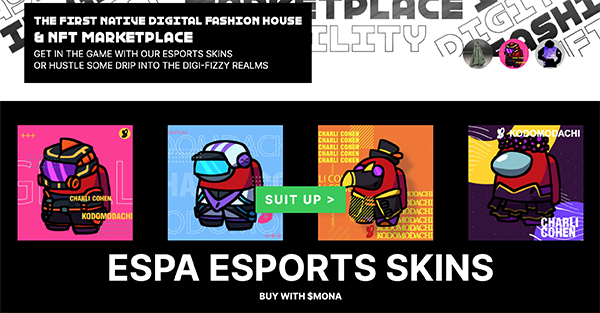
There has to be utility and a way to interact with the product. At the moment, gaming, VR and these massive 3D environments are where that exists. We launched our ESPA, which is the first Indian modern eSports platform, allowing our players, designers and developers to plugin and use our outfits. Digital fashion designs are this whole authentication system within the gaming environments that they go into to engage in casual eSports battles where the players can start earning a livelihood and an income for themselves as well as they engage in these kinds of gaming environments. I’ll stop there because I know that was an extremely long tangent. That’s the broad overview.
You’re literally talking about people being able to buy digital fashion, any outfit, your shirt or something that maybe is even branded potentially and then not just be able to own that and hold that as an NFT, but also be able to use that in a gaming environment, for example. How do you connect the portability of that from your side, on the DIGITALAX side or the marketplace where you purchase it so that it can be used in that gaming environment? Is there a common format that people are using that would enable that or is it something you’re developing?
There are two parts to that. When people talk about interoperability and being able to take assets or content cross-platform, when we think about metaverse, we always think about it being the seamless digital experience. From a technical point of view at the moment, that is not solved. That comes down to the file formats themselves, that you can’t build a gamut or anything in one 3D application, say Houdini or Maya, and then take that into a game engine like Unity or Unreal and drag and drop it and have it work or take something from Fortnite into GTA. It doesn’t work at the moment. DIGITALAX is approaching that problem in two ways. Number one, we are building out our own 3D file format that is based on having dynamic interoperability across different 3D application environments.
I can go into more details about how we’re doing that, but it’s a whole engineering process where it’s about how do you take the logical information from the output environment or the final location of where a 3D object is going to be deployed. How could a 3D object know that it’s going into an environment like Fortnite and then be able to be dynamically transformed so that the key information retained is then compatible to that Fortnite environment even if it’s coming originally from an environment like GTA? We’re building out that whole system. It’s an engineering process. It needs to be built. There needs to be R&D around it. It’s what we’re focused on at the moment.
In the meantime, how we’re tackling these interoperability problems or how do you take them across that point, we are building out our own whole SDK and within experts or our SDK where there’s this user authentication. They get their assets bond into the game and we have APIs and full integration on that side, but that’s not enough by itself because we all know that you can’t go to a game and knock on the door and say, “Accept my content.” A lot of these larger studios as well, they’ll tell you, “Sorry, that doesn’t fit within us at the moment.”
That was going to be one of my next questions, is how the industry is responding to your big adventures and how are gamers responding? You have a marketplace situation, so you have multiple customers. In Twitch, you got to wonder what they’re thinking too, in terms of what they’re going to do in this space versus where they want to integrate. You decided to start with something simple and straightforward.

Digital Fashion: Through digital fashion, gamers are able to own their content, allowing them to attach moments and time to it.
The whole thing comes down to incentives. How do you direct incentives or how do you create an ecosystem that incentivizes the right stakeholders. This is why we built native to Web 3.0 and Ethereum as well because with Web 2.0 you cannot build ecosystems of incentives that program customizable value to the different stakeholders. It doesn’t work. Within crypto, you can. We have our token, MONA token. Within our ecosystem, that’s what it’s about. It’s about directing incentives. How it works within ESPA is a player can come into our marketplace, purchase these digital fashion items that are designed by different designers as NFTs, and take them into this different gaming or content environments.
The NFT itself in that digital fashion item is spawned in under their character. As they’re playing, they’re getting scored on a leaderboard and they’re being able to get paid out and get income streams from engaging in these casual eSports battles. It’s a whole different sector as well that we’re tackling, is how do you allow a gamer or a player to go from amateur to pro. You mentioned platforms like Twitch. It’s incredibly hard for these streamers to make a proper livelihood and career. We’re also about breaking that down, is how do you democratize access for players into the industry to create value after engaging in play? From a profit distribution side, how that works is the profits from the sales of the NFTs on the marketplace. They get split between the designers creating the garments and then also the developers as well that are accepting these content pieces or these fashion pieces into their games.
The unique part about that is we’re not intruding on a developer’s current in-game economy, so they still are encapsulating the value there. What we are providing is a Layer 2 utility for them. That is where the eSports utility comes in and it’s a well-defined use case where it’s an additional novelty for the players and providing a different roadmap for a player base when it’s that whole purpose of going from amateur to pro and how do they level up their careers. That’s how we’ve navigated it.
Have you talked to any of the big eSports leagues or organizations like FaZe Clan about what you’re doing? Can you give us a little sense of how they’ve responded or maybe hints of the strategic partnerships you’ve got cooking up?
We went about it in two ways. Number one, I’m very much someone that pioneers the underdogs. That’s why the NFT industry is so unique in a sense because it’s all about how you give direct value to undervalued creators, how do you give a voice back to them. This is what we focused on here at ESPA as well, is focusing on the indie community when it comes to the game development side and then also the modern community because they’re a huge backbone to the industry that is overlooked. A lot of people don’t even know about the modern community or how the biggest players in a sense and biggest player basis are all part of that whole ecosystem.
We focused on that side to start with to give that voice there. Also, it’s part of our messaging and story that we want to have as the backbone. It’s not about giving the keys back to the legacy leaders in the space or the legacy industries that create all these walled gardens, because we want to break that down. That’s the purpose of how we give it back and distribute the value to the other core backbones in the industry, which is very much the morning on the indie side. When it comes to the eSports side, we’re focused on the average player and how they can come in. Not just on the professional players now who already have the value, but how can we allow a player sitting in his basement to go from amateur to pro? How do we give them a tool in their hand to have access to that rather than them thinking, “This is impossible. I’ve either got to slave away on Twitch for 24 hours and hope to get picked up?” That’s a lottery ticket or I give up and I get it an adult or normal job.

Could you share the name or where we can find it?

All animals deserve clothes.
Yes. We have it trading on Uniswap and then also QuickSwap at the moment. If someone wants to invest, we didn’t do any traditional investments with the team. We didn’t take any allocation. There were no VCs or backers behind it. It was crypto-native to have that strong community basis as well. If anyone wants to support or be more part of it, it’s going on Uniswap or QuickSwap and then buying up some of the token, which also has governance utility within our ecosystem as well.
What’s the name of the token?
It’s MONA.
Thank you so much guys for having me. It’s fun.
Important Links:
-
Discord – DIGITALAX
-
@DIGITALAX_ – Twitter
-
Instagram – DIGITALAX
-
Reddit – DIGITALAX
-
Twitch – DIGITALAX
-
YouTube – DIGITALAX
-
iTunes – Edge of NFT Podcast
About Emma-Jane MacKinnon-Lee

Emma-Jane has worked in the deepest corners of crypto, from options trading and crypto hedge funds, to being appointed by the Dubai government to develop blockchain use cases across the financial, transportation, trade and logistics, tourism and real estate sectors.