Top Podcasts
Edge Of Austin 2022, DCentral & Consensus: Brady Gentile (Hedera), Mike Krilivsky (NFTpay), And Jay Chang (Genopets)
Today’s episode features Brady Gentile from Hedera Hashgraph, the enterprise-grade public network for decentralized applications. Brady talks about what he does at Hedera and what’s happening in the space. Returning to the show is Mike Krilivsky, the CEO & Co-founder at NFTpay, who shares his journey to create their company and what it’s all about. Finally, Jay Chang from Genopets sits down with us to talk about their exciting project that took the world by storm. Tune in to learn more about all these disruptive web innovations.
—
Listen to the podcast here
Edge Of Austin 2022, DCentral & Consensus: Brady Gentile (Hedera), Mike Krilivsky (NFTpay), And Jay Chang (Genopets)
I’m here at Consensus, the exhibit hall. It’s a massive place. Right in the middle is the Hedera Hashgraph Booth. I’m here with Brady Gentile, who will tell us a little bit of what he does at their Hashgraph. What’s going on in your world? It’s good to see you.
It’s great to see you, too. The last time we saw each other was at NFT LA.
Remind everyone what you do at Hedera and what has been going on in your world since NFT LA.
At Hedera, I’m doing ecosystem marketing. It’s understanding and marketing all of the various ecosystems, applications, and participants within those ecosystems, fostering their growth and growing out communities.
What has been popping since NFT LA? It has been a few months, which is like years in Web3, right?
Since at NFT LA, a lot has been going on the application development side of Hedera. As many may know, we’ve got HBAR Foundation, an adjacent organization to Hedera that does grants for different types of applications. We have a few verticals, so DeFi, metaverse, sustainability, privacy funds, and female founders’ fund. There is a whole bunch of different verticals that we are looking to foster growth for. Since then, we have had a few accelerators come online for that, a few applications that have been funded in a good amount of capital that’s deployed to grow out the ecosystems. It has been great seeing that growth. We are starting to see some of those applications start to come online, and it’s exciting to see. It’s cool.
We will delve into more. We are going to have a proper show soon. Maybe give me a sense of the vibe Consensus like the types of conversations you are having with folks and what you are excited about for the future. We got 17,000 people here. It’s hot, 110 degrees but the conversations are also exciting.
At first, it was supposed to be 10,000, and that number jumped very quickly. We ended up having to bring more staff to the event. We brought more swag, pamphlets, and literature to try and help explain what Hedera does and what it is. It’s a bit different in 2022 being in Austin than it was at the last Consensus conference in New York a couple of years ago.
That one seemed to be a lot more maybe financially focused and a little bit more corporate, being in New York. This one being in Austin brought a lot more of a deep Web3 focus. It seems like permissionless focused applications and ecosystems are being built in Web3. It seems like a lot of things have matured since the last one. There seems to be a lot of innovation and a bit more maturity being brought to this space.
Can you give us a sense of the types of applications people want to build on Hedera Hashgraph and some of the scalability benefits of using your platform, not to mention the eco side of things?
A big focus is DeFi applications on Hedera. We have that DeFi fund which is earmarked for $200 million.
That’s not bad.
We are hoping to use that to bolster the DeFi ecosystem and foster its growth on Hedera. One of the big things that when we talked to DeFi applications on Hedera, that they are realizing the benefits of Hedera, are Consensus timestamps for all of the transactions. That’s unique to Hashgraph Consensus, which underlies our network. Being able to have timestamps for all of those transactions is important to be able to validate some of that information.
At the same time, the scalability and throughput of the network and tokens on the network can go to 10,000 transactions per second. With charting, later on, it’s essentially an unlimited number of transactions that can be performed. The cost for those transactions is incredibly low, fractions of a penny to transfer tokens and use DeFi applications on the network.
The carbon footprint is very low as well, right?
That’s right. There was a report that was done by the UCL Centre for Blockchain research. They found that, on average, the kilowatt per hour transaction for Hedera was the lowest when compared to a number of other Layer 1 networks, Ethereum 2, and then even the visa network as well transactions on this Web2 visa network.
Even with TELUS, is it slower than TELUS?
We don’t have a comparison to TELUS in terms of its sustainability. For the small amount of carbon footprint that it does have for transactions, we went above and beyond. We purchased carbon offset credits quarterly. We do operate in a carbon-negative fashion. The governing council for the network has decided to continue with that commitment into the indefinite future. That’s a value that we care about.
I’m looking forward to seeing what comes out of this grant program and all the innovations to come. Thanks for spending a little bit of time with us. You got some conversation to have and some swag to dish out but thanks again. I look forward to having a deeper dive very soon.
Thank you. Appreciate it.
—
Mike Krilivsky, what’s up? It’s good to see you here.
It’s good to see you as well.
We are hanging out here over at Dcentral in Austin, Texas, and we are here to talk about NFTpay. It has been a while since we had you on the show. The last time we did, we were talking about a number of things, including Creatify. You’ve had quite a journey since then. Talk about the journey that took you to Creatify, and then ultimately, NFTpay and what it’s all about.
Web3 changes fast. We adapt and move forward. We will start with some background. The last company, we pioneered this all-over printing print-on-demand space that enabled people to create products and sell them online in an efficient manner in under 30 seconds. People created over 100 million products with this patented technology. This was all the way back in 2012, ‘13 or ‘14. In 2016, we started noticing this issue where people were taking IP that didn’t belong to them like Mickey Mouse or something, putting on a T-shirt, and trying to sell it online without Disney’s permission.
Using our technology and companies like Shopify, Amazon, etc. brand owners, and marketplace owners, we’re like, “This is messed up. This is wrong.” In 2016, the San Francisco blockchain was booming. I’m like, “How can we solve this issue?” We started digging into blockchain and said, “We can authenticate these images on the blockchain. There’s one source of truth for the buyers, creators, and sellers. We can also take advantage of smart contracts and make sure these licensors are paid automatically to bypass inefficient licensing models.”
This was cutting my teeth in the blockchain Web3 space. Back in 2016, I formed a team. We are going forward with some technology that now people refer to as NFTs. That’s where it started. You fast forward to 2021, and then NFTs started exploding. Some of our friends, some highlights, Haseeb Awan, inventor of the first Bitcoin ATM machine, investor in NFTpay, his friend Vignesh bought the $69 Beeple painting as an NFT, and then a portfolio company of mine, Origin Protocol. They launched the DJ 3LAU album, which sold for $11 million.
Once I saw that I said, “We have to get back into this space now, start innovating again, pushing, and going.” That’s when we started this business called Creatify. We let all our friends know and said, “We are going to make NFT simple.” We didn’t like the experience of the existing marketplaces. We didn’t like the experience we felt. It was so fragmented and slow and clunky. Some of the crypto nerds were having a blast buying $11 million 3LAU albums and Beeple paintings.
For the masses, people are like, “What the hell is this? How do I do this?” We designed a simpler marketplace. Before we even got to launch it, we had one of our investors, Yohei, of this project called PixelBeast. He said, “Mike, I want to do a 10,000 NFT launch with PixelBeast. It’s going to be this investor community, a cool group of people. There will be some perks.”
Shout out to Yohei. We had him on the show. It was a fun project. He’s an exciting guy in terms of him trying to get the builders and non-traditional folks in the space. The punchline here is that you guys learned something in the process of collaborator.
We learned so much. We worked with Yohei on this project. We helped sell out 10,000 NFT launches to start, and Yohei was one of them. We saw how much time and effort it took to do this. We also saw this giant education piece. Anyone that wasn’t already in the crypto scene and already had a wallet and cryptocurrency was struggling to buy NFTs.
My thing has always been, “How can we make it easily for the masses to participate to take advantage of this new opportunity? How can we impact people’s lives and bring them in?” From the Yohei launch, the previous Citadel launch, and every other launch thereafter, we were like, “There’s one common thread. We have a simple way for these people to buy this NFT.” That’s when we had a credit card solution.
We are like, “We’re going to make this better and accessible for everyone to use.” We doubled down on this one thing that would turn into a twelve-step multi-day process to get your MetaMask to go on an exchange like Coinbase, upload your driver’s license and your bank statements, and wait for verification to go by cryptocurrency, and wait for it to be in your account. You have to upload your money. You have to send your cryptocurrency to a MetaMask wallet. You have to connect that MetaMask wallet to an existing NFT site. You can finally buy the NFT. If it’s a hot project, that NFT is gone.
Innovate, push, and keep going. Click To Tweet
If you are brand new to the space, you are thinking, “Am I losing my money? Is it there? Is it not?”
Eathan, our co-host, videotaped him onboarding one of our good friends to our Spirit Seeds, which unlocked a ticket to NFT LA. It was an hour and a half video. It took a while. There’s a lot there. This is a smart entrepreneurial guy. We are not talking about folks that have never touched a nap before, messed around with different social media sites, and done online banking. Even for that group, there’s a huge hurdle here we are talking about.
We saw that, and I thought this was crazy. I’m like, “This is nuts.” When you go online to buy something, you pay money, and then you get the order confirmation like, “Your order is coming.” I was like, “We need to change this. There’s going to be billions of people getting into the NFT space.” We are in our infancy. We might have done $41 billion transacted in 2021 but we are bullish on this being a $40 trillion space in the somewhat 5 to 10-year span. How can we make it easy for everyone to purchase an NFT?
We made it as simple as possible on the front end for the user. It’s a regular credit card experience. You put in your credit card and billing address and hit buy. We do all the complex stuff on the back end like the KYC, to make sure it’s not a fake credit card. We do crypto wallet management for you. That way, you don’t have to go to a site like MetaMask, remember the seed phrase. Otherwise, you lose everything, and people are paranoid and scared. It’s not a weird browser extension. We handle all that for you behind the scenes. You can buy an NFT with NFTpay in less than a minute.
You can do that now.
There are about twenty or so projects integrated now. New ones are onboarding every single day.
That’s available now. It’s got that feature. Are there other features about it that people should know about?
Yes. It’s a beast. It might sound simple. How many blockchains are out there in existence? There are hundreds, thousands maybe.
There are probably about 7 and 10 ones that are commonly used for NFTs. You get Solana, Polygon, and Scales doing some cool stuff with NFTs.
Shout out to Scale.
Jack’s awesome. How are you working with all these different protocols?
We are trying to start with the most used ones first. Ethereum-based chains have the largest market share. It’s over 80%. We started there. We have about nine blockchains integrated. Everyone has been speeding down our door for Solana. Solana is next on the roadmap. Essentially, the biggest NFT marketplaces in the world are in our queue to potentially integrate with. That’s much more difficult than a 10,000 NFT launch.
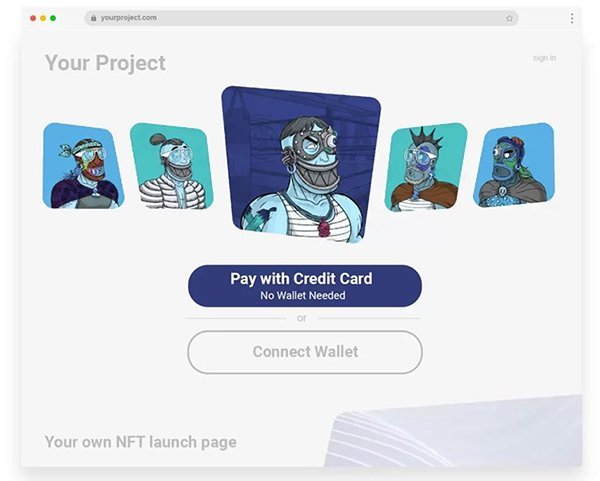
NFTpay: We’re starting to see some of those applications start to come online, and it’s really exciting to see.
There’s still a little bit of work to do but the point is we have their ears open. Their fans are going to them, requesting NFTpay at this point. That’s amazing. We want to continue that. We want to say, “You want to be able to buy via a credit card, go tell OpenSea. Go tell all these people your experiences and how it has been. Do you want to spend twelve hours on Discord with these other broken type solutions or do you want to be able to enjoy your day?”
Walk me through it. For someone launching a 500 NFT drop, it’s a little bit of a competitive process. There is an allow list. At the end of the day, the proof is putting your money where your commitment is. How do you do that with the credit card technology? Do people pre-queue and the credit card clicks in? How do you work with reconciling the benefits of credit card technology with how traditional NFT generative launches have done? What consulting do you offer to projects that are thinking about how to integrate those two?
Fortunately, we do it in probably the best way you can do it. There are several different ways. You can implement credit card implementation into a 500 NFT launch or any type of NFT launch. There are ways where you can go out, buy cryptocurrency on behalf of the customer, and then do it. That’s what we’ve seen a lot of people do.
I’m curious how you guys do it.
We do it where we integrate right with the contract itself. When you buy that NFT, we have a wallet filled with ETH. We are buying it on the contract simultaneously while your credit card is being processed. Out of all the ways we studied, we believe this is the best way because you get it exactly when you want it. If it’s gone, you don’t get it.
How do you peg USD to ETH at that moment?
You have to have a couple of different price monitors and we have a few of them. We have little algorithms on the internal side that show exactly what it’s supposed to be because there’s a variance on every single chart. We take some of the main ones like CoinMarketCap and some other ones. We pin them all against each other. We try to find an average or see what makes the most sense at that point.
It’s interesting because it’s the nuances, how you make the sausage, and the thought that goes into it that is so relevant. We can zoom out.
Josh always asks good questions. Shout out to Josh.
I’m curious about it. It’s cool. It’s not easy to do this stuff. It’s important for people to appreciate the nuance that goes into building this type of technology and integrating Web2 into the Web3 world.
Clearly, it’s one step in the process that you guys zoomed in on and saw. This is a massive problem as part of the Creatify journey and what brought you here to NFtpay. It also has to integrate seamlessly with these other steps of the process with NFT launches. How do you integrate with those other steps? Do you intend on your roadmap to fulfill some of the needs folks have a little bit more broadly with these launches?
What other steps do you mean exactly?
Josh, for example, was talking about the queuing approach. Folks are coming in, looking, and on an allow list, a white list or whatever approach people take. The step prior to putting the credit card down and once that credit card purchase is made, how does that relate to the queue that was lined up?
We try to make it as if all payment types were one. We believe a payment is a payment. When that payment of a credit card happens, we simultaneously have the cryptocurrency transaction happen with the contract. That’s how we are doing. We are doing that to the best of our absolute ability. Shout out to our Chief Product Officer Reza and our CTO, Nick Fallon. They are the brains behind the intricacies of this section of the business. They are phenomenal. They worked on world class products and had billion-dollar exits with companies like Tubi and the largest banks in the world. They are above my pay grade level.
Talking about other banks and experiences, going in alone isn’t a Web3 thing. There must be partnerships and relationships in here to help move this thing forward. Tell us a little bit about those.
We love partnerships. Web3 is all about community, people, and partnerships. We completely support anybody that’s doing something cool in the space like Edge of NFT. We love you guys. We support you. We say great things about you to everyone. We send people your way. There are a million companies that aren’t doing NFT launches and marketplaces but work with them all. Those guys are our best partners. Why? It’s because we make their clients more money. There are confidential statistics from some of my NFT marketplace friend owners that 84% of people, even crypto owners, would rather pay with a credit card for an NFT. That’s incredible.
I don’t know what the latest stats are on the number of wallets on OpenSea. The last time I checked, it was in the 350,000 to 400,000 range. You look at the population as a whole. Any way you slice or dice the market, huge opportunity. On that note, a lot of different types of folks are coming to you, yet the mainstream media likes to talk about how the market is flattening. What do you see being in the trenches? What are some of the exciting use cases for NFTs in your technology on the horizon?
We can sense that we are in this bear market. Some of us have lived through cycles before. I was there in the 2018 bear market. That’s when I put my early NFT project on pause and continued with the print-on-demand one, and then reengaged in the bull market in 2021. Now I see that this is not going away. I said it from the beginning of 2021, and their NFT revenue is going to be bigger than all of cryptocurrency. Why? It’s because it touches anything of value in the entire world and then beyond the world in the metaverse, every music, art, video, physical product, and metaverse product. This is going to be a 40-trillion market.
We are not worried. NFT market as a whole is not taking as much of a dip as even the stock market or cryptocurrency. A lot of cryptocurrencies are 89% down, and some are worse. You are going to see the NFT market still expanding. You might expand much slower than it would in a bull market but it’s going to keep expanding. We are in the infancy of NFTs coming out for real estate. We are at the infancy of NFTs coming out for physical products. We are in the infancy of all of this.
We have very interesting partnerships coming in. I will mention a couple because they are friends of mine. You guys probably know Brock Pierce and his wife, Crystal Pierce. She’s trying to sell these amazing NFTs in her gallery. Crystal is friends with so many awesome people around the world, many artists. She has these galleries and presents beautiful NFT. Some are worth millions. Some are worth tens of thousands.
—
Thank you. Thank you for having me.
You did a hybrid approach.
Was that in LA? I remember that conference.
Thanks for coming by. I appreciate it.
—
Important Links
-
Yohei Nakajima – Past Episode
-
@Genopets – Twitter
-
iTunes – Edge of NFT
About Brady Gentile

Brady Gentile is a Product Marketing Manager at Hedera Hashgraph, the enterprise-grade public network for decentralized applications. His previous experience includes working at the distributed database company DataStax, and security company Cloudflare. Brady’s responsible for engaging and educating developer and consumer audiences about Hedera and its game-changing use cases.
About Mike Krilivsky

Mike Krilivsky is an Entrepreneur, NFT & Crypto Enthusiast, Investor, Advisor, Mentor, Speaker, Futurist.
About Jay Chang

For the past decade, I’ve built a career as a consultant building & launching products for Fortune 500 companies. I’ve led 0-1 products to a growth stage across a variety of industries with a focus on emerging technologies, games, and social platforms for global companies.
I started my career in Product Management, but became obsessed with Product Marketing when I discovered my passion for taking products to market and building thriving open source developer communities.
After 8 years of agency experience building and launching everything from VR games to AI Selfie drones, I left the client world and fell in love with growing developer communities. I spent 3 years deep in the trenches with blockchain developers through the first crypto ICO boom in 2017 taking the EOS network to market before taking a break from decentralized open source tech last year.
Today, I’m a Product Marketing Manager at Google on the Platforms and Ecosystems Developer Marketing team. I’m a small part of an amazingly talented group of individuals that are growing Flutter to be the most widely adopted multi-platform UI framework in the world; loved by a global developer community.
Outside of the tech world in my day job, I’ve spent the last 5 years interviewing chefs around the world on my Instagram. I’ve been blessed to travel the world experiencing cultures and sharing culinary stories through the universal language of food.