Dropping the “Most Sh*ttiest NFT” with Matty Mo, Ara Katz, And Dr. Christopher Mason: What A Highly Polished NFT Turd Can Do for Human Health
November 21, 2022
June 29, 2021
Podcast
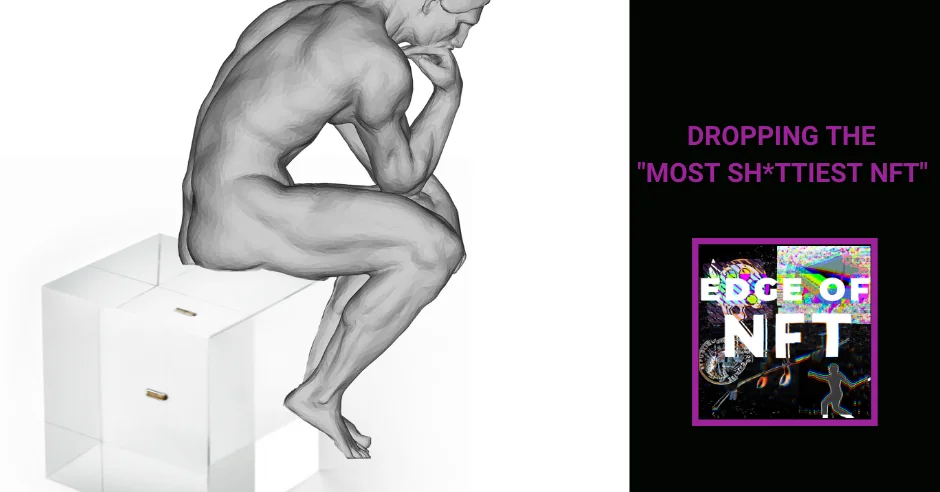
Just when you thought the latest headline-generating NFTs couldn’t get any weirder… Join Matty Mo, Ara Katz, and Dr. Christopher Mason to discuss their “Sh*ttiest” NFT” drop. Matty Mo is the founder of The Most Famous Artist and Ara Katz is the co-founder and co-CEO of Seed Health. Dr. Christopher Mason is a professor of Physiology and Biophysics at Weill Cornell Medical College. The three come together to promote an art auction of poop, yes poop. Listen in to find out what kind of polish has been put on one very special turd and why you should care, for your own sake and the sake of some of our most precious ecosystems, the ones inside our guts.
—
Listen to the podcast here:
Dropping the “Most Sh*ttiest NFT” with Matty Mo, Ara Katz, And Dr. Christopher Mason: What A Highly Polished NFT Turd Can Do for Human Health
We are all here at the Edge of NFT and ready to dive into a special hot topic spotlight episode where we go deep with a team on their latest drops, projects, and announcements. Eathan, who is joining us on this journey?
**Our episode features guests Matty Mo, aka The Most Famous Artist, Ara Katz, Cofounder and Co-CEO of Seed Health and Dr. Christopher Mason, Professor of Physiology and Biophysics at Weill Cornell Medical College. Matty has been featured on our show before, during our DeFi Summit episodes, and is making his triumphant return. As a refresher for our readers, Matty is a New Mexico-based artist and entrepreneur. He’s best known for creating the social token-powered global community known as The Most Famous Artist. Together, they create large-scale headline-generating spectacles and are working on helping 10,000 artists achieve financial freedom, independent of institutional gatekeepers. **
Ara is the Cofounder and leads Seed Health, a microbial sciences company pioneering applications of microbes to impact human and environmental health. In collaboration with leading scientists, their decentralized model enables rapid efficient development of multiple category-defining probiotics. She is also a co-lead of Seed Labs, solving pressing ecological challenges with bacterial tech. Among many other accolades, Ara was named in Marie Claire’s The New Guard: America’s 50 Most Influential Women, listed on Business Insider’s Silicon Alley Top 100, and 36 Rockstar Women in NYC Tech.
**Dr. Mason’s research is focused on high throughput sequencing-based methods to generate cell-specific molecular maps of genetic, epigenetic and transcriptional activity, which provides multi-dimensional molecular portraits of development and disease. He then develops algorithms to leverage these data for detecting, cataloging, and functionally annotating interactions between these molecular changes and also connecting them to larger data sets for replication and contextualization. **
In the long term, the hope is that these systems-based methods will enable such a rich understanding of the functional elements of the human genome. We can begin to repair or re-engineer these genetic networks for ameliorating or attenuating disease. That means he processes tons of data to understand the role of DNA and health. He analyzes the data and combines it with other data to understand what’s going on, to hopefully someday fix our health by fixing DNA.
Welcome to the program, everyone. It is an honor and a privilege to have you here. As if the world of NFT wasn’t crazy enough, you amazing folks have come together to raise awareness of the game-changing nature of Seeds research into the science of probiotics and its implications on our health and the Earth’s health with an interesting topic. Matty, tell us a little bit about how we’re going to bring some respect to our crap.
For a long time, poop has been very taboo and has been something that’s been flushed away but it contains so much data that can lead to advancing human health around the globe. I am involved in the NFT space as an artist and involved in creating headline-generating spectacles. I’ve come together with Dr. Mason, Ara, and Seed to try to do a drop that we know is going to generate headlines but also intends to raise money for research for gut-brain health. It’s an NFT 101. It’s both a physical and a digital object.
The digital NFT will compare with a physical object, which is a glass encapsulation of my human fecal matter. There is a long history of using human biological matter in art, including Duchamp’s Urinal and Manzoni’s Artist’s Shit, which is at the Tate Modern in the permanent collection. This fits both in the art canon but also in this world of NFTs, and that it’s something that will hopefully be differentiated in its avant-garde approach and its potential benefits to science and research.
Disgusting equals value. Click To Tweet
That’s something else. I have to ask though, how did you all come together around this concept, around this idea? What’s the backstory here?
I can speak a little bit having been somewhat the orchestrator of one of the things that we pride ourselves on at Seed outside all the awesome research we get to do in various areas of the microbiome and microbial sciences. We’re always thinking about how we can use art to Trojan Horse science into the Zeitgeist and pop culture. We’ve done it before. We did a campaign called Give A Shit, which was one of the largest citizen science initiatives to compile the largest image database of stool, which helped train an AI to be able to recognize and characterize stool off of an image, which hadn’t previously been done.
We used that and we won a bunch of awards for it, not just because it was an awesome project and we got to thousands of images from around the world but it was a way of also de-stigmatizing this area of human health that we literally flushed away. That has revealed itself to have extraordinary potential in understanding and characterizing it, which is a lot of what Chris’ work is about. Understanding the way that both the characterization of the microbes that live within on us and the role that they play in health and the development of pathology. Also, the way that we can harness the potential of those microbes to use them for probiotics or live biotherapeutics or other applications in the environment to improve health.
One of the things we like to do is think about how we can provoke and catalyze these important conversations. We work in a lot of areas of health that people find disgusting. There’s an interesting history of why they’re disgusting. There are many genres of humor that have been enabled because people find these things disgusting. Even in Chris’ bio, there’s an aspect of humanization to this that is incredibly important. Chris talked about, over 15% of the population lives with conditions like IBS. That doesn’t even characterize all the people who live with disrupted quality of life or these things that are outside of the physical symptoms, the shame, and a lot of the other aspects of disrupted health that are not honestly talked about.
Poop is something that we never saw the value of but NFTs are something that has provoked a huge conversation that disrupted the traditional value systems of art. Crypto and blockchain disrupted and decentralized the traditional ways that value has been created in the world. We’re coming off of a year where people are asking all kinds of questions about our systems and the things that generate value. For us, it was that metalink of saying, “Could we mint human fecal matter, something that is questionably valuable, as an NFT?” It’s something that people also find, in some ways and some parts of the art world and people who don’t understand something, as a way of saying, “Could disgusting equal value?” It was our way of saying, “Let’s use these new methodologies and mediums to Trojan Horse these big ideas and conversations that we need to be having.” We do it all to raise money for research.
Matty, you should have eaten some mint before you drop that turd. I don’t know if you had that forethought. Maybe you can pretend that’s what happened.
It’s interesting because my girlfriend painted a picture of her brother’s thesis in neurosurgery and neuroscience. As you’re sharing that, I’m reflecting on the fact that scientific drawings are beautiful. Scientific photography is often considered art and it’s featured everywhere. This is a much more literal example of science at the end of the day.
I was happy to join the team effort because we’ve studied a lot. I’m at the Mind-Brain Research Institute. Also, we study a lot of microbiome interactions between cancer as well as neuropsychiatric disorders, and also the microbiome. We’ve been looking at microbes at this point for over a decade. We keep finding new species, new strains, new biology, new functions in on and all around us. Blending some of these functional traits of microbes that we know are important for health and also risk for disease and giving us an uncanny marriage of financial tool and microbial discovery. It’s certainly never been tried before.
NFT Art: Poop has for a long time been very taboo, but it actually contains so much data that can lead to advancing human health around the globe.
We do know, at least from a research perspective, that stool has an extraordinary value. It is tragic that we’ve flushed it all away because we’ve been using it therapeutically for fecal microbiome transplants as well as for basic diagnostics and understanding of patients with Inflammatory Bowel Syndrome, Inflammatory Bowel Disease or Crohn’s disease. All these diseases are a complex interaction between the human and the microbial cells that you have to view in its entirety much as you would say for an NFT. You have to view the entire thing and understand the complexity. It’s an apt metaphor for the complexity of the biology of gut health and disease. There’s even a wastewater surveillance network from the CDC. We’re not flushing wastewater away anymore. It’s an international effort and we’re sequencing sewage everywhere because we know it has value for the pandemic.
Chris, beyond these unfortunate diseases that plague our society, at the end of the day, the biome is valuable for every human being. It has a lot to do with how we function and our health. Could you talk a little bit more about the gut-brain axis and how everyone that’s reading should care about this?
Most people probably have heard at some point about the microbiome and that it’s this entire another ecosystem in on and around you. It probably has equal to the number of cells in your body as you have for human cells but also likely more. There’s an ongoing debate about how many bacterial cells and human cells. It depends on how vigorously you shower and the last time you went to the bathroom. There are a lot of factors. There are a lot of them, tens of trillions of them in your body and on you. They process about 1/3 of the small molecules. Your bloodstream is either made by microbes or modified by the microbes in your gut.
If you’re looking for the nearest pharmacy, look down by your belly button and there it is. You could argue that no one is drug-free. We’re all drug metabolizers, modifiers, and creators, us and our microbes. There is this entire ecosystem, this pharmacy. Also, for the gut-brain axis, 95% of the serotonin in your body, which is a neurotransmitter, is in and around your gut. It’s this entire ecosystem that connects to the vagus and from your gut to your brain. There’s this constant feedback between what’s happening in your gut and the inflammation. The signals from the brain telling you you’re hungry, it’s the most simple one we all think about. Also, higher digesting food, the degree of immune response when you have something that is unusual for your body.
There is a consistent phone call back and forth in your brain and your gut that we now know is disrupted in things like risk for depression, schizophrenia, autism, as well as other things that are obvious like ulcers or disrupted microbiome like acne on your skin. There are some things that we’ve known about for years but a deep appreciation for the gut-brain axis has only come up in the past decade and transformed how we view neuropsychiatric disease.
You mentioned autism. That’s a great time to dive a little bit deeper into the fundraising component of this particular NFT drop.
First of all, to clarify what Matty said earlier, the poop was not in glass. It was first laid off a lens in an FMT capsule and then put into glass. Chris, it might be awesome to explain what an FMT is but then maybe make the link to autism.
For those of you who have not heard of it, FMT is a Fecal Microbiome Transplant. It’s exactly what it sounds like. Think of donating a kidney, I’ll pop out the kidney and I can throw it in another body. The fecal microbiome transplants can have a healthy stool microbiome either put in a capsule form or suppository. It works pretty well both ways. In transplant, a healthy ecosystem onto one that has a disease. One way to think about this is if you think about putting grass in a backyard where you get soil but you’d like to have grass, you transplant the grass. Think about kidney transplants, the same idea applies.
From a research perspective, stool has extraordinary value. Click To Tweet
What you do is replace what is a dysbiotic system with one that’s healthy. It’s not like transplanting 1 or 2 species. What you do is transplant the whole ecosystem. It’s extraordinary. It is a lot like the kidney, we’re not getting one type of cell that’s found on the kidney to get it to function. You give the whole organ over. Your microbiome is this organ of your body. These have been extraordinarily efficacious for treating ulcerative colitis and Crohn’s disease, anywhere from 50% to 85% success rate depending on which study you look at. There are a few things in medicine that are as effective. It’s an extraordinary therapy.
The challenge is finding people that are healthy donors that can be the super stool donors that are consistently giving healthy ecosystems as donors. A lot of nonprofits, clinical trials, and startup companies have studied this. What the FMT has been treating historically for are GI problems but now, it’s been looked at for what microbes are in your gut that might be exacerbating or attenuating, making better or worse autism, depression, or other neuropsychiatric disorders. At this point, there have been dozens of studies linking the two strongly.
We’re now in the stage where we could better understand the species that are there when we find someone’s successful, what’s in that transplant, and try and replicate it. It’d be the equivalent of saying that there’s an organ shortage but we barely understand how the organ transplant works, at least we did years ago. What if we could grow a complete ecosystem and help that as a drug or as a treatment for autism. There have been cases where FMT has radically decreased symptoms. Even changing some probiotics has helped some autism patients that I’ve seen clinically at the hospital. We know there’s an interaction. We know there’s an exchange but we don’t have a lot of pure data on large trials or deep characterization of these FMTs.
We all know how challenging it is to raise money for nonprofits in this landscape. We saw the power of creative endeavors like the Ice Bucket Challenge, for example, which I’m not sure if anyone on this group did.
I did it. You probably couldn’t do that with a bucket of stool. That wouldn’t work as well.
This is a close second to that experience.
This is definitely a “don’t try this at home” episode. Do not try fecal matter transplants at home. Ara did give us an interesting stat. Before we relaunched about French kissing and the type of microbes that you can transfer there, I was the one who requested it.
French kissing is about 80 million microbes. It’s one of the last studies we saw. We have an IRB that was approved, which maybe we’ll do another NFT for which we’ll probably present to you too, which is to do a citizen science project called Have Sex for Science where we would swab the general microbes pre and post-sex to be able to understand the impact of sex on the general microbiome.
We were suggesting maybe a kissing NFT, but you’re going way beyond that already. Ara, tell us a little bit more about the proceeds here and the giveback program. People probably will want to understand the details.
NFT Art: Scientists are always thinking of ways on how they can use art to Trojan horse science into the zeitgeist.
Depending on the final auction price, we’ll be determining through the help of Chris and a couple of other of our other scientists where we’re going to make the grant. It will be, specifically, in the area of gut-brain research and for Autism Spectrum Disorder. Depending on the size of the grant, it will dictate exactly where we’re going to allocate the funds to be most impactful.
Like the Ice Bucket Challenge, they had so much money raised. They had to figure out how to make sure it was well spent. It sounds like your commitment is on a return on investment for science.
It will very likely be going to a PhD or a lab at academic institutions. It will also be tax-deductible.
If you have a stellar gut microbiome, you’re the ideal donor. You have a wealth of value living in your gut. Are there people that are these ideal donors that are out there walking around with this potential inside of them?
Yes. Everyone has microbiomes that fluctuate over time. If anyone has been traveling and got a traveler’s diarrhea, we’re all keenly aware of when something can go awry. If you have a really healthy ecosystem, it contains a lot of what are called keystone species in particular where they maintain a lot of health and making sure the inflammation is kept at a decreased level. One species like this is the Akkermansia muciniphila, which is a species that keeps the mucin levels correct and keeps the intestinal lining at lower rates of inflammation. There are other species that make small molecules like arachidonic acid that protects some of the intestinal linings. We shed our intestinal cells in a matter of days. You need to keep them healthy and keep them protected. We’ve begun to appreciate who carries all these keystone species that are the good actors that seem to be successfully colonized and staying in the gut and not transiently coming through.
Give me an idea. If someone goes and donates blood, the people that get their rent money from donating blood, if I got a killer gut biome and I want to make some money, what are we talking about? What can people make off of dedicating their poop?
You could make $13,000 a year during the early days of some of the FMT. You’re not going to get rich but that’s enough. It can give you a couple of nights out in New York City. Maybe that would be enough for that. We’re being compensated. If you’re a good donor, they’ll pay for it. It’s much like donating blood or donating sperm. One analogous version would be James Harrison. He was called The Man with the Golden Arm. He had strong and persistent antibodies against the RH group antigen. He’s the super blood donor that was found in Australia. He’s very rare. If you can find someone that has a unique biological feature and can donate blood or stool, they should donate as much as they can.
Jeff thinks he’s got the shit.
No one is really drug-free. We’re all drug metabolizers, modifiers and creators. Click To Tweet
You don’t know. There’s only one way to find out. Josh and I had buddy years ago out of DC that had massive gastrointestinal issues. He was about to have major surgery. As a last resort, he’s like, “I’m going to try this FMT thing.” Night and day, almost immediately, he was back on track and everything was good to go. It’s truly amazing stuff. It’s a touchy subject. It’s something that people don’t often talk about, poop-related items or whatever. We talked about it in the beginning. Do you feel like now is the time to bring that to the forefront? Is the populace ready to take this on? We talk about the problems a lot but we don’t talk about the solutions that much.
As a scientist and in a clinical context, people are much more frank about it. They know it has value and there’s information that’s in both urine and stool that can be utilized to determine the best course of action. FMT is a pretty broad treatment. It’s yes or no. It’s similar to an organ, like, “We just give you the organ.” We also test for immune rejection. FMT is getting a lot more refined much as we see in organ transplants. We want to make sure that won’t be rejected. We’ll see it get more refined and more manufactured I hope, which is happening this day.
There’s this great South Park episode on FMTs and the microbiome.
Matty, you’ve done a lot of things over the years, some of which have gotten negative attention and some have been positive attention. You’ve approached art in a variety of ways. What are the similarities and differences between this project and projects that you’ve worked on in the past?
I’d like to start by saying that using the form factor of an FMT and embedding it in a museum quality object and pairing that with an NFT is about as forward-looking as you can get as an artist. Great artists tell the stories of their time using the tools of their time with nods to the past. In that respect, this art project aligns with the type of work that I’ve been trying to create since day one. This type of work isn’t for everybody. We know that the more polarizing the work, the deeper the conversation and what we’re trying to do is stimulate a discussion around the value of the human gut biome.