Top Podcasts
Delving Into The Confluence Of Art, Humanity, And Web3: A Voyage With Superchief, Impact One, NFT Now & Gateway
Web3 art is pushing its own boundaries to the outer limit as imaginative creators are dreaming up endless possibilities. In this special Edge of NFT Asia Roadshow Tour Edition sponsored by our friends at Casper Association, the Edge of NFT team delves into the confluence of art, humanity, and Web3 with some of the most prominent voices in the space. Mikolaj Sekutowicz and Nabyl Charania tell us how Impact One honors its commitment to restoring a balance between nature and urban life to create nature-positive economies. Eric Choi at DIIANT updates us on the much-awaited launch party of Superchief’s new marketplace. Dave Krugman of ALLSHIPS shares how his innovative platform is enabling artists to thrive. And get to see an amazing creation by an artist at the amazing opening party at The Gateway. Tune in for all of these and more!
Listen to the podcast here
Delving Into The Confluence Of Art, Humanity, And Web3: A Voyage With Superchief, Impact One, NFT Now & Gateway
This special Edge of NFT Asia Roadshow Tour Edition is sponsored by our friends at Casper Association. They oversee the evolution of the Casper Network, a blockchain supporting innovative tech giants, as well as decentralized applications and platforms featuring both upgradable smart contracts and predictable gas feeds. They also have a great new show called Casper Blockchain Podcast. You can check out on Spotify or by visiting Casper.Network and click on News.
I am here with two interesting gentlemen talking about the mental health and art intersection space. I had a chance to meet Mikolaj. He was one of the first people I met when I got here to Korea Blockchain Week Impact at The Shilla. I got a chance to learn all the serendipity around what you guys are doing in the space. Thank you for joining us.
Thank you so much. It was amazing to meet you at the entrance of the crowded conference room.
Let me give folks a little bit about your background and we’ll get into the conversation. Mikolaj is the Founder and CEO of Impact One. I’m inspired by his passion for architecture, sustainability, and city planning. He established Therme Art, a dynamic platform that stimulates dialogue and fosters innovation within these realms. He’s also formed leading the One Health Research Center to research and develop evidence-based standards and impact evaluation for nature-positive city infrastructure.
Nabyl is the Founder of Meta4 Capital. He’s a serial entrepreneur with multiple exits that seated several successful companies as well as private investment funding with outstanding returns. That’s always good when you’re investing in companies. Everyone wants outstanding returns. He’s a limited partner in a lot of funds, including A16z, Borderless Capital, and Double Down Fund. He’s also founded and launched multiple VC funds, including Fuel Venture Capital, as well as Meta4 Capital. He is a strategic advisor to several high-growth startups, including Cogni, a leading FinTech banking and lifestyle company.
He is a prominent NFT collector with sizable holdings across multiple collections. You’ve invested in AI. We have a new show, Edge of AI. We might have to talk about that. Yuga Labs and QuickNode to name a few of the many things that keep you busy. I’m fortunate to have a chance to get to know you, guys. One of our main focuses will be Impact One, which is an impact investment initiative dedicated to restoring a balance between nature and urban life to create nature-positive economies.
Impact One is establishing a new asset class of infrastructure that places interconnected human and environmental wellbeing at its core under the name of wellbeing infrastructure. It is a profound goal and mission. I would love to understand a little bit more of the history and how you got to this point where we’re looking at this beautiful art exhibition in Seoul, Korea with a view outside the window of this presidential suite on the 22nd floor.
Thank you so much. There’s a lot to unpack because it’s not obvious but we started the company that is at the core of our business activity. It is quite a big developer of wellbeing centers. It’s Tam Group. They became one of the most successful re-developers of urban life. If you can go back to Pompeii, you see that our cities were always made out of stone but it should have been made out of nature. Our original environment is not stone. Our original environment is nature.
What is nature? Eighty-five percent of all bios on the planet are plants. We need plants to thrive. Plants are something that has been in our direct environment for 10,000 years and we removed all of this. We think that we can be in an environment. Even this presidential suite is not our natural environment. We need the invisible part of nature, the part that comes with biodiversity, microbiome, and clean air.
All are produced by a specific environment that can be scientific. This is the evidence-based part analyzed. It is what our One Health Research Center is doing. We are working with different institutions like Johns Hopkins, Hemlock Society, and MIT on establishing the right parameters for human bodies to thrive in the right environment.
One thing that we discovered early is that one of the biggest disruptors of our biological life is what we call culture because all our activity is in the end cultural activity. All our programs, what we eat, how we live in communities, and how we build and create our environment are programmed by culture.
There is a big software that is a part of our everyday reality that is unfortunately based on a fundamental flow on the idea that we humans are the center of the universe. We can remove everything else, do everything artificially, and still survive. That is not possible. The only reason why we are surviving on this planet is that there’s still nature. If we were to remove our nature, we would be with Elon Musk on the way to Mars with the big problem that we need to terraform.
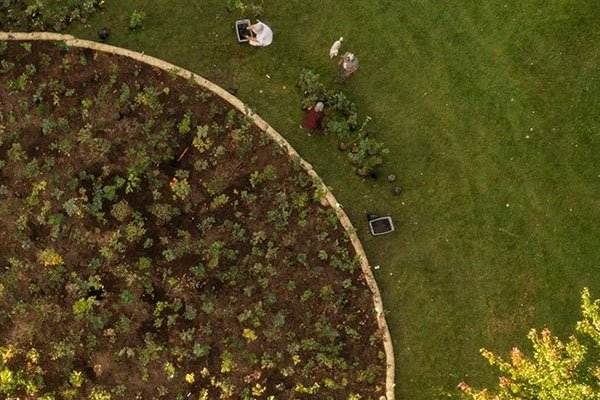
Web3 Art: The only reason why we are surviving on this planet is that there’s still nature. If we were to remove our nature, we would be with Elon Musk on the way to Mars with the big problem that we need to terraform.
When we talk about creating the right environment, is this using all the senses in terms of the right atmosphere, smells, lighting, and exposure to technology and the rays that emit from technology? Is technology allowed to be part of the equation? Is this about getting away from being so attached to our phones and other electronic devices?
It’s at the core of the problem. We believe that technology reaches the grade of complexity that allows this technology to reconnect us to nature because nature is technology. If you look at a tree, a tree is 10,000 times more complex than any human technology.
There is math built into biology and computer programming.
We know that a tree is a phantom biological machine because photosynthesis is what created our atmosphere in the first place. If you go back 500 million years, we have only 5% oxygen and atmosphere. The 21% we are having was all created by the most complex technology we have on earth. These are plants but we are not choosing this technology and our economic system.
You go back to Adam Smith, The Wealth of Nations. The moment where we value nature is when we transform it with human labor. This is where we attach to the natural resources value. The paradox is that a tree is valued more in the form of a table than in the form of a tree. If we were able to reverse engineer trees, that would be the highest grade of technology we would have. The good news is that technology is enabling us to understand nature and connect to nature on a much more profound level.
Nabyl, this is a noble cause. I’m excited to think about the potential here as a consumer and beneficiary of this research. What’s the ROI from your perspective? Did you see this as short, mid-term, or long-term? How does it compare to your normal investment thesis?
The way we look at it is we’re living in the most exciting time in human history. For 50 million years, the human brain hasn’t gone an upgrade but we’ve been able to build all these exponential technologies that are finally all building on top of each other in what we call S-curves. It’s everything from computing power to video power to robotics to AI.
We’re finally at this point, combining with the blockchain, that we’re able to build pieces of art like we’re seeing that would not have been possible even several years ago. From an investment perspective, our thesis was simple. Can we invest in things that are going to be culturally redefined? That’s what becomes extremely valuable in the future.
My background is not in art. My background is more tech, which was what it was before. I got into crypto and collecting sneakers. When this whole NFT boom began, the way I looked at it was this was finally a way for people like me who were never into the art world, never had access to it before, or were not part of your culture. It was finally becoming a part of the culture of people all around the world because of the democratization of technology.
From a fun perspective, our thesis was to invest in these culturally redefining pieces and curate the best things that are happening with this technology in the digital asset space that is going to become extremely valuable in the future. Refik is an artist and mathematician. At the end of the day, my background is math. Refik has been discussing what is going to be the Monet of this era.
I heard Daniel, the CEO of Yuga Labs, talk. His mission with Yuga is culture on the blockchain. It’s a similar theme and noble objective. There’s an exhibition here we’ll get into but this isn’t your first collaboration with Refik. Can you talk a little bit about how you all intersected and what led to the exhibition that we get to see here in Seoul? We’ll go into the basis of that particular exhibition.
I met Refik for the first time on a panel that was created by Hans and me at the Venice Architecture Biennale. This is the big Biennale. It’s a one-year architecture. The other years of art. We started our art program, Tama Art, in 2017 and became a major player in supporting Biennale institutions like the Serpentine in the UK. We are trying to see how we can support the art and culture production that is trying to heal this fundamental flow we talked about.
It’s a culture that is not destructive but is constructive towards nature that tries to establish a homo status with nature. It is a balanced system. We created this under the wellbeing culture, how culture can provide wellbeing instead of providing a hostile environment. Hans invited Refik, whom I met on the panel that I moderated. He started to speak. I was like, “I don’t understand any word.” I had no idea what he was talking about because this was 2019. He came from this blockchain and NFT world. I had no idea.
He was thinking about NFTs and blockchain in his way back in 2019.
It’s about AI and NFTs. For me, this was new. He was sitting among these people that I was talking to every day through the established artists and architects. He was an outlier interesting on this panel. We also had the famous indigenous rights activist Nina Gualinga and the famous botanist Stefano Mancuso, who proved that plants are intelligent systems. They are not AI but NI, Nature Intelligence. Between these three and also some others was such an interesting conversation.
Somehow, we sensed that we belonged together. We started to work with Refik. That became a success story for all involved parties. It led us to visit the indigenous tribe of Yawanawá in 2022 in the state of Accra. You need to rent a plane. You go 3 hours on the plane, 4 hours on the car, and 10 hours on the river. You’re in the heart of the biggest treasure we have on the planet. It’s the treasure of our biodiversity. This is where all the information is stored for 500 million years that is relevant for our survival on the planet and direct environment.
We have a showcase in Seoul called Sense of Healing. It embodies a coalescence of art and technology. It’s the ability to gain insight, collective renewal, and connection. It’s a beautiful exhibit. You told me about it and we’ll share it with our readers and do some filming out there to show everyone. What was the inspiration behind this exhibit as it connect to the world of Web3?
With the connection to Web3, I will let Nabyl speak but the sense of healing was an artwork that was meant to open the human brain and let the human brain interact with itself. One of our biggest problems is that the mental health debate is a little bit upright because we don’t know. It’s not scientific. We don’t see into the brain. It’s like the medicine in the 12th century before it was allowed by the religion and churches to open the body and the doctors were guessing.
The brain is still a black box.
It’s a black box that we are starting to measure. What we have created is an initiative called Mind with MindMaze. It is a leading neuroscience company. They provided us with brain data of tens of thousands of patients. Refik used AI with this brain data to visualize it. This is a strong moment because suddenly, you’re standing in front of a data sculpture that is relevant. Its purpose is to show you how the healing process of our brain is created.
You can talk a little bit about the Web3 component.
From my perspective, Refik has always been into data, AI, and math. The ability for him to take this data set and use his algorithms to interpret it into art that’s on the blockchain is unique. The ability to have this asset decentralized and accessible to the rest of the world is, to us, extremely powerful. The blockchain enables this work to become what it is. If you think back to the old days, it was commissioned by a specific few people. It was stored in their houses. Nobody else could see it. We’re here where everybody can look at what is this culturally redefining piece because of the blockchain.
Is this one-on-one? Where do the plans go from here with Sense of Healing?
Sense of Healing is one-on-one. In a traditional way, it’s like a painting or a sculpture. There’s an artist’s proof also that it is important in the traditional art world to have this accessibility. Nowadays, it’s what Nabyl said. We also created an addition. This work is based on five chapters. The mind goes from depression to happiness. For every chapter, we have an addition of twenty.
The interesting thing is that everybody can see it, access it, be in a dialogue with the work, and understand its purpose. At the same time, there is clear ownership. Ownership and presentation of the work can be divided. The presentation can be much more accessible than in the traditional art world. This is the one thing. The other thing is that the next step of Sense of Healing will be an interaction. The work will interact with the viewer.
This is our plan. We realize that we already have a few installations that allow this. You have the technology to reach the brainwaves and certain bio parameters. I cannot say too much about it but our idea that we talked about with Refik is to create a space where you would get instant neurofeedback. You go into the space. Imagine you’re meditating. While you’re meditating, the space takes your brainwaves and it’s changing. You can have support for your meditation. The sound and visuals can support you. You can see what is happening inside. That’s a little bit of where we want to go.
I’ve been familiar with biofeedback for a long time. This is the evolution of that in an interesting way. I’m excited to see the exhibition. Where can folks learn more about Impact One and Sense of Healing?
We have a website Impact.One. This is an umbrella company. We have all the different companies which we are engaged under. You can be linked to the different initiatives.
I feel like we glanced at the surface of how much you guys are doing to impact the world. I would love to talk more about the Edge of AI at some point in the near future and cover that side of things. Thank you both for your time. I’m excited to see the exhibition. I wish you the best for what you’re doing to make the world a better, happier place.
Thank you very much.
I’m here in Seoul, Korea, in a very special place. This is called the Sky Kingdom. My guest here is going to tell me a little bit more about this venue. It’s been an action-packed week, as it is with the world of Web3. The fun things happen at night. We have the launch party of Superchief’s new marketplace, which is long-awaited. Eric Choi at DIIANT is going to tell me a little bit more about it. He is the Founder and CEO. Eric, it’s great to be up here at the top of Seoul with you.
I’ll answer the first question first, which is where we are. We’re at a hotel called Soul Dragon City. It’s been a landmark next to Yongsan, Itaewon area where the US military base used to be before it was moved. It’s an interesting spot. I am tied to this venue because it was the first after-party I ever ran in crypto back in 2015 and this is where I did the first event.
Let’s talk about what you guys have been busy building together with Superchief.
I’ll give you a rundown of myself and DIIANT. I’ve been in the crypto space for years. 2023 is the end of my third cycle. I run a Web3 venture studio based in Seoul called DIIANT, which I started in 2020. We’re a ten-person team that’s based locally. That’s an international team in terms of cultural and diversity boundaries. We like to build cool shit.
When we spoke to Ed during the NFT Korea Festival back in March 2023, he had generally talked about a marketplace. I had a catch-up call with him. We hit it off and had a lot of philosophy and he does in common. I asked him about his marketplace and how it was going. Some of the people before were not as satisfactory, whether it was in philosophy or vision alignment. I saw an interesting opportunity. As invested in the art space, I can be but less in the NFT space. My team has been working more on DeFi protocol infrastructure.
In the middle of that, we were working on a new ERC standard template. While working on that, I explained that to Ed and the ethos beyond DAOs and where we feel that community and culture can be seeded to grow. Once the set alignment met, it started making sense. We were like, “We want to partner up on something long-term together but let’s go on a first date before we put a ring on it.” We jumped in and started the marketplace. Three and a half months later, here we are.
Tell us a little bit more about the marketplace. There are a lot of NFT marketplaces out there. From our time at Ava, I know how meticulous they are with what they’re trying to do with supporting creators and artists. Knowing Ed for several years, I know how meticulous he is about the artist’s journey to where they start. I imagine there are some nuances here that are important to what you guys have built and where it’s going.
I’ll explain a little bit of my history in the arts. Ed, even though he grew up with his grandmother running a gallery, as he was growing up, he’s been in the art space forever. He was a journalist spy for several years. We know his art history. The way that I lean toward the art is I was a professional dancer for fifteen years of my life. I did popping, locking, contemporary jazz, and so forth. That was going to be my profession before I jumped into crypto. I went to the Korean military. A kid dropped a missile on my foot. I couldn’t walk for six months.
Were you guys on the same team?
They show art off so that people can enjoy it.
What are you going to do?
Thanks.
It’s a pleasure.
Thanks for having me.
We read it here first.
Important Links
-
Spotify – Casper Blockchain Podcast
-
Dave.Krugman - Instagram
-
Dave_Krugman - Twitter
-
iTunes - Edge of NFT Podcast