Top Podcasts
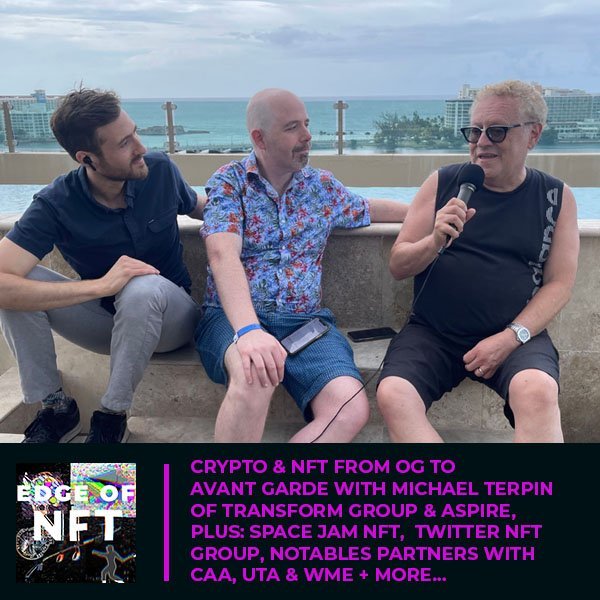
Crypto & NFT From OG To Avant Garde With Michael Terpin Of Transform Group & Aspire, Plus: Space Jam NFT, Twitter NFT Group, Notables Partners with CAA, UTA & WME + More...
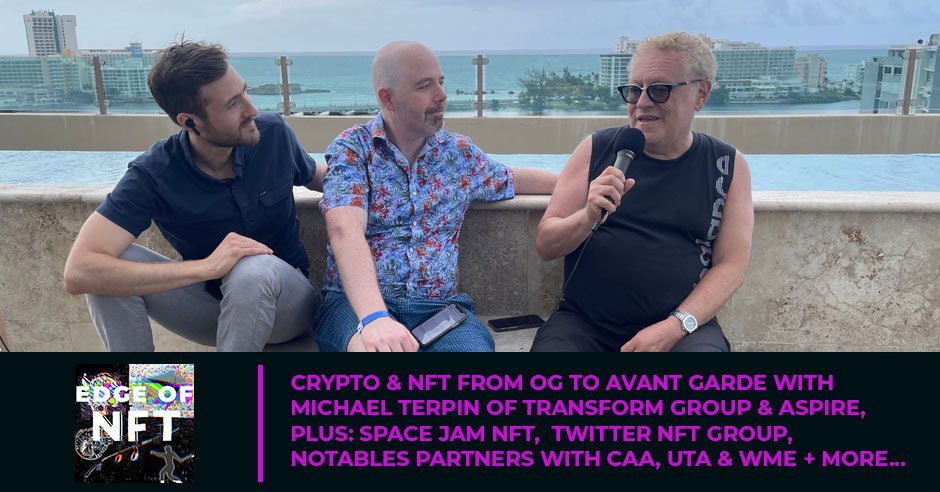
NFTs haven’t just appeared out of the blue. Years of background and development have led to the innovations of today. With all eyes on this volatile market, it’s important to understand the background and fundamentals. Michael Terpin joins hosts Eathan Janney, Jeff Kelley, and Josh Kriger in this in-depth conversation about what’s happening in the world of NFTs. Michael is the Founder and CEO of the leading advisory and PR firm for the blockchain industry, Transform Group. He has been an active supporter and leader in the blockchain and crypto ecosystem in every way imaginable. Get to know more about NFT, Michael’s latest innovative projects, and what’s next in crypto in this episode of The Edge of NFT Podcast recorded live with Michael from his rooftop in San Juan, Puerto Rico.
—
Watch the episode here
Listen to the podcast here
Crypto & NFT From OG To Avant Garde With Michael Terpin Of Transform Group & Aspire, Plus: Space Jam NFT, Twitter NFT Group, Notables Partners with CAA, UTA & WME + More…
**This episode features guest Michael Terpin. He is the Founder and CEO of Transform Group, a leading advisory and PR firm for the blockchain industry. Transform group has worked with more than 300 clients in the sector since 2013 including the likes of Abra, Ethereum, Kraken and Tether. Michael also owns the blockchain accelerator Transform Studios and is a Managing Director in Transform Ventures, which invests in advises companies in the DeFi and NFT sector including Bridge Mutual, Launchpool, RARE WAX and YIELD App. **
**Michael is also the CoFounder and Chairman of Aspire, a leading digital asset creation platform, which has grown in under six months to a $50 million market cap across its platform tokens, ASP and GASP. Aspire allows for quick, inexpensive creation of full token ecosystems including unlimited NFTs with unparalleled speed and security as well as negligible gas fees. Michael’s list of other accomplishments is too long to list here but includes founding and exiting several successful companies and supporting the blockchain and crypto ecosystem in every way you can imagine. Michael, welcome. **
Michael, it’s great to be here with you and to be able to do this episode in person in Puerto Rico. It’s been a couple of years since I was here. The first time we met was at one of your conferences in Puerto Rico back in 2018. Times have changed in terms of the blockchain landscape, the Puerto Rico landscape. NFTs are the talk of the town now. As usual, you’re early to the game and doing a lot in that space. We’re excited to get your perspective.
Thanks for coming down to the island again. There’s been a lot happening since 2018. In 2018, everything was about ICOs. You don’t even hear anybody use that term anymore. However, we did sell out every hotel room and Airbnb on the island whenever we came down to find out what was new and ICOs and some of the other things that were hot at the time. Ethereum had crossed $1,000 from being $10. It got over $4,000 after people were pronouncing it dead at $80. As Mark Twain said, “History may not repeat but it tends to rhyme.”
Now, we’re talking about Ethereum potentially flipping Bitcoin in the future. Hotels and Airbnbs are still hard to come by. Eathan and I had to scramble to find somewhere to stay. If people are wondering what’s going on in Puerto Rico, is it still alive and well? I have to tell you, the restaurants, bars, hotels are packed and the piña coladas are tasty. Wouldn’t you agree, Eathan?
I would agree. Thanks for sharing your piña colada with me and encourage me did drink more than I normally would. Michael, the next question I have for you is a bit about Aspire and how that as a decentralized asset creation platform plays into your vision for the future of NFTs.
Aspire is a company that I cofounded with Jim Blasko who is the technical whiz behind the vision here. People forget that NFTs predate Ethereum and the original NFT was Colored Coins. Back in early 2013 when you took a Bitcoin and then you put something in the memo to differentiate it from other Bitcoin and therefore, you get a single Bitcoin, which back then you could get for $20 or so. You could have 100 million NFTs because every single thing inside of a Bitcoin, you could go in and put a different memo field and say, “Playing card 1 of 10,000.” You could do it with Coloring, maybe 100th of a Bitcoin or 1,000th of a Bitcoin. That was the beginning of the whole non-fungible token concept.
I worked with Counterparty back in 2014, which was one of the earliest tokens. The first ICO was something called Mastercoin, which was built on top of Bitcoin. Counterparty was also built on top of Bitcoin. With Counterparty, they created the first playing cards where instead of putting a memo inside of Bitcoin, you created a token that was lodged on top of Bitcoin and used Bitcoin for gas. That’s 2014. At one point, Counterparty had 30 in the top 100 tokens on CoinMarketCap.
Flash forward several years, which in this industry is like 1,000 years in some other industries, Counterparty has died more or less. First of all, the three founders all left the project and went on to do other things. More importantly, the notion that everything should be on top of Bitcoin and use Bitcoin as gas became difficult when the price of bitcoin gas went up to about $20 a transaction before a SegWit. If you’re going and trying to create an NFT and every time you transfer it would cost you $20 and it’s a $5 NFT, that doesn’t work. We could see that that’s happening with Ethereum because people moved from Counterparty to Ethereum because the price of gas was low.
We’ve had times when minting an NFT could cost you $100. Now, people are looking at layer 2 solutions like Polygon that will dramatically lower those fees. It’s this never-ending chase for lower fees. What Aspire does is it takes the original open-source code from Counterparty and reworks it so that instead of having Bitcoin as gas, we have our own token, the GASP coin, Gas Protocol. That is designed so that it is built on a Litecoin standard. It can go on an exchange easily. You can go and get about one million transactions for a little over $1. Even if the price went up 1,000X, you’d still have affordable gas.
What do you have cooking in terms of projects on the roadmap with Aspire that you’re excited about?
One of them is called NFT Studios. That is a group that we did a little bit of seed funding out of Aspire. They’re going to be building their first game, it’s a game of studio. As you can see, some of the hottest tokens are gaming and metaverse studios.
It’s number one with a bullet in the top 100. The first game is called ChiFiBots, fighting robots that look like Pokemons and have a lot of gamification around it. It’s a bright team of artists and programmers that are out of Mexico, Vietnam and a few other places. They’ve got a big team and they’re putting together these cool games that are going to run on Aspire. They approached us because they like the fact that you could go in and have these fractions of a penny for gas.
**We’ve got Transformers and we’ve got Transform Group. Is there a Michael Terpin robot in the mix? Is that part of the deal? **
I haven’t seen it yet but I’ll find out.
Michael, you outlined a tremendous history that you’ve had within the blockchain space and also with the evolution of NFTs. Was there a moment or a series of moments in which you identified that NFTs became a game-changing part of the blockchain landscape in your mind? What are your thoughts on that?
I’d say CryptoKitties. CryptoKitties showed that you could have something that would completely go viral to an extent that rare Pepe Cards on Counterparty didn’t quite get to that level. You can see that games have always been important in the evolution of blockchain. When you’re able to go and have this dynamic that’s been popular in non-blockchain games of being able to have something live and care for etc. and be able to do that on a blockchain where we had ownership as well. To me, that showed the potential. There’s been exponential growth. The Beeple moment is what got all the artists out of the woodwork. I have a concern that there’s such an explosion of supply that even a fast linear growth in demand means there’s still going to be a lot more out there than people are going to want to buy. This happens in any market, it happened in the dot-coms, it happened in the ICOs and yet blockchain and the internet keep on growing.
There’s always a build-pop-retest moment and people ask us a lot in the NFT craze. I feel like it is a retest moment where we’ve set the foundation. People don’t realize how much money has gone into the ecosystem that hasn’t been spent or deployed yet and how many cool things are coming up. What are your thoughts on that?
In terms of raw dollars, there were months that you didn’t even have six figures of NFTs. I don’t think you could count it in the hundreds of dollars. Now, we’re talking about $2 billion that has been spent on NFTs, which is an extraordinary growth in terms of dollars that is far faster than the fungible token marketplace grew and far faster than the internet grew. There’s something there. There’s an early adopter demand and we’ll see whether it crosses the chasm to the early mainstream and everybody wants to have an NFT instead of a collectible. Most people collect something. If you can have permanence and digital, that’s the magic equation that excites the creators as well as the collectors.
One of the coolest applications that we’ve seen of NFTs is the coming and already here, the metaverse and how people are going to apply NFTs in the future and what people are cooking nowadays. You’re working with NFT Studios and Upland as well. I’m curious how you see those two projects or other projects claiming and playing a role in the future of NFTs within the metaverse.
Blockchain is perhaps the secret ingredient to finally get these virtual worlds off the ground. I’ve been working with companies and virtual worlds going back over 30 years. I worked in the early ‘90s with my first VR from the Terpin Group with one of the first virtual reality headsets which was the size and weight of a football helmet. It cost about $2,000 and it gave you headaches. That was considered revolutionary as time. Now, you then went through waves of Oculus Rift, Samsung and some of the other VR platforms. You still didn’t have what at the end of the day that you have. The fact that you can go and own something inside of the game and trade it, that’s what exploded World of Warcraft and some of the other original virtual currencies before cryptocurrency. It’s got the potential to help gaming plus collecting plus virtual worlds all work together seamlessly.
We’re talking to folks that are doing holograms and all sorts of stuff to support this ecosystem. There’s a lot of energy and a lot of folks in the group who are traveling here who are into realistic three-dimensional worlds and what you can do. It’s exciting when you combine that technology with NFTs.
We’re also curious about the other cool projects that you’re seeing that are leveraging NFTs and maybe some things we haven’t heard about but should be paying attention to. Any insights there?
Not everything is art and digital. Sometimes NFTs are used to prove the provenance and make for easy trading of physical items. A good example is a company that I’m an advisor and an investor in called Icecap. It’s Icecap.diamonds. Icecap is a good example of having a physical good, a marketplace and NFTs work together. Also, it’s a good example of a giant industry, in this case diamonds, which is $90 billion a year and about $25 billion a year of finished diamonds, being able to go and use NFTs to make a global marketplace. There’s a lot of wealthy families that say, “I want to put a certain percentage of my money into gold, silver, crypto, real estate, stocks and bonds.” If you say, “I want to put 1% of millions of dollars for a family office or wealthy family or a corporation into diamonds,” how do you do it?
You can’t go and say, “I’d like to place an order for $1 million of diamonds.” What diamonds? Whereas you can do it gold because it’s fungible. What Icecap does is it takes the non-fungibility of diamonds and turns each diamond that’s an investment-grade diamond, which is calculated by nine different factors. There are the traditional four C’s, the Carat, Cut, Clarity, Color and puts it at the top of the line there. They’ve got another five that means the difference between can you sell to the industry versus do you have to sell it to a pawn shop and have what you paid for it? Because of this, it’s a professional-grade marketplace where you can go in and buy something and it may be 5% of what the industry is paying.
The thing that’s cool that they brought out in Icecap.diamonds is they have 500 different factors. You’ll say, “What is selling to investors?” You’ll say, “The thing that’s selling the most, therefore liquidity, is VS1 D-cut one carat.” You look and see what’s listed. What does it compare to other things in its category? It’s the value basis. Ever since that’s listed, everything at the top of the value starts selling. Icecap signed a deal with a group that’s going to be marketing this to thousands of family offices that already buy gold and silver. All of a sudden, now you have a formula.
What’s going on with RARE, one of those interesting NFT projects in your portfolio?
NFT: There’s such an explosion of supply that even a fast linear growth in demand means there’s still going to be a lot more out there than people are going to want to buy.
RARE is an infrastructure and they’ve created the model. Everyone in Hollywood knows what Digital Asset Management is or DAM that usually involves big legacy computer systems, enterprise software, etc. What this is it’s D-DAM. It’s the centralized or distributed digital asset management around NFTs. A couple of problems exist in NFTs and one of them is when you have an NFT, how do you know that the link that you’re getting is something that is going to be there tomorrow?
There are several NFTs where the source file is stored on an AWS server or somebody doesn’t pay the bill. You spent $50,000 to a bridge to nowhere or a hyperlink to nowhere. Here, they’re able to have a suite where you go and you’re able to inexpensively mint by paying for it with RARE tokens, which is the decentralized server on the nose that creates this and then also it permissions us. If it’s 1 of 1, you’re the only one in the world that can see it.
Even when you have things that are stored on IPFS, they’re not encrypted. If one person ends up getting that link because they bought one of them, they can share it on a forum and all of a sudden one million people have it and it’s no longer rare. Here, you need a permission key. It enforces rarity and it enforces the fact that this is going to stay there. It enforces digital asset management. It’s a revolutionary set of tools. I’m an investor in the equity and then there’s going to be a token coming out in the near future.
**That’s exciting. That’s a project I’ve been following as well. All the use cases around that, get pretty interesting. I’m imagining these special moments, these rare moments and experiences that occurred that you want to keep to a more select audience from the virtual moments like maybe the birth of baby Yoda, a real birth moment or some other NFT that you want to pass on to other generations. **
It’s been noted that the most successful NFT product out there is going to be NBA Top Shot. In some cases, it looks like some of these things that you’re spending thousands of dollars for, the videos are available on the internet. You can find it on the web. How rare is that? This will allow so that if there are some never-before-seen footage of a Michael Jordan dunk or whatever, you can prove you only have 1 of 1. The problem of having an IPFS without encryption is you think you have 1 of 1 and then somebody shares it on a server and all of a sudden, 1 of 1 million is debased. Here, that can’t happen.
**We’re going to be excited to chat with them in the future. They’ve been busy building but they’re looking forward to coming on the show. That’ll be great. **
Michael, what else are we in the general public missing about NFTs? Are there game-changing categories of NFTs that we should be paying attention to but are not?
The evolution is going to show things that haven’t even been thought about yet. When the telephone came out, its original use case was supposed to be broadcasting opera. That’s not what people use the telephone for now. You’re going to find use cases that are built on top of use cases. With RARE, for example, they permit the ability of somebody to go and publish a book. Instead of giving 70% to Amazon, they’ll end up keeping 90% and the other 10% goes to a combination, the token holder, the distributor of RARE and the platform. You can go in and sell a $20 eBook that’s maybe a coffee table book and you open it up and there’s a photograph there. Within that page, you can then go and buy the NFT. Maybe there’s a different thing or there’s an artwork that will go for ten times as much or you can have different airdrops. The layering of NFTs inside of NFTs as an ecosystem is something that’s in its infancy.
**We’re in the early days. A lot has happened and evolution and innovation are happening at a rapid pace. If we talk to you again, who knows what’s popping in this crazy world of NFTs. We’d love to get to know you more as a person, I’m sure our audience would as well. You do a lot of interviews about the industry. We want to know about Michael Terpin, the man behind Transform Group, the man behind the myth. **
**Michael, Edge quick hitters are a fun quick way to get to know you a little better. There are ten questions and we’re looking for a short single or fewer responses but feel free to expand if you get the urge. **
Michael, what was the first thing you ever purchased?
I have to differentiate this from what I purchase versus what my family purchased for me. I’m thinking it probably would have been numismatics, rare coins. I collected coins when I was a kid. I had to take my allowance money and go to the coin store in downtown Buffalo, New York and buy Buffalo nickel or whatever the first one was at the time.
**Many of our guests were collectors even as kids. It’s the theme. **
Michael, what was the first thing you ever sold?
Creativity is what gets us past the problems of today. Click To Tweet
That also would have been coins. I collected coins from the age of maybe 6 or 7. I started buying them and would watch them go up in value. When I got closer to realizing I need to save up money for college considerably for that, I started a little mail-order company to sell coins when I was about eleven years old. It was funny because when we were cleaning out my dad’s house of some things a couple of years ago, my wife came across this little thing that had a business card that I had when I was about 12 or 13 and said, “Terpin’s coins.” Considering I got into crypto, it has a double meaning.
We need to NFT a photo of that.
I was thinking the same thing. Michael, what is the latest thing you purchased?
Some wine.
Red or white?
Both. Probably the last thing that I purchased is a Magnum Nuits St. Georges.
What is the latest thing you sold? Now we’re going to know the real Michael. Why is he trading crypto?
Probably Bitcoin. I sold some Bitcoin and then bought some back lower.
You’re still a Bitcoin maximalist.
She is lovely though.
**Mooching off of others’ private jets. **
**More than I would have. **
I was on my computer answering emails.
**We’ll mint the first workout video NFT. **
What’s our last news, Eathan?
They’re wrong.
**I thought we’re going to do it now. **
Both. I’m not punning.
NFT: Having value does not make it a security.
**I would like to see that. **
**Thank you so much, Michael. Appreciate it. **
Thank you.
—
Important links
-
@MichaelTerpin – Twitter
-
iTunes – Edge Of NFT
-
@EdgeOfNFT – Twitter
About Michael Terpin
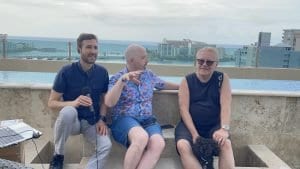
Michael Terpin has more than 25 years of PR agency management. He has directly supervised many renowned PR campaigns of the digital media era, including early-stage PR for America Online, Earthlink, Jupiter, Motley Fool, Match.com, and Shapeways, as well as full-service campaigns with established brands, including Alpine, AT&T, Diamond Multimedia, Fujitsu, JBL, Konami, Marriott, Memorex, Philips, Rackspace, Red Herring, and TEAC.
In the blockchain sector, Terpin has led the PR efforts for more than 100 blockchain companies and foundations, including some of the leading token crowdsales. Client successes include the launches of Augur, Counterparty, Dash, Ethereum, Factom, Golem Network, Lisk, MaidSafe, Tether, as well as ongoing campaigns for Bittrex and Shapeshift.
Terpin co-founded BitAngels, the world’s first angel network for digital currency startups, which now has more than 500 members globally.