Top Podcasts
Brent McCrossen Of The Glimmering - Taking TTRPGs To The Next Level, Plus Stripe For NFTs Raises $26Mil, Bill Gates Lambasts NFTs, Bored Ape Value Crashes, And More…
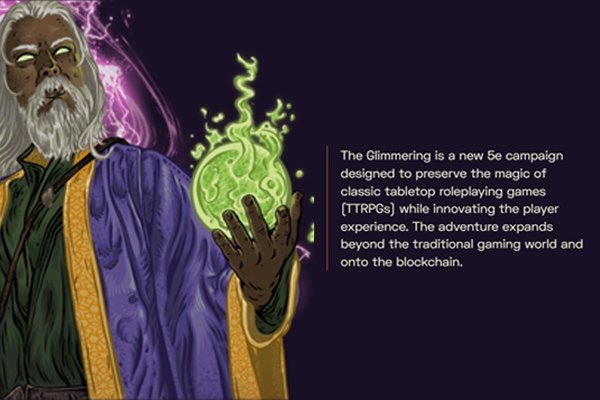
Tabletop role-playing game enthusiasts unite! This episode is a treat for you. Jeff Kelley, Eathan Janney, and Josh Kriger are joined by the CEO of GRIPNR, Brent McCrossen. Brent brings to us their latest project, The Glimmering, a new 5e campaign designed to preserve the magic of classic TTRPGs while innovating the player experience. Born straight from the mind of a Dungeons & Dragons master, The Glimmering is a unique take on your beloved traditional games but with blockchain! Join this conversation and get to know its origin story and how they are putting NFTs into the game and allow you to do epic shit!
—
Listen to the podcast here
Brent McCrossen Of The Glimmering – Taking TTRPGs To The Next Level, Plus Stripe For NFTs Raises $26Mil, Bill Gates Lambasts NFTs, Bored Ape Value Crashes, And More…
Stay tuned for this episode and find out how our guest is taking tabletop games to the next level and using NFTs and Web3 technology to do it.
Why our guest has a passion for inspiring others to share his passion to create.
Also, find out if Bill Gates is still skeptical about NFTs or ready to dive into the next wave of tech. All this and more on this episode. Enjoy.
—
Our sponsored Spotlight episode features Brent McCrossen and The Glimmering, the new 5e campaign and empire of imagination that allows you to do epic shit. It is designed to preserve the magic of classic tabletop role-playing games while innovating the player experience. Brent is the CEO of GRIPNR, which was co-created with the support of Revelry Startup Studio, where he’s the Managing Director.
Before building this adventurous company, Brent was the Founder of Audiosocket and LIDCORE, two media tech firms that help musicians make a living by licensing their creative work in commercial media. Brent’s love for tabletop role-playing games, supporting creative communities, and building world-class media businesses inspire him to bring GRIPNR’s vision to life. Brent, welcome to the show. It’s great to have you here.
Thanks for having me on, gentlemen. I appreciate it.
For our readers at home, Brent and I, prior to this, are dorking out on our similar tastes in shirts. We learned that Brent is wearing a shirt that he personally stylized, which certainly indicates your creative spirit. That’s a nice segue into this episode.
I love Paisley’s end of life. It’s not the only pattern that I like. I’m a big fan of it.
Unfortunately, you are going to get inundated with custom shirt design requests at this point and probably got other things you want to focus on.
I have no time to design a page for the 22-season.
The builders of Web3 aren’t always focused on personal fashion. They are busy building but it’s nice to see that you’ve struck that balance. Let’s go deeper into The Glimmering, which is a gate to another plane. It’s a place that’s dark, has terror, and has some fascinating vistas. It sounds pretty cool. I’m excited to dive in here. How did this idea come into being?
My good buddy, Patrick Comer, has been a friend of mine for many years. He is the CEO of a company called Lucid and he has been playing Dungeons & Dragons since he was a little kid, and he never stopped playing. He not only is a player but also a Dungeon Master or a game master, as we call him, which is somebody who leads the gameplay. I’ve played it off and on throughout my entire life because I had an older brother who played it, and I wanted to follow in his footsteps.
In November of 2021 or maybe September, Patrick called me and like, “I’ve got an idea. I want to run it by your startup studio,” which I thought was interesting because he was running a very large successful multinational startup. It had offices around the globe. I figured he was either extremely bored running that company or was about to have an exit. I didn’t know why. We took the meeting, and he brought us this idea. His brother is really big into DeFi crypto. He’s got a fund out of New York called XBTO. Although they love each other, they are extremely competitive.
He’s like, “My brother is having way too much fun and making much money in this crypto stuff. I realized he wasn’t looking at NFTs. If I were going to get an alpha, I would have to start there.” We dove into it, and he found the Loot for Adventurers Project, which is a black background with white text listing items that you would come across in a tabletop role-playing game like D&D.
That took the community by the store at some point in 2021, and then they came up with additional paths and all sorts of fun stuff.
The community is building on top of it. When he noticed that, at least at the onset, there was no gameplay in the Loop Project, what dawned upon him was that tabletop role-playing games that are a perfect use case for blockchain. It’s because you are rolling dice. The dice outcomes are data. Those data points get put into a character sheet that creates your character. The dice rolls also inform the outcomes of the gameplay itself.
We agreed to look at it from a startup studio lens. We ran our validation process and quickly came to the conclusion that it was a strong business idea. It fits all of our personal interests. That concept of founder opportunity fit, where what you are good at, what you love, and what the world needs, that intersection is what we call founder opportunity fit. We decided we wanted to support it. Patrick said, “I want you to be the CEO of it.” I got tricked into it delightfully because I got to build one of my best friends. Shortly after we agreed to start this thing, he went and sold Lucid for $1.1 billion.
I’ve figured out exactly why he was noodling on this idea. It was because he knew he was going to have an opportunity to do something next. He was using the ideation process on GRIPNR as a way to de-stress himself as he managed the conclusion of that transaction of his company. That’s how the idea came to be. From there, the team has just exploded.
I love the spirit you exude of bringing imagination to life. From us talking about your shirt and how you envisioned something that you wanted to bring this idea to life is really exciting. We love these people. In addition to the core, we hear that you plan to launch an NFT Genesis collection to be used in gameplay. Can you tell us a little bit about that?
The collection itself, as well as the gameplay, are two critical and inseparable pieces. What tabletop role-playing games are effective is storytelling. The stories are told, led, and lived by the player characters. In the world of The Glimmering, there are eight ancestries. What we call races are ancestries across twelve classes. What that means is that there’s an inordinate amount of artwork. It’s not a single image that has a lot of different color variants or maybe smiles and expressions. It’s literally 96 different types of possible characters like an Orc Wizard versus an Orc fighter or a human, whatever class you want to reference next.
We knew there was going to be a ton of artwork. We knew there were going to be a lot of tricks and puzzles. We had Kyle, who’s our Creative Director. He was in charge of finding us the right artists. He worked with an artist called Angryblue, who had done the Assassin’s Creed stuff with Rob Zombie, the video game, and all that trailer. We brought in Justin, and he was a great fit. His work is hanging in the Rock & Roll Hall of Fame. He’s exceptional but within the first 48 hours of him working on the project, he said, “There’s no way that I can do this alone. It’s too much artwork to illustrate, and you have to color it.”
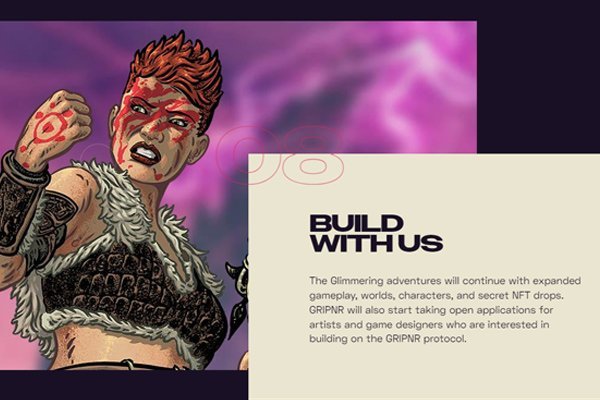
Very quickly, the art team became six people. Three of them are on a contract basis as we needed to scale up production, and then three were the core of our team. Angryblue is the Lead Illustrator, Dan, who goes by Omnigraphicon, being his second in command. The lead colorist is a guy named John Rauch, who has been credited on every Marvel and DC comic that’s come out in the last several years. GRIPNR’s first game world is called The Glimmering, and all of these characters interact within that tabletop role-playing game.
For the game itself, I’m a huge D&D fan. Patrick has been playing all of his life but none of us have built tabletop role-playing worlds ever, and we knew we needed somebody good. I have a friend who’s a tabletop game designer. I called him and was part of the validation process first, hoping that he would tell me that I was crazy and I should stop doing this and go spend time elsewhere, and he didn’t. He’s like, “This is a brilliant idea. It’s a perfectly natural fit. You got to do it. You need a great game designer and I’m not the best. I’m going to get you the best.”
He introduced me to a guy named Stephen Radney-MacFarland and who has been designing games for Dungeons & Dragons, Paizo, and others for many years. We met with him. He had a lot of open questions. He had seen some good and bad commentary around NFTs and the blockchain itself. He wanted to make sure he was working with the right people. We spent a number of weeks getting to know each other. Pretty quickly, he realized that back when he was doing organized gameplay for D&D, and there was this process where you would play an organized session at a convention, and you would have this sheet of paper that the Dungeon Master would sign.
You would get a stamp on it but then if it didn’t get put into a database somewhere, you try to bring that certificate to another game store and couldn’t play your character. He saw clearly that our use case for tabletops on the blockchain solved a lot of the challenges with organized play campaigns globally. The artwork and the story go together. Honestly, the folks who are both building the game world and designing the art are the most talented I’ve ever worked with in my career.
I love the moment where you pitch the idea, and you don’t expect a great response necessarily, and somebody says that they love it. It’s exciting but it’s like, “I got to do this now.” I got to take this step into the unknown, which is a fun moment in the creative process.
At the Startup Studio, we try to kill confirmation bias aggressively because we want to build the right thing first and not create a bunch of waste, especially economic waste. I’m looking for reasons to kill an idea more than I am to try to convince myself I’m right about something. When folks like Stephen and my buddy Loki introduced us, who were literally in this industry for decades are like, “This is exactly the right use case and the right approach.” You can’t walk away from those signals. Since we also loved it, it made it even easier to say, “Let’s go.”
A quick shout out before you jump in here, Josh. Shout out to a friend, Rob Fitzpatrick, who wrote a book called The Mom Test, and it’s about that very thing. The process of making sure that following ideas just because people say they are excited, you got to get the test in and make sure people are going to get into it.
We are all lean startup guys, Brent, and that’s how Jeff and I started our previous prepared meal company. It is now national, and it starts with customer discovery and seeing what’s possible here. When we started this show, it was an experiment. It was the traction that we got before we leaned in that encouraged us on our journey here. It’s cool that you are able to drink your own medicine in terms of how you work with startups. Let’s dive in a little bit deeper into some of the mechanics. We’ve got this concept role to mint. What is that, and how do people participate in it?
We stole that idea from another friend of ours named Kevin Lin. He was the Founder of Twitch. He’s a New Orleans guy and he is creating a new NFT game project called DustBreakers. They were way ahead of us many months before we started even looking at this. They were already building, and when DustBreakers came out, the idea was to play to mint. Rather than opening up the NFT mint to anybody, maybe they care about the project. Maybe they don’t. He wanted to build in early a community of folks who fundamentally believed in what he was trying to do, proved that they cared about it and would be around for the long-term and not just looking for a quick flip.
He created the play to mint, and with play to mint, they created a quick but still beautiful video game that was browser-based. You could go, and you could play in some of their animated worlds within DustBreakers and kill the bad guys and get points. Based on your ranking, you would get on the white list. Given we are a tabletop game, we wanted to steal from that playbook and roll to mint as a concept where you are interacting with the community. Also, demonstrating that it’s something you believe in, that you care about, you want to learn more about and participate in because these things, again, it’s all storytelling. It’s collaborative storytelling, and it’s important to us to lead with those first principles.
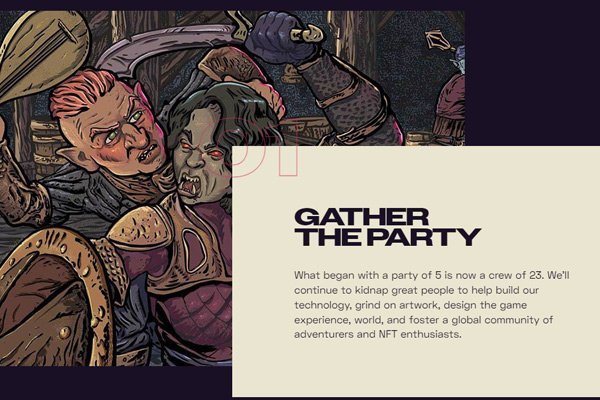
The Glimmering: The concept of Founder Opportunity Fit is where the intersection between what you’re good at, what you love, and what the world actually needs meet.
It’s not very complicated to do. It’s about interacting with us on Discord. We’ve created what’s called a one-shot campaign, which is like a short film of D&D. It’s a two-hour play session instead of the typical 4 to 5. You can come to play those games with us on Discord and share and talk about the project. Proving that you are interested and you want to be a part of the community, and then you’ve successfully rolled to mint.
We got to get you in our Discord too, and introduce our community to yours. We will make sure you get an invite there and get your special podcast guest status, and local celebrity status. The utility is a big part of the conversation in NFTs these days. We see it left and right. I know you are considering that pretty strongly. What are the benefits that you are bringing to the community along with the NFTs?
One of the founding purposes of the business is to add value to both the game masters, the game designers, the artists, and the players candidly, that have made tabletop role-playing games with what they’ve become over the last many years. We see a number of those constituents being underserved economically. Our first game world is The Glimmering but that’s not where we end. GRIPNRs greatest ambition as a company is to become an industry-standard protocol for all tabletop role-playing games that want to be on-chain.
We will use our treasury to finance the best and the brightest game designers to build their games on our protocol, and all of the collectors that are in the Genesis Collection get first access to every single project that is built on top of their protocol. That’s utility, number one. In the future, when we roll out The Glimmering Game Masters, the ones who run the games as well as others, collectors in general, we will be able to mint areas of the world. When gameplay happens within those areas of the world with The Glimmering and rewards are paid out, either loot bags, additional NFTs or tokens because we are going to be launching a token when we launch play on-chain, then the people who own those areas of the world will also be able to participate.
The upside of having helped finance some of those games that are getting built. Beyond that, it’s not just this initial collection. After we drop the NFT player characters for those who hang around and stake them, there are going to be additional rewards in airdropping NFTs that are related not only to their player character but other areas of the world. It’s access to every future project built in our protocol. It’s access to additional NFT airdrops that we are going to do for The Glimmering NFT player characters and access to minting sections of the world and the token that we launched when we released a play on-chain.
I’m looking at an article. I had heard something similar but I googled it. I think it’s pretty accurate, though. This is from 2021, “The latest data show that intangible assets comprise 90% of the value of S&P 500 companies.” The fact that you are doing something like mint and land in the gameplay space as a way to give back to the community it’s a big deal. You are sharing that digital asset that you have with the community in a powerful way. I like that model.
We think so as well. Again, in the game design, game masters spend hours preparing for a game and spent hours running a game, and we believe that they should be able to receive fair enumeration for that. A lot of game designers are extremely underpaid in our experiences, and they are unrepresented. DMB has got a bit of reputation historically for being mostly a White dude’s game.
That’s changed dramatically in the last couple of decades but we are not seeing that type of diversity reflected in the game designer element. One of our ambitions is to make sure we are reaching out to the talented and unrepresented communities and giving them a shot, and giving them the money to go build whatever games they want to build on top of our protocol. If they are doing great work, we want to support them.
We met a lot of the Polygon team a while back. We connected with them the first time face-to-face at NFT New York, and they have been doing a lot in this space. It’s exciting to hear that you announced a partnership with Polygon Studios. I would love to give people a little bit of a peek behind the curtain in terms of how that partnership came about, why you chose Polygon, and what the nuances are of having a partnership with one of these big EVM-compatible solutions.
I’m going to give full credit to my CTO, Luke Ledet, for a lot of that decision-making but it was a brilliant decision. It was certainly the right one. When we looked at different blockchain options for the company, we had to take into account that when you play GRIPNR games, game outcomes are recorded back to your character on the blockchain. Not only are all the player stats on-chain but there’s also a ton of data associated with the NFT that’s on the blockchain, not just the picture.
When you play the game, those outcomes rerecord new data back to your NFT. If we did that on Ethereum, especially now, the cost of that would be so prohibitive that pretty much no one could afford to play the game. We needed a more scalable blockchain solution that was going to enable gameplay without driving exorbitant gas fees. There were a couple of options that we could have gone with but there was another driving force that brought Polygon to the forefront for Luke.
The second element is we want to prove fair mint to our community. Not even me, as the Founder and CEO who’s going to have an opportunity to grab more rare NFTs than the general community at large. We wanted to implement Chainlink’s verifiable randomness function so we could prove and anybody could prove that when an NFT is a mint and all of the data that’s getting input into that NFT character is completely random and nobody has the ability to snipe for rare trades.
At the time, Solana implemented that but we knew we wanted it in December 2021 when we started building the tech. Those were two of the other things that informed our approach to Polygon. When we made the decision to do it, Luke took the lead, as I would expect a CTO of his caliber to let the Polygon folks know exactly what we are building. They are like, “Holy cow, you are taking tabletop games and putting them in the blockchain. Who’s behind this? How can we help support you? What can we do?”
Since then, they’ve started to back the project. Time has proven that it was a good decision because so many new Web3 games are being built on Polygon, not Polygon alone but they are getting a lot of momentum and a lot of attention. They are raising a lot of money. Alex from Reddit put in a couple hundred million to their game studio, and they have been supportive and worked at the earliest stages. As we get closer and closer to rollout, you will see more and more announcements between GRIPNR and Polygon Studios.
—
—
Yeah.
What is the most recent thing that you sold?
That’s the Discord lifestyle, for sure.
That’s our WhatsApp now, and I have to say.
Be careful trying to reprimand that child.
I will bang my head against the wall.
No real comments at this time.
Important Links
-
The latest data show that intangible assets comprise 90% of the value of S&P 500 companies – Article
-
Bill Gates lambasts NFTs – Article
-
Article – Bill Gates hiding out at luxe billionaires’ golf club in California
-
Bored Ape Ethereum NFTs Drop Below $100,000 for First Time in Almost a Year – Article
-
Twitter – The Glimmering
-
Medium – GRIPNR
-
Discord – GRIPNR
-
Spotify – Edge of NFT
-
iTunes – Edge of NFT