Top Podcasts
Beyond The Promises Of Blockchain With Mary Camacho & Josh Hardy From Holochain
We’ve almost always equated the next iteration of the internet, i.e., Web3, with the blockchain. That association has stuck so much that it’s almost impossible to consider anything Web3 if it’s not done on the blockchain. Today’s sponsored episode is challenging that notion. Today, we’re talking to Mary Camacho and Josh Hardy of Holochain, the platform that delivers beyond the promises of blockchain by providing a lightweight, secure, and versatile framework for every day distributed apps. Holochain serves as a neutral territory for scalable coordination, a technology crucial for addressing global challenges and fostering thriving, regenerative, and creative communities and economies. There’s a lot of stuff going on with Holochain, marking a significant inflection point in what would be the future of the internet. Tune in for more!
Listen to the podcast here
Beyond The Promises Of Blockchain With Mary Camacho & JoshHardy From Holochain
This sponsored episode is very special. I’m here with Mary Camacho and Josh Hardy of Holochain, the platform that delivers beyond the promises of blockchain by providing a lightweight, secure, and versatile framework for everyday distributed apps. There’s a lot going on in Holochain. I’m excited to unpack it with you both. I learned that Josh here is not in Josh DAO yet, which we’re going to quickly resolve. Let me share with our audiences your backgrounds, and then we will get right into it.
Mary is a social scientist with a Master’s degree from the University of Chicago. She’s very used to cold climates. She boasts over twenty years of experience as a leader, founder, and executive in tech and telecom firms. She has also championed ethics in business communities and played a pivotal role in evolving distributed operations within organizations. Mary has advised numerous startups in strategy, funding, and product development. With Holochain, Mary is driving the launch of innovative tech that delivers immense value in a rapidly changing world of social and political dynamics.
We will talk more about this but for those of you who haven’t heard about Holochain, this is something you should know about. Holochain serves as a neutral territory for scalable coordination, a technology crucial for addressing global challenges and fostering thriving, regenerative, and creative communities and economies. Its unique architecture aligns with the ways individuals and processes operate with a strong focus on individual agency and group context. It’s very relevant to the conversation.
I love to always meet another Josh. Josh here is an Australian based in London. He’s the Web3 builder and co-founder of Rain Protocol, a framework designed to make smart contracts more readable and writeable. With a background in music and songwriting, he collaborates with digital artists in the Web3 space, merging creative and technical skills to drive innovation. At the core, Holochain is a P2P networked data-integrity engine with broad applications including supply chain, value flow, accounting, and remote devices. There’s a lot of fun stuff we can talk about but first, what did I miss about Holochain? What do people need to know?
The basic and easiest thing that everybody needs to know is that Holochain is a framework for building distributed peer-to-peer applications. It’s that simple. We’re talking about the applications that everybody uses every day, whether it’s social media, messaging, games, or a lot of great things. We talk about it as something that you can use for supply chain, value flows, and all of that, and it very much is but most people are starting with prototypes, games, small applications, work applications, and all sorts of things like that which make our lives a little bit more disintermediated from Big Tech.
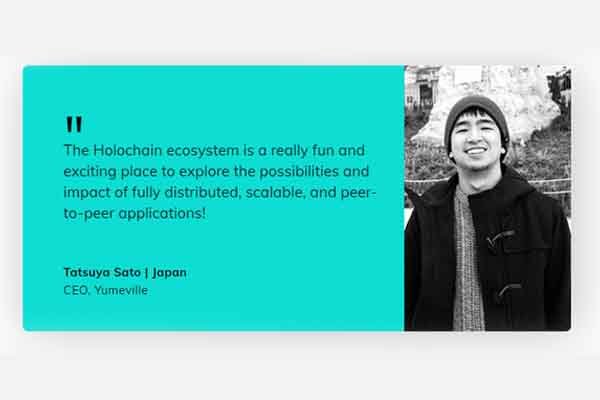
Holochain: Holochain is a framework for building distributed peer-to-peer applications.
It is a big topic. It has been for several decades. What’s the backstory on Holochain? How did it start? When did you get involved?
The technical co-founders of Holochain are Arthur Brock and Eric Harris-Braun. They have been working together for more than a decade. They started with the idea of metacurrency. Arthur’s background was in community currencies and currency design. When they came together to build Holochain, it was a small part of a much larger project that they were up to in the world, which is transforming the dynamics of how people interact digitally.
With Holochain, the idea was the way we have done everything is fundamentally set up to favor those who are already in charge, those who have power, those who have money, and those who are centralizing everything in technology. In their minds, that puts all the wrong dynamics into society. What they wanted to do was make sure that the tech we were using would enable the sort of society we wanted to live in.
There are other distributed technology L1s using blockchain, and some of them have had challenges with nodes and centralization of decentralized governance where you get these power struggles even within the decentralized world. What’s Holochain doing to address that dynamic?
First of all, Holochain is not a blockchain and there’s no native currency. Holochain is a completely different beast, monster, or critter. We call it a lot of different things on some days. The idea is that there isn’t one single Holochain. Every application is its own Holochain. There isn’t this thing happening at the level of the network. You have nodes in an application.
The only reason people are there is because they get value. Every application is running on the computers that the app is installed on. They provide their infrastructure for engaging. It’s a very different model. It can interact well with a blockchain because it uses some of the same technical infrastructure, cryptographic libraries, and things like that which allow you to be able to bind and do interfaces with blockchains but it’s a different set of infrastructure that you’re playing with that you can create different kinds of apps with.
I’ll ask you this question too, Josh. What got you excited about Holochain in the first place and got you involved?
I’ve been business partners with Arthur Brock for many years in various businesses. He’s an amazing creator. I found out about this one probably around 2015 or 2016 right at the early stages. I don’t think even the first prototype had been built yet when I started working with the organization, which was not quite Holochain yet. We didn’t incorporate until 2017 but I’ve been pretty much part of the gang since the early days.
Our show has been around for a few years. Some of our audiences are OGs. They have been in this space for a long time but a lot of folks got into this space more recently, and it’s great for them to be exposed to Holochain and learn more about what technologies are out in the world that might be relevant to what they’re building. Josh, I would love to know a little bit about your backstory and how you intersected with Holochain as well.
I live in London, and I have been working on something called Rain Protocol. One of the founders of Rain Protocol is also a core developer on Holochain, David Meister. Through him, I met the Holochain guys. Mary wanted to experiment with how we could mix Holochain with blockchain technology like L1s. I came on to explore that space.
When was that?
That wasn’t that long ago.
In Web3, that’s a couple of years. How is that going so far?
It’s good. I wasn’t a Holochain developer before. I don’t know if I would call myself a fully-fledged one now but I’ve built something in Holochain. I was able to onboard and get going. If there are any developers out there who want to try it, don’t be scared. It looks intimidating but once you get into it, it’s not too bad.
I’m excited about what you’re doing with that intersection with music. We will talk about that a little bit more. I want to mark this moment in time. I flew in from LA with Audrey on our team, and you’re here from abroad. We’re at this event. We’re calling it the funky Web3 NFT third space at Monroe. It’s this cool jazz bar that apparently had a roaring ’80s and ’90s party. It’s a little bit more subdued but intellectual. What are we all doing here? What’s going on, Mary?
This is a very strange time. We came to San Francisco for a conference, and that was not meant to be. The conference could not happen. Last minute, we pulled this together, and it’s getting started. People are going to be arriving soon. We said, “It’s okay. When something changes, it’s time for the community to step in and ensure something new is born.”
We did that with an event here and we’re going to have some fun. Lots of people are going to come together, get to know each other, and network. All the things that are important about a conference anyway happen on the sides of the conference. They don’t happen inside the panels and the keynotes. They happen in the hallways, and we all know that. We’re participating that way.
Edge of Company is honored to be a media partner. Thanks for having us here and making us part of this. The decentralization of our event was an important thing that we did. We took it to another level and had decentralized land grants from the community to have a booth at our event supporting the locals. We also tried to cultivate a high-vibration networking environment with live art and other things because when you’re watching a panel, you’re not co-creating. You need a little bit of everything, and this is a critical part of it. I’m excited to do this with you both.
It’s fun to be here.
With that context, it would be helpful to dive into Holochain a little bit more, the nuts and bolts of it, and then also talk about some of the use cases. It’s enabling decentralized solutions, and that includes new forms of currency, accounting, and key management. Can you elaborate on some of these use cases?
You can build almost anything with Holochain but some of the ways that it was designed were specific for certain kinds of use cases. A couple of things that are the most important is that you always have your private keys. That’s normal in crypto. That’s not normal in centralized tech. It’s a big problem with centralized tech. In building Holochain, we weren’t just looking at blockchain. That was on our radar but it wasn’t the point for us. It’s more at odds with centralized technologies and how are people being controlled by those who own the keys to the kingdom. That’s how we think about it.
Key management is a big deal. With Holochain, the first thing you do when you start an app is you’re creating your agent key, and then from there, you sign onto the app to create, “This is me in this application space.” It’s important to integrity because, in every interaction that you have with others, you get to validate the other people or the other peers on the application.
Currency is a big deal though because we are not typically talked about in the currency space because we’re not a token type of network. However, what you can build on Holochain is what we call a mutual credit currency, and this comes from some of those currency designs I was saying Arthur was very involved with creating prior to Holochain. What happens with mutual credit currencies is they are always going up and down. It’s like accounting. It’s less like tokens. Tokens are like, “We’re going to mint a bunch of tokens,” and they come out of nothing.
The value is determined by the supply, demand, and the tokenomics.
In a ledger that goes up and down and works like an accounting ledger, one side goes up and one side goes down. In a mutual credit currency, it’s always functioning more like the accounting of something versus the creation of something and then having it be supply and demand in the market. It can have an effect though.
Does it still enable multi-party stakeholders? In other words, it’s not binary, whether it’s a buyer or a seller. You can have a more multifaceted economy.
What you do with mutual credit currency is that you have rules about where credit comes from. Who can go negative in the currency is part of the rulemaking. Depending on what you’re dealing with, in our case with Holochain, Holochain doesn’t have a currency but Holo, which is a for-profit company that the non-profit foundation owns, is a cloud-hosting provider, and it needed a micro-currency to run the payments to cloud nodes. We have built HoloFuel, and this hasn’t been released yet. This is still an alpha. It’s still getting ready to be released.
It has been a lot of work and time to get here. I remember hearing about HoloFuel. I was a little late to the alpha but not too late because it’s not out yet. You have been building for a while.
A lot of that build has been on Holochain, and some of that build has been on Holo, the platform. Holo required a currency, and that is also a mutual credit currency. If you look at what kinds of accounts or nodes get credit limits, not everybody does. Host nodes, because they’re providing the service, are the asset value of the network. They’re the ones that can have credit lines. Every mutual credit currency has a different design. It would be done for different purposes but it works from a different premise than the way that a lot of cryptocurrency works.
It’s worth taking a pause and looking at the concept of Web3. I consider you all a Web3 company. I heard a Twitter Space about this. People are debating, “What is Web3? Where is it going?” Fundamentally, some of what Web3 has been in the last few years has worked. Some haven’t. It has been an experiment. I see a lot of alignment in terms of what you’re doing with Holo and Holochain in the concept of Web3. I’m curious if you’re offended by my observation or if you agree.
It’s interesting. We probably don’t define ourselves as a Web3 company but we do think we’re building part of the next web. I say it that way on purpose because Web3 has become so tied up with blockchain, and sometimes people think, “If you’re not doing it on the blockchain, then it can’t be Web3.” We think we’re very aligned with what Web3 is about but because we’re not specifically trying to do blockchain technology, we’re trying to invent a new internet. There are a lot of partners inventing a new internet. That’s what a lot of us want.
That’s what a lot of the Web3 community wants. Josh, you’re shaking your head.
That was nodding and shaking vertically.
We’re not disagreeing on this topic yet. You’re new to Holochain but you’re not new to Web3. What’s your perspective now that you looked under the hood?
I’ve been saying this to Mary. A lot of dApps should have their front-ends on Holochain because the protocol will be on the blockchain. That’s fine. That’s decentralized but the way you interact with it is often through a website, and those websites are centralized. Every other day, you see a front-end gets hacked. The password for the domain registrar gets hacked. Suddenly, it gets pointed to a phishing site. People are losing their keys because they’re signing transactions that aren’t the ones they expected to be signing and losing their money. Something like Holochain where you can have a decentralized self-hosted interaction with the blockchain makes total sense to me. I don’t know why. All dApps should be using Holochain or something like Holochain.
I have a little bit of hoodie appreciation going on. Josh is rocking a hoodie that says, “Freedom, research, and creativity.”
This is my favorite hoodie.
I’ve never heard those three words assembled in that way but it’s a pretty powerful combination. It resonates with your perspective on all this.
I didn’t write those words.
You weren’t wearing this hoodie for a particular reason.
I wear this hoodie all the time for the same reason, which is that I agree with it. It resonates with me.
It seems like a lot of what you’re trying to do with Holochain is mirror human-to-human natural interactions and experiences through technology. Is that accurate?
Holochain is fundamentally architected differently. When I explain it, I like to say that every time that you’re taking an action, it starts first locally, and then you sign cryptographically everything that you do. It gets published into the distributed hash table, and that’s where it’s validated by peers. That makes a big difference because what it means is data starts here and then goes to a space that’s shared, and you get to say how that’s shared.
That matters when it comes to thinking about how you architect an application. What we found is that instead of having people think, “Let me architect an application by describing my data,” sometimes we have them go, “Tell me what the manual process is because you may want to mimic a manual process instead of mimic the way that you would do it in a centralized database application.”
Instead of thinking about how you do it with Oracle or a CRM system like PeopleSoft, you go back to the pure basics of what exactly is happening between Person A and Person B.
Sometimes it’s out on the field. We were on a campground one time talking to people about this, “What do you do? You write it here, you take it to your friend, they do something with it, you take it to somebody else, and then they put their stamp on it.” Thinking about it in that more procedural human form helps you understand how you might get something done in Holochain better.
You’re bringing me back to my former life as a management consultant where we did process flow diagrams. I don’t hear about them too often these days but it was a helpful process, especially working with organizations that do certain things over and over again. They don’t stop to think about the value chain, how they get from one point to another, and how to simplify that before technology wasn’t there, and they weren’t using X system to do that.
You know what a CRM is. It’s this set of data against which you do three different processes. If you try to take that and model it in Holochain, it’s hard because I can’t tell you how difficult it is to break up the centralized concept of that data into pieces that people are in control of. It’s a very different thing.
We have talked about the essence of Holochain and Holo and the analogy of Web3. Let’s get into the realm of NFTs as well. You have this collaboration with Fractal Tribute. Maybe you can walk us through what that collaboration was all about and how that enables the use of blockchain for artists and creators.
Josh and I created this together. He did the development. I did not. Maybe it’s not so obvious because I can code, just not as well as he does.
Everyone can code, especially with AI now.
This started way back. I wanted to do music and I started thinking about what I wanted it to do but it wasn’t going to happen. We weren’t ready. We were getting ready to get to beta on Holochain. It was this idea of our collaborative music and live space. Maybe it could be some creator NFTs that got created and shared and then maybe a concert thing. It was this big mix of a lot of crazy ideas that didn’t all flow together very well.
Fast forward, I’m working with Josh on the Web3 prototypes. Another person who works for us in the company, Alistair, went and took a game that a developer, Damien, who is also in our community had worked on, and combined it with some of Josh’s NFT work that we were doing for the Web3 prototypes. Suddenly, we had an r/place with making an NFT. I was like, “This is the collaborative art game.”
What we added on were a bunch of other parts and pieces to it. We added that it would be something that would have a marketplace internally. You could buy the NFTs on the game itself. The creators of the game would then have a Fractal distribution of any funds that were collected. We took a bit of what Josh was doing with Rain Protocol and some of the things that we were doing with Holochain Web3 prototypes, meshed it all together, and made it a fun game. That’s what Fractal Tribute is.
Can I play this game? Am I going to get to play it?
You download it on your computer.
This is a game.
A lot of NFTs are for sale for $0.02.
It’s like crossing galaxies or something.
What’s an example there?
I’ll let Josh answer that one.
---
I had a great time. I met loads are great people.
If I don’t want to answer, can I give it to Josh?
Donna Summer’s 45.
That’s music. Josh, what about you?
It could be a barter.
I didn’t think about that.
You’ve been a digital native forever.
What about you?
He has always been a nerd.
It was a Boulevardier, a Negroni with whiskey.
Pass. I can’t remember. It’s my time.
Josh?
I couldn’t do that. I would feel too guilty.
Openness.
To yourself, others, or both?
What about you, Josh?
Josh?
Are you going to be coding or relaxing?
Relaxing and eating some food.
We can solve it at Josh DAO.
Important Links
-
YouTube - Edge of NFT
-
@HighOnHopium - Twitter
-
@MaryFCamacho - LinkedIn
-
@MaryCamacho - Twitter
-
Telegram - Mary Camacho
-
Spotify - Edge of NFT
-
iTunes - Edge of NFT