Top Podcasts
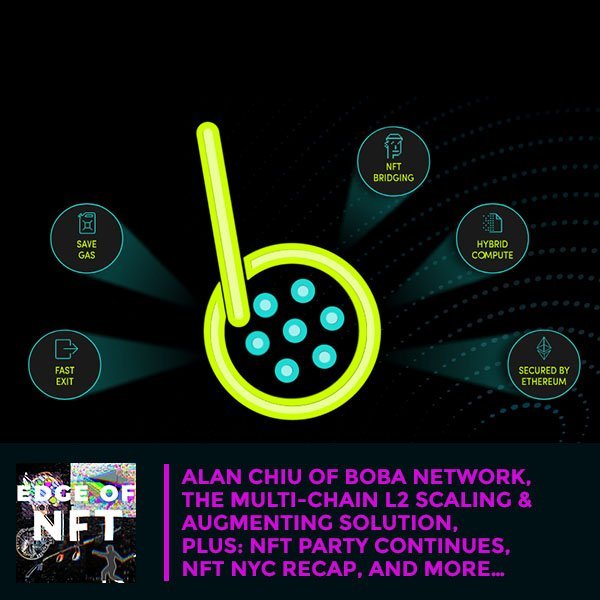
Alan Chiu Of Boba Network, The Multi-Chain L2 Scaling & Augmenting Solution, Plus: NFT Party Continues, NFT NYC Recap, And More…
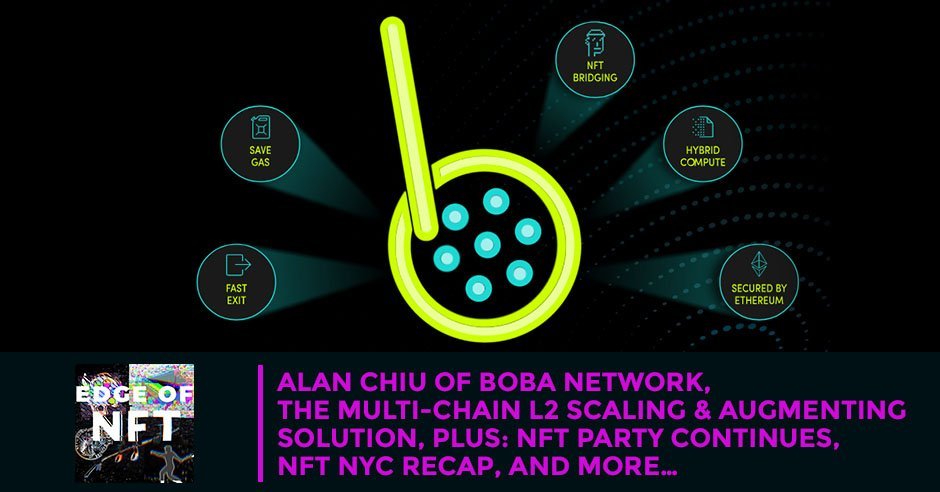
The crypto space continually evolves, and the advanced use cases for NFTs broaden with it. In this episode, Jeff Kelley, Eathan Janney, and Josh Kriger chat with Alan Chiu of Boba Network about how they contribute to this growth. As the CEO and Founder, he leads the efforts to achieve Boba Network’s goal of bringing Ethereum to the next billion users worldwide. He discusses how they aim to make the space more accessible with multi-chain L2 scaling, augmenting solutions, and their hybrid compute capability. Learn more about Boba Network and the exciting stuff they’re bringing to the table by tuning in to this episode. Plus, don’t miss today’s hot topics with recaps of NFT NYC and discussions on NFT Parties.
—
Listen to the podcast here
Alan Chiu Of Boba Network, The Multi-Chain L2 Scaling & Augmenting Solution, Plus: NFT Party Continues, NFT NYC Recap, And More…
This episode features Alan Chiu, the Cofounder and CEO of Boba Network. Alan has more than twenty years of experience in building and investing in enterprise and FinTech startups. He leads the efforts to achieve Boba Network’s goal of bringing Ethereum to the next billion users worldwide. Boba offers fast exits backed by community-driven liquidity pools, shrinking the optimistic rollup exit period from seven days to only a few minutes while giving LPs incentivized yield farming opportunities.
Boba’s extensible smart contracts will enable developers across the Ethereum ecosystem to build dApps. It will then invoke code executed web-scale infrastructure, such as AWS Lambda, making it possible to use algorithms that are either too expensive or impossible to execute on-chain. Boba Network aspires to be the people’s L2 that puts users and developers first. The goal is to build a pragmatic L2 that is the first step towards opening Ethereum to the next billion users. Alan, welcome to the show.
Thank you for having me.
Alan, you’re doing Boba. It’s a multifaceted and massive vision that we’re talking about here. We’re excited to unpack it for the show. It’s certainly not like other farming projects. I’d love to talk to you a little bit more about your origin story and how all of this came to be.
First of all, I came from a distributed systems background. I studied Electrical Engineering and Computer Science. I worked on two distributed systems startups that both had a successful exit. When blockchains came along, by then, I had moved into the venture space and became an investor. I still felt that I had to jump in and do something in this space because the permissionless nature of blockchains changes the game and takes the whole distributed systems space to a whole new level by introducing decentralization.
Eventually, a few years ago, I partnered with Jan Liphardt, a professor from Stanford Engineering, to start our company, Enya. We started exploring applications for blockchain and some of the more advanced crypto graphics techniques. After DeFi Summer happened, there was a lot of congestion on Ethereum. We thought that the infrastructure was not scalable enough to keep up with the demand created yet.
The thing about DeFi Summer was it was all crypto natives doing transactions on Ethereum. That alone was enough to drive gas fees to a pretty high level. What about the rest of the world? If you didn’t come in early enough, it was too expensive for normal people to participate, and that didn’t feel fair to us. We thought that to solve this problem fundamentally, we’ve got to increase the compute capacity of the underlying decentralized infrastructure. On top of that, how do we bring the benefits of crypto to everybody around the planet?
We needed to have all the brightest developers join the Web3 movement, but one of the barriers to entry for a developer is how little they can do in a smart contract. You can only perform basic computations. You can’t even do machine learning. Forget about being a top engineer at Google. Things are jumping into Web3 or talking about it. You take a loan and start learning what it takes to build Web3 applications. You’re like, “I got to throw away all of these advances in computer science that I’ve taken for granted for the last twenty years?” That’s not going to fly.
We decided we needed to not just scale Ethereum and blockchains in general. We also needed to connect the Web3 world with the Web2 world because some of the more advanced algorithms like machine learning are impractical to run on-chain. There has to be an easy way to enable this level of interoperability between the two worlds so that you can build one unified application as a developer. On the backend, you can choose what workloads you want to deploy on decentralized infrastructure in Web3 versus what you want to deploy on a Web2 infrastructure. That’s what gave rise to the idea of hybrid compute, which we launched on Boba Network in March 2022.
To clarify and question for you, when did those infrastructure needs come into your line of thinking as you were building out Boba?
When NFTs started taking off, we’ve all seen these crazy mints where the gas would go astronomical during those short periods, which meant these NFTs would only be accessible to the whales of the world. That didn’t seem fair to us. We wanted to make sure we were able to build infrastructure that would increase the supply of compute capacity of blockchains so that future mints won’t suffer from the same problem.
Spending a gigantic amount of ETH on gas is wasteful, so we have to solve that problem. We at Boba solve that by scaling Ethereum. We have announced a multichain strategy. We’re taking out technology and helping other Layer 1 partners scale as well. The overall goal is to improve accessibility to crypto and broaden it to the point where everyone on the planet can benefit from it.
You all are well on your way to doing that. It’s exciting stuff. I wanted to take a minute and level up to the 30,000-foot view. Some of our readers are on the end of the spectrum where they’re starting to understand some of the terminology we’re using here and some of the stuff that is essential to what you’re doing, but maybe they don’t fully understand. Can you explain to folks here that aren’t familiar with what you mean when you talk about L2 and then how that influences some of the basic inner workings of Boba?
That’s a great point. L2 generally refers to this whole category of solutions that make the underlying blockchains, generally referred to as L1s. It is faster, cheaper, and more scalable. Amongst all the different Layer 1s, Ethereum was the first to become popular. It’s also the first to run into a lot of congestion issues, which is why as a user of Ethereum, you see gas fees go up significantly when so many applications take off from transaction volume. That gave rise to a lot of innovation to figure out how we can scale these Layer 1s, such as Ethereum, so that gas fees would come down.
There are different Layer 2 solutions, but Layer 2 or L2 generally refers to efforts in scaling blockchains. Boba Network is an optimistic rollup, which is one form of Layer 2. We scale the underlying blockchain, such as Ethereum, by separating the execution of transactions from the settlement of transactions. It means instead of replicating the same computations over and over again across the entire Ethereum network. We’ll perform the computations on Layer 2. We’ll do them once and then store enough data back to Ethereum to prove that we’ve processed these transactions honestly in the way they expected. Any third-party verifiers come in and check and make sure that as a Layer 2, even though we have centralized execution, we haven’t done anything fraudulent.
We store enough data into Ethereum as a settlement layer such that even if Bona Network were to disappear, you can still recreate the state of the network from the data that we have stored on Ethereum and recover your funds. The nature of Layer 2 solutions like Boba Network has the ability for users to recover those funds even if we went away. That’s why we say we inherit the security of Ethereum because you’re not dependent on any individual Layer 2 solution’s own consensus protocol for the security of your assets. You’re still benefiting from Ethereum’s security.
We talked about hybrid computing with Boba. It’s one of your central elements, lowering gas fees and making faster transactions. Can you tell us more about hybrid computing in the NFT space?
Let’s say you develop writing on smart contract at a high level of what hybrid computing enables. You can embed an API call, move your smart contract, and call it an external API. It could be a Twitter API or your own API where you run a machine learning model behind it. NFT is a smart contract at the end of the day. You can embed API calls that call your off-chain gaming engine.
If you’re a game developer and you want to deploy on-chain NFTs that dynamically sync with your gaming engine, you can do that with Boba. You can also sync your NFTs with off-chain data. It could be the weather or how certain sports teams are doing. It opens up the design space for developers to figure out, “Now that I can develop and design NFTs that can change based on off-chain information, what could I do?” The sky’s the limit.
You mentioned this earlier. I’d love to wrap my head around it a little bit more deeply. You were talking about using something like AI or whatever genetic algorithms and engaging that with an NFT. We often talk about NFTs being little supercomputers. In a sense, you’re saying that although some of those capacities are there for computing using an NFT, it can’t get too complex. By having a different layer and using a hybrid layer, we can do a lot more and not have it clog up the system.
You can do a lot more with hybrid compute because, ultimately, the compute capacity on-chain is always going to be more limited than in a Web2 world because of the overhead of decentralization. There are certain things that you want to decentralize, but there are other things where if you’re executing a machine learning model and figuring out the valuation of an NFT that you want to borrow against, we don’t have to run that model on-chain. In fact, it’s impractical to do that. You can run that off-chain and call that from your smart contract.
For example, Web3 games. The gaming engines are not going to be running on-chain. They will be running off-chain, but if you want to synchronize your NFTs with the latest state of gameplay from the gaming engine, hybrid compute gives you an easy way to make that happen. It has one line of code, and the responses from your calls come back within the same transaction. It’s very easy for developers to adopt.
It is very fascinating stuff. I’ve been excited since the emergence of Web2 about the capacity to mind and visualize publicly available data as it changes. We were in New York City for NFT NYC and they had city bikes. I remember being fascinated that they allowed some of that data out there that you could look through./You could see the different paths people were taking and the most highly trafficked areas. Doing fun stuff with NFTs with that data seems like that’s what’s possible. It’s exciting.
There’s a lot you can do. It’s like connecting your phone to the Cloud.
I wanted to dive a little bit deeper into NFT bridging, moving between Layer 1 and Layer 2. We’d love for you to tell us what that would look like. I’m also thinking about some of the more advanced use cases of NFTs that we haven’t seen yet and what Boba could do to impact those. When I think about NFT LA, we had a pin on video streaming. There were all these music NFT projects. You mentioned gaming. I’m curious if you can fold other use cases into this conversation about the bridging possibilities.
Bridging is a great use case for Boba. Here’s the thing. When you mint a new NFT, you don’t really know how valuable that NFT is going to be down the road, but you’ve already paid the gas fees to mint it upfront. If you’re doing that on Ethereum, it is pretty expensive. On the other hand, most of the NFT trading activity is still happening on Ethereum. It’s the largest market. People are like, “I’m stuck. I have to do things on Ethereum.”
With the introduction of Boba and our NFT bridge, you can have the best of both worlds. You can mint your NFTs on Boba and enjoy the low minting fees. You can only bridge a subset of the entities you want to sell back to Ethereum Layer 1 and enjoy the much higher level of liquidity over there. You only need to incur Ethereum gas fees when you want to sell your NFTs, and only for those you want to sell or trade, as opposed to paying those high gas fees for everything you want to mint.
Is the cost to bridge over pretty nominal on the initial bridging before you sell them?
Anytime you touch your Ethereum, you’re going to pay more gas. If you’re staying on Boba when you bridge, you need to pay a little bit more fee, but you control the timing of when you want to bridge your NFTs over from Boba back to Ethereum. You can avoid those high gas fees. You’re not competing with everybody else in the world during the initial mint.
For those folks that are reading, there are even sites that tell you the lowest time of day to do that. You can plan ahead, so you don’t have to stress about it so much at that moment. That makes sense. What about some of the more advanced use cases for NFTs like we’re seeing with video streaming and in media? Is that similar to a gaming use case or are there some nuances there?
Boba Network: L2 generally refers to this whole category of solutions that make the underlying blockchains, generally referred to as L1s. It is faster, cheaper, and more scalable.
What are the video streaming use cases that you have in mind? I’m curious.
For example, there’s a live stream that is created as an NFT or a TV show as an NFT that they’re dropping some NFTs in real-time.
There’s a lot we can play with here, especially with Boba’s hybrid compute. For example, you can reward your community members based on off-chain actions. You can use hybrid computer off-chain APIs and see if someone has done something on Twitter or wherever. You can reward them with NFT drops. You can also check out how certain music or podcasts are doing on Spotify and then have on-chain actions that are triggered by the performance of these different podcasts or songs on Spotify.
This integration and interoperability between what happens on-chain and what happens in the off-chain world have a lot of benefits. We can create a lot more interesting applications. We’re talking about some of the ideas that have come up in a developer community that has started playing around with hybrid compute. There’s a lot more that will be invented down the road.
You answered my question. I’m sorry if I didn’t ask it directly. I could have. There are all these converging technologies that go beyond what we are doing with NFTs. That ability to differentiate between the on-chain world and the off-chain world and connect those two together is a very powerful concept.
Speaking of powerful, AWS Lambda, web-scale infrastructure, and being able to deploy that as part of the Boba Network, talk to us about that a little bit. What does that mean for users of the Boba Network? Talk to us about the features of it that helped with execution.
What that means is, as a developer, you have a lot more compute power at your disposal. What that means for users is that they will start seeing much more interactive and interesting Web3 applications. To give you a couple of examples, there’s a team working on an NFT landing protocol. If you have a collection of NFTs that are pretty valuable, you want to use them as collateral to borrow against. The protocol needs to know how much these are worth.
What this team has done is they’ve developed a data-driven machine learning-based model to put a valuation on entities. You can never run that kind of model run on-chain. What they would do is deploy that model on AWS and have the on-chain protocol invoke that model and figure out if someone wants to borrow against a certain piece of NFT, how much is that worth? That model spits out a number and the protocol can decide how much of that they want to loan against. That’s something that you couldn’t do otherwise.
There’s so much more in a DeFi space. For example, there’s this emerging trend of creating on-chain DeFi protocols that are tied to real-world assets. That requires a protocol to have a way to find out from the off-chain world how these assets are performing. Is this particular shopping center throwing off the cashflow that they say they are? How do you verify that? How does a variation in cashflow from month-to-month change the on-chain yield for that protocol? That’s something that we’ve seen a number of teams working on. It can be enabled by hybrid compute very easily on Boba Network.
It feels like there is almost a purist mentality. In some cases, the project will only look for Web3 solutions that are built on the blockchain and not look to other solutions that are out there in the world to help with processing power, data storage, and so on. What we’re doing with AWS Lambda, powerful algorithms, and giving people access on the development side and the user side is a good example for folks to look at how you take your company, services, and product or offering to the next level.
**Don’t ignore existing technologies that are out there that weren’t necessarily built for Web3 but are completely available to it. Note that, in time, most things will move toward a world of decentralization, blockchain, and Web3, but they’re not there. It doesn’t mean you don’t tap into that power. Those are very cool and interesting use cases. **
It’s got to be part of the natural evolution of Web3 to have more points of interoperability with the Web2 world and the physical world. Look at how the original Web eCommerce movement grew and at how mobile has grown. Initially, it was a niche in its own special corner of the world. Eventually, once you’ve grown large enough and offered enough utility, you start integrating with the physical world.
When the iPhone was first developed, I don’t think anyone saw the coming of Uber. It’s turning this phone almost into a remote control for the physical world where you can summon a car or a meal. That’s how Web3 is going to be as well. As we grow as a movement and as a community, increasingly, applications and products will be built that are integrated with the Web2 world and the physical world. That’s a sign of success.
When COVID hit, some sharp friends of mine did this exercise that I thought was interesting. It was imagining the 2nd, 3rd, and 4th order effects of COVID. You can do that with some of these Web3 things. The first-order effect was everybody was at home. The second-order effect was they couldn’t go to the gym. The third-order effect was either they started to work out outside or they started to gain weight. You can see there are different economic responses to all these different things.
When you talk about Uber growing out of the mobile development revolution, you can do similar thought experiments about Web three and NFTs. That’s pretty cool. You guys are very collaborative in building this network. I could see you enjoy that aspect of it. What kind of partnerships are you guys looking at moving forward?
Yeah, sure. Let’s do it.
What’s the age there?
I was eleven.
Coffee.
Some stock and tokens in Q4 of 2021.
Does hangry count as a personality trait?
Yeah.
No. I wasn’t there.
No.
I check in about once every couple of months.
I’m excited to do more with them in the future.
Let’s do it.
Thank you all.
Important Links
-
@AlanChiu – Twitter
-
@BobaNetwork – Twitter
-
Spotify – Edge of NFT Podcast
-
iTunes – Edge of NFT Podcast
About Alan Chiu

We help companies capture the business insights they need while preserving data privacy, using technology built by Stanford engineering professor Jan Liphardt and team.